
Yorkshire Terriers (Yorkies): What's Good About 'Em, What's Bad About 'Em
Yorkie Terrier temperament, personality, training, behavior, pros and cons, advice, and information, by Michele Welton, Dog Trainer, Behavioral Consultant, Author of 15 Dog Books
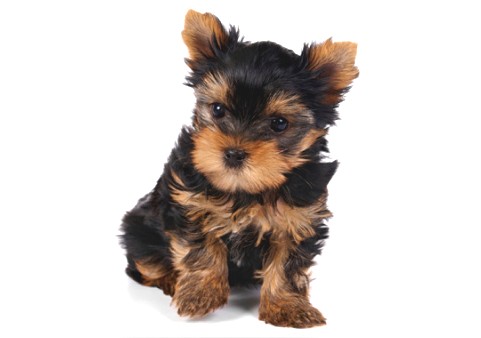
Jump directly to:
| Temperament | Bright, lively, inquisitive, spunky, sharp shrill bark, can be an excitable chaser but also likes to snuggle |
| Pros and Cons | What's good... What's bad... |
| Size | Tiny (7-8 inches, 3-7 lbs, but some are larger) |
| "Types" | Show lines, so-called "teacup" lines |
| Exercise | Minimal |
| Training | Mostly moderate, but housebreaking very difficult |
| With strangers | Can be friendly, but more often reserved, sometimes suspicious |
| With children | Older well-behaved children only |
| With other pets | Fine with family pets, but often feisty toward strange dogs, especially large dogs |
| Shedding | Very light, good for allergy sufferers |
| Grooming | A goodly amount of brushing, combing, and trimming; else clip the coat short |
| Lifespan | 12-15 years |
| Colors | Blue and tan (most common), other colors are possible |
| Puppies | Easy to find |
| Rescue dogs | Easy to find |
| Similar breeds | Silky Terrier, Toy Fox Terrier, Maltese |
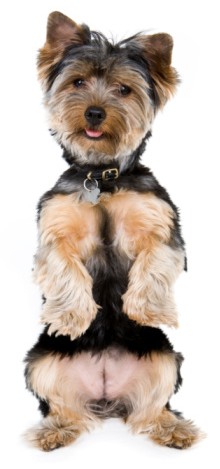
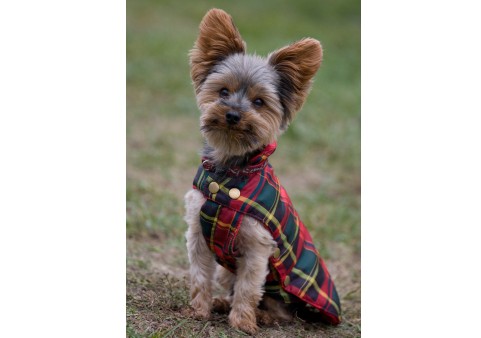
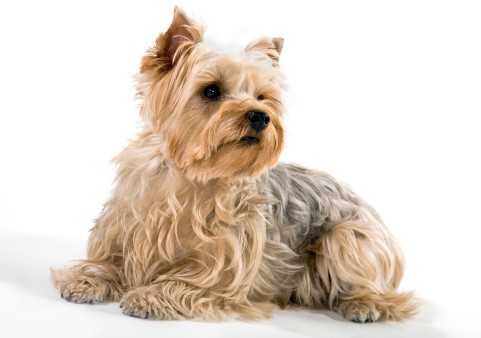
Yorkies are bright little dogs who enjoy learning tricks. This lovely girl is clipped in a short coat that looks great and is super easy to maintain.
My experience with Yorkshire Terrier temperament
Temperament and behavior stem from what a breed was designed for
What is a Yorkie? A unique combination of terrier and toy dog. Starting out as a smallish terrier in Scotland, the Yorkie was brought to Yorkshire, England, by Scottish weavers and miniaturized into a true lapdog size.
But lapdog doesn't necessarily mean all Yorkies like to sleep on laps all day.
Some Yorkshire Terriers are indeed dedicated cuddle-bugs. But others act more like tiny terriers, with instincts to chase anything that moves and warn off strangers with a sharp shrill bark.
As a trainer and behavioral consultant, the biggest problems I see with Yorkies have to do with how their owners treat them. If you carry your Yorkie everywhere, you're telling him that you think the world is too terrifying for him to walk around in.
Coddling and babying leads to insecure dogs who tremble in your arms and bark when they see a strange sight or hear a strange sound. This isn't a healthy state of mind for any dog to live with.
Don't treat your Yorkie like a doll to be carried or cuddled for hours. Do obedience training with him. Build him a tiny obstacle course. Teach him to play fetch with a cherished toy or ball. Above all, make sure he behaves.
When treated sensibly, most Yorkies are lively and inquisitive, physically and mentally quick, and spend much time trotting around the house and yard, checking things out.
Now, you do need to take precautions! There are indeed dangers lurking everywhere for toy dogs. The trick is to let your Yorkie walk on his own four feet as much as possible, while still keeping an eagle eye out for real danger.
If you don't protect his safety, he can be hurt or killed, but if you baby him and don't require him to stand on his own four feet and be well-behaved, he can end up insecure or downright nasty
This is NOT a breed to allow off-leash. Too much can happen to these small creatures in the blink of an eye. Larger dogs may view him as a delicacy and he is just brave/foolish enough to charge toward them, bellowing threats in his high-pitched voice. Plus he has excitable chasing instincts and will chase birds and butterflies across the road.
If all this sounds like Yorkshire Terriers are too active for your taste, rest assured that even the go-getters are lovers of comfort who enjoys snuggling into soft pillows periodically through the day.
Pros and cons of Yorkshire Terriers
The Good
- Fine-boned, elegant, easy to carry, doesn't take up much space
- Sheds very lightly (one of the best breeds for allergy sufferers)
- Lively and inquisitive, moves swiftly with light-footed grace
- Doesn't need a lot of exercise
- A keen watchdog – won't fail to announce strangers
- Peaceful with other pets
The Bad
- Physically fragile, requiring a great deal of supervision and monitoring
- Notorious housebreaking difficulties
- Prone to barking
- Regular brushing and combing, or regularly trimming/clipping the coat short
- Suspiciousness, shrillness, and nastiness when babied or spoiled or not socialized enough or made to behave
 |
Dog Breed Traits – Which Traits Are Right For You? In this brand new series, I'll help you decide which dog breed traits would best suit you and your family, your home and yard, and your lifestyle, so you can choose the best dog breed for your family. |
Keep in mind that the inheritance of temperament is less predictable than the inheritance of physical traits such as size or shedding. Temperament and behavior are also shaped by raising and training.
FREE eBooks by Michele Welton
 "Respect Training for Puppies" and "Teach Your Dog 100 English Words" are free step by step guides to teaching your pup to be calm and well-behaved.
 "11 Things You Must Do Right To Keep Your Dog Healthy and Happy" is a free guide to keeping your dog mentally, physically, and emotionally happy and healthy so you can enjoy a longer lifetime of companionship.

- You can avoid some negative traits by choosing an ADULT dog from an animal shelter or rescue group. With an adult dog, you can easily see what you're getting, and plenty of adult Yorkies have already proven themselves not to have negative characteristics.
- If you want a puppy, you can avoid some negative traits by choosing the right breeder and the right puppy.
How big are Yorkshire Terriers?
According to their national breed club, Yorkies should be about 7-8 inches at the shoulder and weigh 3-7 lbs. But some individuals are smaller, and many are quite a bit larger.
Let me ask you: Have you heard of a Teacup Yorkie? a Tiny Toy Yorkie? an Extreme Tiny Yorkie?
Those phrases are made-up. There is no such breed or variety as a Teacup Yorkie, Tiny Toy Yorkie, or Extreme Tiny Yorkie. Those are simply cutesy marketing terms that some clever breeders use to try to make you think you're getting some kind of extra-special Yorkshire Terrier.
Such a breeder might tell you that "Toy" Yorkies are a certain weight range, "Tiny Toy" Yorkies are slightly smaller, "Extreme Tiny" Yorkies are smaller than that, etc. These breeders might even price their dogs according to weight, as if that alone should define a dog's value. And their prices are usually outrageous.
It's all hogwash.
There is only one Yorkshire Terrier breed. Period. And no matter what his size, he is considered a Toy breed. Whether an individual weighs 2 pounds or 6 pounds or 12 pounds, he's still just a Yorkshire Terrier, which is a Toy breed.
Unfortunately, Yorkies under 3 or 4 pounds are greater risks when it comes to health. Their bones are more fragile. There isn't enough room in their mouth for healthy teeth. Their internal organs are often weak and can fail suddenly. They tend to have difficulty regulating their blood sugar and can go into hypoglycemic shock if they go too long without eating.
Responsible Yorkshire Terrier breeders never try to produce these high-risk creatures. If a tiny Yorkie pops up in one of their normal-size litters, they find the best home they can for it. But they try not to produce them in the first place.
So if possible, try to stick with Yorkies who will mature at 4 pounds and up. They have the best chance of living a normal healthy life.
How can you tell whether a Yorkshire Terrier puppy will mature at 4 pounds and up? There's a rule of thumb that says a puppy will most likely mature at 4 pounds and up if he already weighs at least 2 pounds at 10-12 weeks old. It's not perfect, but it's usually pretty close.
In fact, if you're looking for a robust Yorkie, don't pass up individuals who are at the top end of of normal (7 pounds) or even over-sized individuals who are 10 or 12 pounds. They're still plenty small and they make sturdier pets.
Are there different "types" of Yorkshire Terriers?
The short answer is No, there's only the one breed. Some people think a "Teacup" Yorkie is a different kind of Yorkshire Terrier. Not true. See the Size section just above this one. That section should answer your questions about the different sizes of Yorkies.
But certainly different sizes can look different. For example, a 3-pounder looks quite delicate, compared to a sturdy 8-pounder.
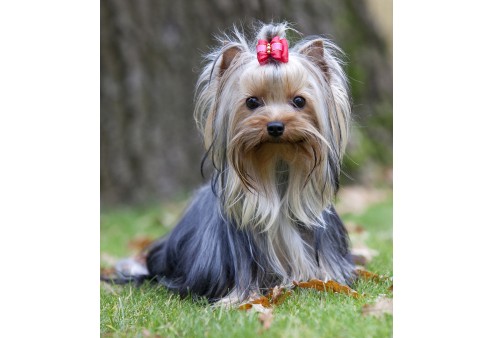
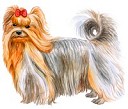
Grooming can also make one Yorkshire Terrier look different from another. If you've been to a dog show or seen one on TV, you'll see that those Yorkies with their flowing coats look different from, say, your neighbor's clipped-short Yorkie.
Show dog coats are sculpted just so, to win ribbons. But those styles are woefully impractical for a family companion. Many show dogs have to be carried everywhere or confined to crates or concrete kennel runs so they don't get messy playing in the back yard.
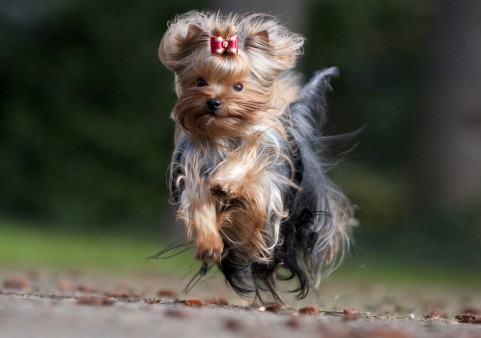
Or else the breeder pins up all the hair with curlers, rubber bands, and barrettes. I love Yorkies, but I don't like to see them like that. It just looks.... wrong.
Yorkies love the outdoors in pleasant weather. These active little dogs really deserve an outdoor yard where they can stretch their legs.
How much exercise do Yorkshire Terriers need?
In theory, Yorkies can get most of their exercise indoors. The problem is that a Yorkshire Terrier can become too hyped-up if they're forced to exercise entirely by running around the house.
In my free online Respect Training book for puppies, I explain why you should always encourage calmness indoors. A dog who dashes around, jumping and barking, is keeping himself in an excitable, over-stimulated state of mind. That isn't psychologically healthy and usually leads to behavior problems.
So try to take your Yorkshire Terrier outside. You can keep a Yorkie in an apartment with no yard. But he'll be much happier with a fenced yard, however small, where he can stretch his legs and run around.
Yorkies are bright little dogs who would also appreciate mental exercise. Just some interesting activities that engage his mind: interactive dog toys; a miniature homemade obstacle course; learning tricks; games such as Hide 'n Seek.
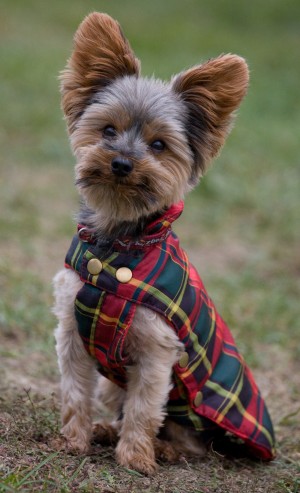
I love the short hair on this young Yorkshire Terrier! It really lets you see his expressive face.
Are Yorkshire Terriers easy to train?
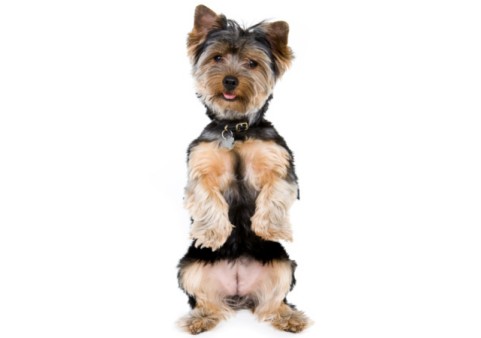
Most Yorkies are bright and quick to learn, though that often depends on what you're trying to teach them. They tend to learn tricks readily: Beg, Dance, Spin, Roll Over. Of course they expect a treat after they perform. They can be little divas!
It's more challenging to teach a Yorkie to walk properly on a leash. They can be very opinionated, so they dislike the leash "telling them what to do" and may dart this way and that, or refuse to walk at all.
The two main behavior problems in Yorkies:
- Housebreaking. As a behavioral consultant, I would put the Yorkshire Terrier on my Top 5 List of Hardest Breeds to Housebreak. If you live in a cold or rainy climate, it's worse, because Yorkies hate both the cold and the rain.
A COVERED potty area is strongly recommended. Sometimes a doggy door is necessary so your Yorkshire Terrier can run outside the moment he feels the urge in his tiny bladder. Or teach him to use an indoor litter box.
- Barking. With their keen senses, Yorkies make excellent watchdogs. However, this can make them too quick to sound the alarm at every new sight and sound. You have to be equally quick to stop them before excessive barking becomes an established habit.
All of these issues – walking on a leash, housebreaking, litter box training, stopping barking – are taught in my free training book, Respect Training For Puppies (30 seconds to a calm, polite, well-behaved puppy).
How sociable are Yorkshire Terriers?
Are they friendly with strangers?
Keen of eye and sharp of tongue, most Yorkshire Terriers are very quick to announce strangers at the door. Once the visitor comes in, some Yorkies will be friendly and outgoing. But many others have the standoffish or suspicious nature of a true terrier.
Unfortunately, suspicious dogs can morph into shrill dogs who won't stop barking. And shrill dogs can easily turn nasty. You must teach a Yorkshire Terrier that he doesn't need to like strangers, but he does need to accept them politely.
Are Yorkshire Terriers good with children?
A better question is: "Are Yorkies SAFE with children?" And my answer is, "With most children under the age of 9 or 10.... NO."
A child can seriously injure a Yorkshire Terrier by stepping on him, or by sitting on him when he's curled under a blanket or pillow, where he frequently likes to sleep.
No matter how well-meaning, young children cannot help being clumsy. That a child meant well is little solace to a Yorkshire Terrier who has been accidentally stepped on, sat on, rolled on, squeezed, or dropped onto the patio.
In addition, many Yorkies feel overwhelmed by the loud voices, roughhousing, and quick movements that children can't help making – and stress and fearfulness (even defensive biting) may be the result.
Safety is especially an issue with the smallest Yorkies. Larger individuals are sturdier.
Are Yorkshire Terriers good with other pets?
In your own household, yes. Most Yorkies are great with other dogs and cats in your family. But I don't recommend keeping the tinier Yorkies in a home with large dogs. A toy dog can be injured simply by a larger dog jumping around with enthusiasm and accidentally landing on the smaller one.
With strange dogs, Yorkies are surprisingly bossy and scrappy. If you're out for a walk and your Yorkie spies another dog, he might begin barking and lunging. The bigger the dog, the more demonstrative the Yorkie seems to become.
Some people find this funny, but it isn't. As with over-reactivity in the house, over-reactivity outdoors puts a dog into an unhealthy mental state and should be stopped immediately.
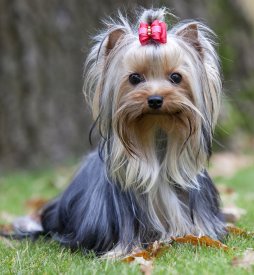
If you leave the coat too long, it drags on the ground and picks up debris. You must be totally committed to frequent grooming.
Grooming: Do Yorkshire Terriers shed? Are they easy to groom?
Great news! Yorkshire Terriers shed very little, produce very little dander, and are one of the best breeds for allergy sufferers.
The bad news.... without frequent brushing and combing, Yorkshire Terriers become a matted mess. Mats and tangles are painful. When hairs fuse together, they pull on the dog's skin whenever he walks. Especially look for mats behind the ears, under the arms, and on the stomach. In longhaired dogs, I always clip the groin (and anal area) short so it stays clean and sanitary when the dog goes to the bathroom.
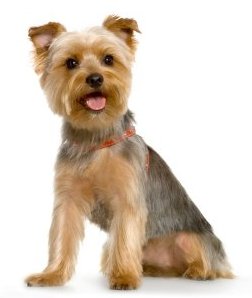
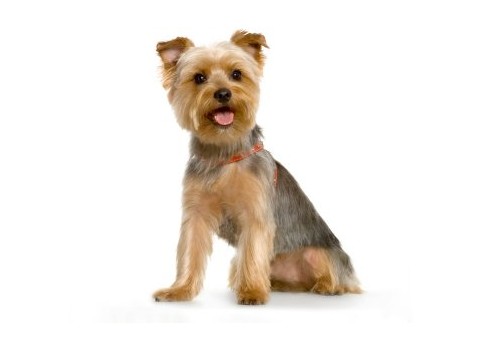
Another example of a classic short clip.
If you can't commit to the brushing, you have to commit to frequent trimming to keep the coat short, neat, and healthy.
For the easiest maintenance, you can shear the coat very short with clippers. Then you won't need to brush it at all. Personally, I love this sheared cut. It's so easy to care for, so comfortable for the dog, and makes a Yorkshire Terrier look like a cute puppy throughout his life!
Yorkies are especially vulnerable to injury, liver disease, slipping kneecaps, and eye diseases such as cataracts.
Are Yorkshire Terriers healthy? How long do they live?
Like most toy breeds, Yorkshire Terriers are usually long-lived, with a typical lifespan of 12-15 years.
And as with most toy breeds, the leading health problem in Yorkies is injury. Leg fractures from falling or jumping off things or being stepped on. Choking on something tiny they find on the floor. Being overdosed with something toxic, even a medication or flea powder. Being attacked or jumped on by a larger dog.... the list goes on.
When you own a Yorkshire Terrier, you must take extra safety precautions – ongoing supervision and surveillance of what's going on around your little guy. Be careful where you step or sit. Don't allow leaps from high furniture. Keep small objects picked up off the floor. Close all gaps in fences and gates.
As far as diseases go....
Liver shunt is a very serious problem in Yorkshire Terriers. At one veterinary university, a full one-third of their liver shunt patients are Yorkies.
You're taking a big risk if you buy or adopt a Yorkshire Terrier without doing a simple blood test to see if his liver is normal. Liver shunt requires specialist care and often tricky surgery, and the dog doesn't always survive.
Expensive surgery may also be required for
- dental disease – a problem in all toy breeds
- a weak/defective windpipe (collapsing trachea) that causes chronic severe coughing that sounds like a goose honking
- loose knee joints (luxating patella) that cause lameness and pain and may require surgery; Yorkshire Terriers have the 2nd highest rate of luxating patella of all breeds, with nearly 1 in 4 Yorkies affected.
Eye diseases are also worrisome; lots of Yorkies are blind from cataracts.
Here is my complete list of health problems in Yorkshire Terriers.
See my advice on → keeping your Yorkie healthy
(feeding, vaccinations, neutering, veterinarians, and more).
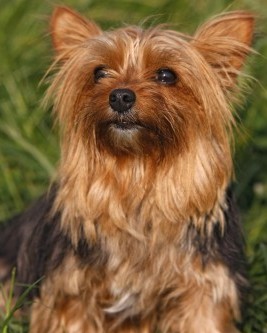
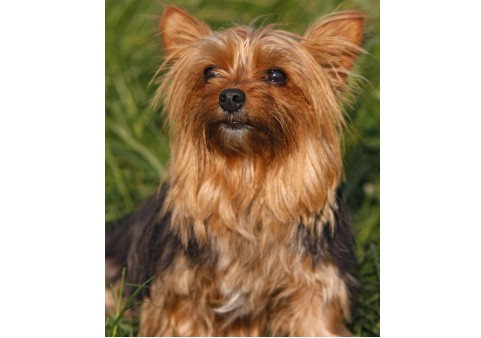
Rich gold coloration. The dark gray "saddle" on the back is called blue in Yorkshire Terriers.
What colors do Yorkshire Terriers come in?
The official Yorkshire Terrier clubs, along with breeders who show Yorkies in the conformation ring, assert that the ONLY correct colors are tan or gold, with a blue saddle.
Blue?? Yes, it looks more like gray, but in the canine world, blue is the term that is used. In Yorkies, the blue is supposed to be dark steel blue, but is often more silvery blue.
Interestingly, when Yorkshire Terrier puppies are born, they're black and tan. As they mature, the black becomes blue.
Yorkies do come in other colors (deemed "incorrect" by their national club):
- Tan or gold with a black saddle. Like all Yorkies, these dogs were born black and tan, but then the black never changed over to blue. This color hearkens back to the Yorkshire Terrier's English ancestors from the 1800s – working terriers who were often black and tan.
- Solid tan or gold. Very little, if any, blue saddle.
- Liver or chocolate (brown). These Yorkies have inherited a color-modifying gene that changes their blue/gray pigment to brown (any shade from light to chocolate). All blue pigment is affected, including their nose and the pads of their feet.
- Particolor. White with colored patches.
The official clubs and show breeders disqualify all these colors from showing in the conformation ring. Nevertheless, those colors aren't going away. Even though they can't be shown, the AKC accepts them for registration and breeding, and you can show them in activities such as obedience and agility.
There is even a tricolored "spin-off" breed called the Biewer (pronounced Beaver ) Terrier. Created in Germany in the 1980s, a Biewer is essentially a tricolor Yorkie, with the colors needing to appear in a very specific pattern.
Unfortunately, from a genetic standpoint, creating dogs with an emphasis on "perfect" markings is never a good thing. You end up with a limited, non-diverse gene pool. Also, focusing on something as trivial as color usually leads to problems with health and temperament down the line. Currently Biewers are being marketed for pretty high prices.
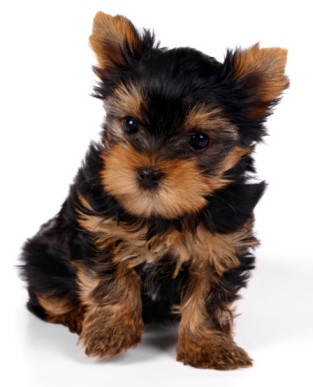
Yorkie puppies are born black and tan, with the black morphing into blue as they mature.
Yorkshire Terrier Puppies
If you already have a Yorkshire Terrier puppy....
Congratulations! I'll be happy to show you how to raise and train your new family member.
- Read my FREE puppy training book, Respect Training for Puppies: 30 seconds to a calm, polite, well-behaved puppy.
- Also see my advice on Yorkshire Terrier health care, including feeding and vaccinations
If you don't have a Yorkshire Terrier puppy, but you want one....
I can help you with that, too.
Yorkies are extremely common in the United States. Out of 189 breeds in the American Kennel Club, where 1 is most popular and 189 is least popular, Yorkshire Terriers rank 9th. Very easy to find.
The problem is finding one whose temperament will be stable, rather than hyperactive or shrill, and one whose liver, knees, and eyessight will remain healthy.
You can buy a Yorkshire Terrier from a show breeder, who breeds Yorkies to match a detailed standard of appearance for the dog show ring.
You can also buy a Yorkshire Terrier from people who "just breed pets." Unfortunately, this is like trying to navigate a minefield. Puppy producers have flooded the Internet with pictures of adorable Yorkie pups accompanied by ridiculous come-ons such as "Tiny teacup baby Yorkies with exquisite baby doll faces, starting at two thousand dollars!"
Also be aware that some unscrupulous sellers offer "purebred" Yorkies that are actually crosses or mixes. Not that there's anything wrong with a crossbred or mixed Yorkshire Terrier – far from it – but it would be nice to be sure of exactly what you're buying.
Here's one quick way to tell the difference between a responsible breeder and an irresponsible "puppy producer" – health certifications.
BOTH PARENTS of a Yorkshire Terrier puppy should have:
- a certificate from the Canine Eye Registry Foundation (CERF) – dated within the past year – certifying the dog to be free of eye diseases such as cataracts
- a certificate from the Orthopedic Foundation of America (OFA) certifying the dog to have normal knees
Finally, I wouldn't buy or adopt ANY Yorkie, whether puppy or adult, unless
- the breeder can show me that the dog has had a bile acids blood test showing a normal liver with no liver shunt. Liver shunt is dreadfully common in Yorkies and the surgery is very expensive and doesn't always succeed. So heartbreaking to go through!
If a seller can't show you those certificates, the puppies are higher risk for health problems. You might choose to accept that risk. But then you need to be willing (and able) to pay a couple thousand bucks for future surgeries and lifelong meds if your Yorkshire Terrier ends up blind from cataracts, or needing multiple surgeries for bad knee joints and liver disease.
See my advice on → finding a good dog
How do I adopt a Yorkshire Terrier?
Yorkies are often available from dog rescue groups. Some also show up at animal shelters, though these are usually snapped up quickly because so many prospective owners are seeking a tiny dog.
A Yorkshire Terrier might be turned over to a rescue group or shelter because of housebreaking issues or barking.
But Yorkies are often owned by elderly people, and when elderly people pass away, if no one in the family is willing to take the dog, he gets abandoned, even if he has no behavior issues at all.
What breeds are similar to Yorkshire Terriers?
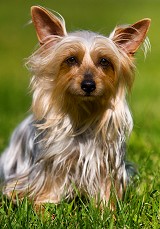
The Silky Terrier looks like a largish (8-12 pounds) Yorkshire Terrier. Compared to Yorkies, Silkys tend to be more stable in temperament, but also more terrier-ish – more independent and hardier. Silkys are fine for some allergy-sufferers, but perhaps not as tried-and-true as a Yorkie.
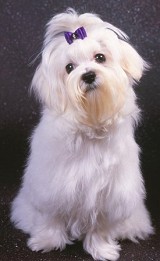
If your heart is set on a tiny dog and you're allergic, the light-shedding Maltese also fits the bill. Compared to Yorkshire Terriers, Maltese have a softer, sweeter temperament, as their ancestry is not terrier, but spaniel.
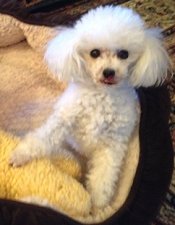
The Toy Poodle is the most hypo-allergenic of all coated breeds. Compared to a Yorkie, the Toy Poodle has a softer, sweeter temperament, is very quick to learn, and is easier to housebreak. The trade-off is more grooming.
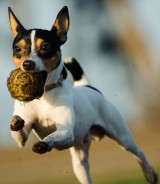
If you would prefer a spunkier little guy with a low-maintenance coat, and you don't mind some shedding, consider the Toy Fox Terrier. He's similar to a Yorkie and a Silky in being a blend of toy and terrier traits.
 About the author: Michele Welton has over 40 years of experience as a Dog Trainer, Dog Breed Consultant, and founder of three Dog Training Centers. An expert researcher and author of 15 books about dogs, she loves helping people choose, train, and care for their dogs.
My best-selling books – now available FREE on my website
 Respect Training For Puppies: 30 seconds to a calm, polite, well-behaved puppy is for puppies 2 to 18 months old. Your puppy will learn the 21 skills that all family dogs need to know. Click here to read for free.
 Teach Your Dog 100 English Words is a unique Vocabulary and Respect Training Program that will teach your adult dog to listen to you and do what you say. Click here to read for free.
 11 Things You Must Do Right To Keep Your Dog Healthy and Happy helps your dog live a longer, healthier life. Get my honest advice about all 11 Things before you bring home your new puppy, because some mistakes with early health care cannot be undone. Click here to read for free.
Related posts you might enjoy