
Whippets: What's Good About 'Em, What's Bad About 'Em
Whippet temperament, personality, training, behavior, pros and cons, advice, and information, by Michele Welton, Dog Trainer, Behavioral Consultant, Author of 15 Dog Books
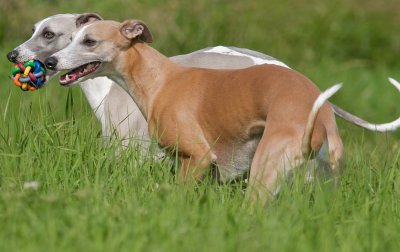
The AKC Standard says the Whippet is "amiable, friendly, gentle, but capable of great intensity during sporting pursuits."
The Whippet, of course, looks like a small Greyhound. Both breeds are members of the sighthound family, which hunts prey animals (rats, rabbits, etc.) by spotting movement and running the unfortunate animal down blazing speed.
The Whippet is sweet-natured and docile, yet playful and athletic. The same dog who will curl up under the blankets – a perfect couch potato, sleeping for hours – will tear enthusiastically around the yard, darting and zigzagging and turning on a dime without slowing down.
Whippets love running games and require short bursts of vigorous exercise each day. The area must be fenced, for this racy breed is the fastest dog of his weight: he can run up to 35 mph.
Whippet puppies can be mischievous and destructive, but adults are calm, undemanding, and unobtrusive indoors, trotting around with a light-footed easy grace and seldom making a peep. They do insist on the luxury of being up on the furniture, so if this offends you, you shouldn't consider a sighthound.
Polite with strangers, the Whippet should be accustomed to people and noises at an early age. He is peaceful with other dogs but has a high prey drive and cannot be trusted with smaller pets.
Whippets are mildly stubborn, but also very sensitive. They respond favorably only to calm, upbeat training methods that emphasize praise and food, plus gentle corrections.
Most sighthounds tend to be touch-sensitive, tending to startle a bit when touched unexpectedly or grabbed for a hug.
If you want a dog who...
- Looks like a medium-sized Greyhound, with a slender, elegant, racy build and a graceful, lightfooted gait
- Has a sleek easy-care coat that comes in many colors
- Indoors, is quiet and dignified, undemanding and unobtrusive
- Outdoors, is playful and athletic and gallops with breathtaking speed
- Is polite with everyone, including other dogs
A Whippet may be right for you.
If you don't want to deal with...
- Providing a safe enclosed area where he can occasionally gallop
- Strong instincts to chase other living creatures that run
- Fearfulness and timidity when not socialized enough
- An independent "what's in it for me?" attitude toward training
- Emotional sensitivity to stress and abrupt changes in schedule
A Whippet may not be right for you.
 |
Dog Breed Traits – Which Traits Are Right For You? In this brand new series, I'll help you decide which dog breed traits would best suit you and your family, your home and yard, and your lifestyle, so you can choose the best dog breed for your family. |
Keep in mind that the inheritance of temperament is less predictable than the inheritance of physical traits such as size or shedding. Temperament and behavior are also shaped by raising and training.
FREE eBooks by Michele Welton
 "Respect Training for Puppies" and "Teach Your Dog 100 English Words" are free step by step guides to teaching your pup to be calm and well-behaved.
 "11 Things You Must Do Right To Keep Your Dog Healthy and Happy" is a free guide to keeping your dog mentally, physically, and emotionally happy and healthy so you can enjoy a longer lifetime of companionship.

- You can avoid some negative traits by choosing an ADULT dog from an animal shelter or rescue group. With an adult dog, you can easily see what you're getting, and plenty of adult Whippets have already proven themselves not to have negative characteristics.
- If you want a puppy, you can avoid some negative traits by choosing the right breeder and the right puppy.
More traits and characteristics of the Whippet
If I was considering a Whippet, I would be most concerned about...
- Providing enough running exercise. Whippets don't need miles of running, but they also can't get by with a daily walk around the block either. They need regular access to a large fenced area – fenced because these dogs are chasing addicts with sharp eyesight for movement. If something catches their attention on the horizon, they will take off and not come back.
See if there is a dog club in your area that offers an activity called lure coursing, which is chasing a mechanical lure in a controlled setting. This is an appropriate outlet for the full-speed galloping behaviors that are "hardwired" into your Whippet's genes.
- Chasing other animals that run. Whippets are usually fine with the pets in their own family. But they are lightning-fast, and individuals with a strong prey instinct could seriously injure or kill any small running animal.
- The independent temperament. Sighthounds are very different from other kinds of dogs. They are independent thinkers who don't particularly care about pleasing you. They can be manipulative and may display passive resistance by bracing their legs and refusing to move. You must show them, through absolute consistency and encouragement, that you mean what you say. Follow my free online training programs.
- Providing enough socialization. Standoffish by nature, Whippets need extensive exposure to people and to unusual sights and sounds. Otherwise their natural caution can become shyness.
- Emotional sensitivity. Be honest... is there tension in your home? Are people loud or angry or emotional? Whippets are peaceful dogs who are very sensitive to stress and need a peaceful, harmonious home.
Should you consider a Whippet if you have young children? It depends on the individual dog and the individual children. These sensitive dogs often feel overwhelmed by the loud voices and quick movements that children can't help making – and stress and shyness may be the result. Personally I think that the sighthound breeds do best in homes without young children.
 About the author: Michele Welton has over 40 years of experience as a Dog Trainer, Dog Breed Consultant, and founder of three Dog Training Centers. An expert researcher and author of 15 books about dogs, she loves helping people choose, train, and care for their dogs.
My best-selling books – now available FREE on my website
 Respect Training For Puppies: 30 seconds to a calm, polite, well-behaved puppy is for puppies 2 to 18 months old. Your puppy will learn the 21 skills that all family dogs need to know. Click here to read for free.
 Teach Your Dog 100 English Words is a unique Vocabulary and Respect Training Program that will teach your adult dog to listen to you and do what you say. Click here to read for free.
 11 Things You Must Do Right To Keep Your Dog Healthy and Happy helps your dog live a longer, healthier life. Get my honest advice about all 11 Things before you bring home your new puppy, because some mistakes with early health care cannot be undone. Click here to read for free.
Related posts you might enjoy