
West Highland White Terriers: What's Good About 'Em, What's Bad About 'Em
West Highland White Terrier temperament, personality, training, behavior, pros and cons, advice, and information, by Michele Welton, Dog Trainer, Behavioral Consultant, Author of 15 Dog Books
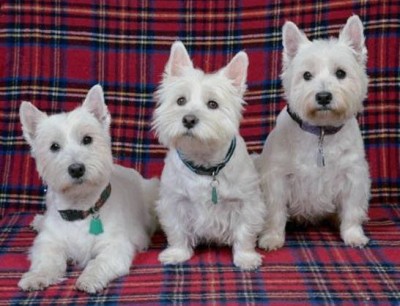
The AKC Standard says that the West Highland White Terrier (Westie) is "possessed with no small amount of self-esteem."
Indeed!
Along with the Cairn Terrier ("Toto" from the Wizard of Oz), the West Highland White Terrier is what many people picture when they hear "terrier."
The Westie is everything a terrier was designed to be. Sturdy, spunky, and bold, he needs his daily walks and interactive play sessions.
Yet he is easier to handle and friendlier than some other terriers. He can adapt to any home in which he can be a full participant and busybody.
Quick to announce anything amiss, including visitors, the Westie usually proceeds to welcome them inside with a gaily wagging tail.
West Highland White Terriers can be bossy with other dogs of the same sex, but otherwise coexist with other dogs and cats more readily than most terriers.
Rabbits and rodents, however, are in for a stressful (and probably short) life, along with wild critters who venture into the Westie's yard. He will pursue with tenacity anything that moves and cannot be let off-leash except in a safe, enclosed area.
Assertive but cheerful, with the typical stubbornness and cleverness of a true terrier, the Westie must be shown that you are in charge, else he may become demanding and testy when he doesn't get his own way. He does respond well to consistent discipline and to obedience training that utilizes food rewards plus fair corrections.
West Highland White Terriers can be possessive of their food and toys, and they are determined diggers and barkers.
If you want a dog who...
- Is small, yet sturdy and tough – not a delicate lapdog
- Has a natural appearance
- Needs only moderate exercise
- Makes a keen watchdog
- Doesn't shed too much
- Compared to most terriers, is friendlier with strangers, more amenable to training, and more tolerant of other pets
A West Highland White Terrier may be right for you.
If you don't want to deal with...
- The dynamic terrier temperament (see full description below)
- Potential aggression toward other animals – strong chasing instincts
- Stubbornness
- Digging holes
- Barking
- Regular brushing and clipping
- A considerable number of potential health problems
A West Highland White Terrier may not be right for you.
 |
Dog Breed Traits – Which Traits Are Right For You? In this brand new series, I'll help you decide which dog breed traits would best suit you and your family, your home and yard, and your lifestyle, so you can choose the best dog breed for your family. |
Keep in mind that the inheritance of temperament is less predictable than the inheritance of physical traits such as size or shedding. Temperament and behavior are also shaped by raising and training.
FREE eBooks by Michele Welton
 "Respect Training for Puppies" and "Teach Your Dog 100 English Words" are free step by step guides to teaching your pup to be calm and well-behaved.
 "11 Things You Must Do Right To Keep Your Dog Healthy and Happy" is a free guide to keeping your dog mentally, physically, and emotionally happy and healthy so you can enjoy a longer lifetime of companionship.

- You can avoid some negative traits by choosing an ADULT dog from an animal shelter or rescue group. With an adult dog, you can easily see what you're getting, and plenty of adult Westies have already proven themselves not to have negative characteristics.
- If you want a puppy, you can avoid some negative traits by choosing the right breeder and the right puppy.
More traits and characteristics of the Westie
If I was considering a West Highland White Terrier, I would be most concerned about...
- The dynamic terrier temperament. Most terrier breeds are remarkably similar. The same words are used over and over – quick to bark, quick to chase, lively, bossy, feisty, scrappy, clever, independent, stubborn, persistent, impulsive, intense. But some terrier breeds are more so than others. Overall, as a breed, West Highland White Terriers tend to be in the middle section of the terrier spectrum. But of course there are some individuals who will be in the higher end, as well as the lower end.
- Defensive reactions. I do not recommend terriers for small children. Many terriers will not tolerate any nonsense from little life forms whom they consider to be below themselves in importance. Many terriers are quick to react to teasing, and even to the normal clumsiness that comes with small children (accidental squeezing of their ears or pulling of whiskers or stepping on their paw). Many terriers are possessive of their food and toys and will defend these from all comers, including children.
- Possible animal aggression. West Highland White Terriers are often more tolerant toward other dogs and cats than many other terriers are, especially dogs and cats who belong to their own family. But many Westies are still dominant or aggressive toward strange dogs.
- Barking. Terriers are often too quick to sound the alarm at every new sight and sound. You have to be equally quick to stop them.
- Grooming. Without regular brushing, combing, and trimming/clipping, West Highland White Terriers become a matted mess. On the plus side, their shedding is on the low side of average. Westies are NOT hypoallergenic or light-shedding, however.
- Health problems. West Highland White Terriers can suffer from skin problems, a serious endocrine system disease called Addison's disease, a serious liver disease (copper toxicosis), cataracts, a degenerative brain disease, joint problems, and more. Read more about Westie Health.
- Mind of their own. Though much more amenable to training than other terriers, West Highland White Terriers must still be taught at an early age that they are not the rulers of the world. The toughness that makes them suited to killing vermin can frustrate you when you try to teach them anything. Like all terriers, Westies can be stubborn and bossy and will make you prove that you can make them do things. You must show them, through absolute consistency, that you mean what you say.
In other words, you must teach your Westie to respect you. Follow my free online training programs.
 About the author: Michele Welton has over 40 years of experience as a Dog Trainer, Dog Breed Consultant, and founder of three Dog Training Centers. An expert researcher and author of 15 books about dogs, she loves helping people choose, train, and care for their dogs.
My best-selling books – now available FREE on my website
 Respect Training For Puppies: 30 seconds to a calm, polite, well-behaved puppy is for puppies 2 to 18 months old. Your puppy will learn the 21 skills that all family dogs need to know. Click here to read for free.
 Teach Your Dog 100 English Words is a unique Vocabulary and Respect Training Program that will teach your adult dog to listen to you and do what you say. Click here to read for free.
 11 Things You Must Do Right To Keep Your Dog Healthy and Happy helps your dog live a longer, healthier life. Get my honest advice about all 11 Things before you bring home your new puppy, because some mistakes with early health care cannot be undone. Click here to read for free.
Related posts you might enjoy