
Siberian Huskies: What's Good About 'Em, What's Bad About 'Em
Siberian Husky temperament, personality, training, behavior, pros and cons, advice, and information, by Michele Welton, Dog Trainer, Behavioral Consultant, Author of 15 Dog Books
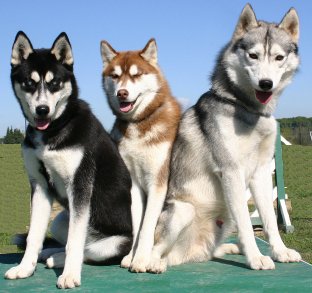
The AKC Standard says the Siberian Husky "does not display the possessive qualities of the guard dog, nor is he overly suspicious of strangers or aggressive with other dogs."
Indeed, the free-spirited Siberian Husky is usually good-natured with everyone.
He is playful, athletic, agile, and light on his feet. He loves the great outdoors and requires vigorous exercise, especially in cool weather. He should be taken running, hiking, and/or biking every day, always on-leash, for he is independent and born to run. If something catches his interest and he is off-leash, he'll be gone.
Teaching him to pull carts and sleds gives him a purpose in life. Without such exercise, mental activity, and lots of companionship, he can be incredibly, massively destructive.
Most Siberian Huskies are sociable with other dogs, but he has a very high prey drive and may destroy cats if not raised with them. Siberians should not be kept around rabbits, ferrets, or birds. Fencing must be high and secure, for he can be an escape artist, and once loose, he may run deer and molest livestock.
Training is a challenge because the strong-willed Siberian Husky is inclined to use his intelligence in clever ways that suit his own purposes. Digging and howling (lots of howling!) are favorite pastimes.
To complicate training even more, Siberians tend to be "drama queens" who screech and scream when you do something they don't like, such as tugging the leash, giving them a bath, or clipping their toenails.
If you want a dog who...
- Is medium-sized and furry, with a wolfish appearance
- Is free-spirited and playful
- Is athletic and agile and loves the great outdoors, especially in cold weather
- Thinks that running full-speed, pulling carts and sleds, and/or carrying a backpack on a mountain hike are his purposes in life
- Is usually good-natured with strangers and sociable with other dogs
A Siberian Husky may be right for you.
If you don't want to deal with...
- Vigorous exercise requirements
- Rowdiness and exuberant jumping, especially when young
- Massive destructiveness and howling when bored, left alone too much, or not exercised enough
- Strong instincts to chase and grab anything that runs, i.e. cats
- Escaping from your yard in search of adventure
- Strong-willed mind of his own, requiring a confident owner who can take charge
- Heavy shedding
A Siberian Husky may not be right for you.
 |
Dog Breed Traits – Which Traits Are Right For You? In this brand new series, I'll help you decide which dog breed traits would best suit you and your family, your home and yard, and your lifestyle, so you can choose the best dog breed for your family. |
Keep in mind that the inheritance of temperament is less predictable than the inheritance of physical traits such as size or shedding. Temperament and behavior are also shaped by raising and training.
FREE eBooks by Michele Welton
 "Respect Training for Puppies" and "Teach Your Dog 100 English Words" are free step by step guides to teaching your pup to be calm and well-behaved.
 "11 Things You Must Do Right To Keep Your Dog Healthy and Happy" is a free guide to keeping your dog mentally, physically, and emotionally happy and healthy so you can enjoy a longer lifetime of companionship.

- You can avoid some negative traits by choosing an ADULT dog from an animal shelter or rescue group. With an adult dog, you can easily see what you're getting, and plenty of adult Siberians have already proven themselves not to have negative characteristics.
- If you want a puppy, you can avoid some negative traits by choosing the right breeder and the right puppy.
More traits and characteristics of the Siberian Husky
If I was considering a Siberian Husky, I would be most concerned about...
- Providing enough exercise and activities to keep him satisfied. Unless you specifically want an athletic working dog for sledding, carting, backpacking, and other outdoor-related activities, preferably in a cool climate, I do not recommend this breed. Siberian Huskies were never intended to be simply pets. Trying to suppress their "hardwired" drive to work, without providing alternate outlets for their energy, is not fair to the dog.
Without regular opportunities to vent their energy, or when left alone all day, Siberian Huskies become rambunctious and bored – which they express by howling and destructive chewing. Bored Siberian Huskies are famous for chewing through drywall, ripping the stuffing out of sofas, and turning your yard into a moonscape of craters.
- Strong chasing instincts. Most Siberian Huskies have strong instincts to chase and seize cats and other fleeing creatures, including deer and livestock.
- Escape attempts. Many Siberian Huskies are clever escape artists who will go over (or under) your fence in search of adventure. To keep your Siberian Husky in, fences should be solid wood and at least 6 or 8 feet high, with wire sunk into the ground along the fence line to thwart digging. Some Siberians will climb right up chain link or wire fencing. Indeed, some individuals can only be contained in an enclosure that has a roof.
- Stubbornness. Siberian Huskies have an independent mind of their own and not particularly eager to please. They can be willful and manipulative, and might scream if they don't like what you're doing. You must show them, through absolute consistency, that you mean what you say and that screeching isn't going to stop you.
In other words, you must teach your Siberian Husky to respect you. A dog who respects you will do what you say and will stop what he's doing when you tell him "No." Follow my free online training programs.
- Heavy shedding. Siberian Huskies shed a LOT. You'll find hair and fur all over your clothing, furniture, carpeting....even in your food. Daily brushing and vacuuming will become a way of life. Make sure you're really okay with this, since it can't be changed.
- Noise. Unless you live way out in the boondocks and have no neighbors, Siberian Huskies should never be left outside in your yard, unsupervised. Their mournful howling will have your neighbors calling the cops to report the nuisance. Or else quietly letting your Siberian Husky out of his yard so he'll wander away.
 About the author: Michele Welton has over 40 years of experience as a Dog Trainer, Dog Breed Consultant, and founder of three Dog Training Centers. An expert researcher and author of 15 books about dogs, she loves helping people choose, train, and care for their dogs.
My best-selling books – now available FREE on my website
 Respect Training For Puppies: 30 seconds to a calm, polite, well-behaved puppy is for puppies 2 to 18 months old. Your puppy will learn the 21 skills that all family dogs need to know. Click here to read for free.
 Teach Your Dog 100 English Words is a unique Vocabulary and Respect Training Program that will teach your adult dog to listen to you and do what you say. Click here to read for free.
 11 Things You Must Do Right To Keep Your Dog Healthy and Happy helps your dog live a longer, healthier life. Get my honest advice about all 11 Things before you bring home your new puppy, because some mistakes with early health care cannot be undone. Click here to read for free.
Related posts you might enjoy