
Scottish Deerhounds: What's Good About 'Em, What's Bad About 'Em
Scottish Deerhound temperament, personality, training, behavior, pros and cons, advice, and information, by Michele Welton, Dog Trainer, Behavioral Consultant, Author of 15 Dog Books
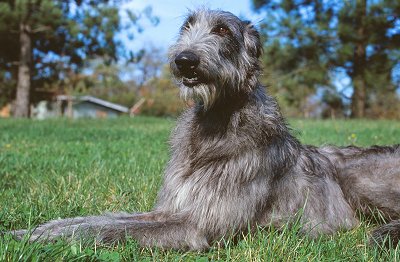
Like all sighthounds, the quiet, dignified Scottish Deerhound doesn't behave like most dog breeds you may be used to, like a Golden Retriever or German Shepherd. For example, a Scottish Deerhound is unlikely to fetch a ball or play tug-of-war or protect your family.
Scottish Deerhound puppies and adolescents are as active, awkward, and mischievous as any other breed. But adults tend to be calm, graceful, and undemanding. They learn house rules well and spend much of their time sprawled blissfully on the softest rug or sofa.
This is not a guard dog, sometimes not even a watchdog – some easygoing individuals will remain comatose when the doorbell rings.
For example the first Scottish Deerhound show kennel I ever visited had Deerhounds lying everywhere. Most didn't even get up after their owner let me in. She just motioned me to step over them as we made our way through the living room and into the kitchen. A couple of dogs opened one eye quizzically as I traversed the gauntlet, but not a single dog got up.
It is outdoors where Scottish Deerhounds have such special needs. They require space for the long strides of their floating lope (described as "poetry in motion") and their powerful, driving gallop. But it must be a safe, enclosed area, else they will be out of sight in seconds and end up dead on the road. It has happened time and time again with sighthounds.
Because of his great size, strength, and speed, the Scottish Deerhound does require early socialization, but he is almost unfailingly polite with strangers.
Scottish Deerhounds are amiable with other dogs, as well. But they are serious chasers of anything smallish that runs, including cats and tiny dogs.
Though mildly stubborn and independent, this is also a sweet and sensitive dog. He is willing to respond (albeit in a slow, casual way, as though humoring you) to cheerful training that includes consistent guidance, verbal praise, and food rewards.
Generally sighthounds do not like to be hugged or clutched at; they tend to move away from too much overt physicalness.
If you want a dog who...
- Is tall, slender, and elegant, yet very powerful – a racy athlete
- Has a short ragged coat
- Is extremely athletic and graceful – can run swiftly and jump great heights
- Is calm, mannerly, and undemanding when indoors, as an adult (puppies are active)
- Is polite with strangers and absolutely not a guard dog
- Is amiable with other dogs
- Doesn't bark much
A Scottish Deerhound may be right for you.
If you don't want to deal with...
- Providing a safe enclosed area where he can gallop
- Timidity when not socialized enough
- Emotional sensitivity to stress and abrupt changes in schedule
- Strong instincts to chase other living creatures that run
- An independent "what's in it for me?" attitude toward training – can be stubborn and strong-willed
A Scottish Deerhound may not be right for you.
 |
Dog Breed Traits – Which Traits Are Right For You? In this brand new series, I'll help you decide which dog breed traits would best suit you and your family, your home and yard, and your lifestyle, so you can choose the best dog breed for your family. |
Keep in mind that the inheritance of temperament is less predictable than the inheritance of physical traits such as size or shedding. Temperament and behavior are also shaped by raising and training.
FREE eBooks by Michele Welton
 "Respect Training for Puppies" and "Teach Your Dog 100 English Words" are free step by step guides to teaching your pup to be calm and well-behaved.
 "11 Things You Must Do Right To Keep Your Dog Healthy and Happy" is a free guide to keeping your dog mentally, physically, and emotionally happy and healthy so you can enjoy a longer lifetime of companionship.

- You can avoid some negative traits by choosing an ADULT dog from an animal shelter or rescue group. With an adult dog, you can easily see what you're getting, and plenty of adult Scottish Deerhounds have already proven themselves not to have negative characteristics.
- If you want a puppy, you can avoid some negative traits by choosing the right breeder and the right puppy.
More traits and characteristics of the Scottish Deerhound
If I was considering a Scottish Deerhound, I would be most concerned about...
- Providing them with a large fenced area. Deerhounds don't need miles of running exercise – in fact, young Deerhounds should never be allowed to jog beside you, or even worse, beside a bicycle. This will only damage their growing bones and joints. Rather, Deerhounds need a large fenced area where they can walk, trot, and gallop in short spurts – ideally by playing with another Deerhound! It's a good idea to own more than one of these unique hounds.
Without the right amount of space and opportunity to exercise, Scottish Deerhounds will become bored, which they usually express by destructive chewing. If there is a dog club in your area, get your Scottish Deerhound involved in lure coursing (chasing a mechanized lure around a track or across an open field). This is an appropriate outlet for the full-speed galloping behaviors that are "hardwired" into his genes.
- Chasing other animals. Most people do not realize just how fast and agile sighthounds are, or how strong their instincts are to chase and seize fleeing creatures. Most Scottish Deerhounds will pursue your neighbor's cat or small dog, if given the chance. And while they will be peaceful with your own cat or small dog when indoors, if the same cat or small dog goes outside and starts to run, it becomes fair game. In today's society, the legal liabilities of owning a large hunting breed should be considered.
- The independent temperament. Like most sighthounds, Scottish Deerhounds are independent thinkers who don't particularly care about pleasing you. You must show them, patiently but persistently, that you mean what you say.
In other words, you must teach your Scottish Deerhound to respect you. A dog who respects you will at the very least stop what he's doing when you tell him "No." Read my free online training programs.
- Providing enough socialization. Standoffish by nature, Scottish Deerhounds need extensive exposure to people and to unusual sights and sounds. Otherwise their natural caution can become shyness.
- Emotional sensitivity. Be honest.... is there tension in your home? Are people loud or angry or emotional? Scottish Deerhounds are extremely sensitive to stress and do best in a peaceful, harmonious home.
- Health problems. Scottish Deerhounds are extremely prone to a life-threatening digestive syndrome called bloat. In addition, an alarming number of Deerhounds die in middle age of cancer and heart disease. To keep this breed as healthy as possible, see Scottish Deerhound Health.
 About the author: Michele Welton has over 40 years of experience as a Dog Trainer, Dog Breed Consultant, and founder of three Dog Training Centers. An expert researcher and author of 15 books about dogs, she loves helping people choose, train, and care for their dogs.
My best-selling books – now available FREE on my website
 Respect Training For Puppies: 30 seconds to a calm, polite, well-behaved puppy is for puppies 2 to 18 months old. Your puppy will learn the 21 skills that all family dogs need to know. Click here to read for free.
 Teach Your Dog 100 English Words is a unique Vocabulary and Respect Training Program that will teach your adult dog to listen to you and do what you say. Click here to read for free.
 11 Things You Must Do Right To Keep Your Dog Healthy and Happy helps your dog live a longer, healthier life. Get my honest advice about all 11 Things before you bring home your new puppy, because some mistakes with early health care cannot be undone. Click here to read for free.
Related posts you might enjoy