
Pomeranians: What's Good About 'Em, What's Bad About 'Em
Pomeranian temperament, personality, training, behavior, pros and cons, advice, and information, by Michele Welton, Dog Trainer, Behavioral Consultant, Author of 15 Dog Books
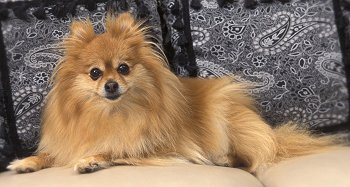
The AKC Standard says the Pomeranian is "inquisitive by nature... cocky, commanding, and animated."
That he is. Vivacious and spirited, bold and brash, the typical Pomeranian thinks he's "hot stuff."
This sharp-eyed busybody likes to check out every sight, sound, and activity – and tell you what he thinks about it. He is delightfully alive and aware of everything going on around him.
Keenly alert to approaching strangers, the Pomeranian makes a great alarm dog. But this can easily get out of hand, so he requires early socialization so that he doesn't become sharp or shrill.
Most Pomeranians are fine with other pets. It is a tribute to their amiability that male Pomeranians can often run and play together with little or no bickering. Some Poms, though, are bossy and will attempt to chase strange dogs, regardless of size.
The Pomeranian is very bright and will look directly at you, cocking his head attentively. BUT he is not inclined to take orders from anyone whom he views as below himself in importance. So don't allow him to make the rules or you will lose control over his behavior. For example, don't allow him to act possessive of his food or toys, and control his barking from day one.
This proud, self-possessed little breed won't meekly submit to mischief or rough handling and is not a good choice for children.
If you want a dog who...
- Is very small and "spitz-like", with pricked ears, foxy face, a thick coat, and curled tail
- Is vivacious and spunky, bright and attentive
- Is a good alarm dog
- Is usually fine with other pets
A Pomeranian may be right for you.
If you don't want to deal with...
- The fragility of toy breeds (see below)
- Suspicious yappiness toward strangers when not socialized enough
- Strong-willed mind of his own, requiring a confident owner who can take charge
- Barking
- Regular brushing and combing
- Heavy shedding
A Pomeranian may not be right for you.
 |
Dog Breed Traits – Which Traits Are Right For You? In this brand new series, I'll help you decide which dog breed traits would best suit you and your family, your home and yard, and your lifestyle, so you can choose the best dog breed for your family. |
Keep in mind that the inheritance of temperament is less predictable than the inheritance of physical traits such as size or shedding. Temperament and behavior are also shaped by raising and training.
FREE eBooks by Michele Welton
 "Respect Training for Puppies" and "Teach Your Dog 100 English Words" are free step by step guides to teaching your pup to be calm and well-behaved.
 "11 Things You Must Do Right To Keep Your Dog Healthy and Happy" is a free guide to keeping your dog mentally, physically, and emotionally happy and healthy so you can enjoy a longer lifetime of companionship.

- You can avoid some negative traits by choosing an ADULT dog from an animal shelter or rescue group. With an adult dog, you can easily see what you're getting, and plenty of adult Pomeranians have already proven themselves not to have negative characteristics.
- If you want a puppy, you can avoid some negative traits by choosing the right breeder and the right puppy.
More traits and characteristics of the Pomeranian
If I was considering a Pomeranian, I would be most concerned about...
- Unstable temperaments. Pomeranians are a popular breed, which means lots of unknowledgeable and irresponsible people breed them, trying to make a buck. That leads to lots of Poms with genetically bad temperaments. I wouldn't buy any Pomeranian puppy unless you meet both of his parents and both have stellar temperaments. If you're interested in adopting an adult Pomeranian, you should carefully test his temperament.
- Fragility. Too many people acquire a toy breed puppy without understanding how incredibly fragile a toy breed is. You can seriously injure or kill a Pomeranian puppy by stepping on him or sitting on him. Pomeranians can seriously injure or kill themselves by leaping from your arms or off the back of your sofa. A larger dog can grab a Pomeranian and break his neck with one quick shake. Owning a toy breed means constant supervision and surveillance of what's going on around your small dog.
Pomeranian puppies are not suited to toddlers, no matter how well-meaning the child. Children cannot help being clumsy, and that a child meant well is little solace to a Papillon who has been accidentally stepped on, sat on, rolled on, squeezed, or dropped onto the patio. Even adult Poms may feel overwhelmed by the loud voices and quick movements that children can't help making, and stress and fearfulness may be the result. Also many Pomeranians won't tolerate any nonsense from children.
- Suspiciousness. Some Poms are very friendly, but most are a little bit standoffish with strangers. Without enough socialization, their natural caution can become suspiciousness, which is a nuisance to live with every time you have guests.
- Mind of their own. Most Pomeranians are not submissive, eager to please dogs. They are very bright, but like all spitz breeds (thick coat, curled tail, prick ears), they do have an independent mind of their own. You must show them, through absolute consistency, that you mean what you say. To teach your Pomeranian to listen to you, "Respect Training" is mandatory. Follow my free online training programs.
- Potential barking. Pomeranians are often too quick to sound the alarm at every new sight and sound. You have to be equally quick to stop them. If you work all day and have close neighbors, Pomeranians are not a good choice for you. For the same reason, Pomeranians should NEVER be left outside in your yard, unsupervised. To make matters worse, some Poms have high-pitched barks that can set your teeth on edge.
- Housebreaking. Toy breeds are almost always difficult to housebreak. It is so easy for them to sneak behind a chair or under a small table, and it takes only a few seconds for the deed to be done. The results can be hard to see. When you don't see it, you don't correct it, and so the bad habit becomes established. If you hope to housebreak a toy breed, consistent crate training is mandatory. Pomeranians should not be loosed in the house for many months, until their small internal organs become strong enough for reliable control.
- Grooming. To keep their thick coat free of mats, Pomeranians require regular brushing and combing, and occasional trimming.
- Heavy shedding. Pomeranians are one of the heaviest shedding of the toy breeds. You need to be okay with this!
 About the author: Michele Welton has over 40 years of experience as a Dog Trainer, Dog Breed Consultant, and founder of three Dog Training Centers. An expert researcher and author of 15 books about dogs, she loves helping people choose, train, and care for their dogs.
My best-selling books – now available FREE on my website
 Respect Training For Puppies: 30 seconds to a calm, polite, well-behaved puppy is for puppies 2 to 18 months old. Your puppy will learn the 21 skills that all family dogs need to know. Click here to read for free.
 Teach Your Dog 100 English Words is a unique Vocabulary and Respect Training Program that will teach your adult dog to listen to you and do what you say. Click here to read for free.
 11 Things You Must Do Right To Keep Your Dog Healthy and Happy helps your dog live a longer, healthier life. Get my honest advice about all 11 Things before you bring home your new puppy, because some mistakes with early health care cannot be undone. Click here to read for free.
Related posts you might enjoy