
Miniature Pinschers: What's Good About 'Em, What's Bad About 'Em
Miniature Pinscher temperament, personality, training, behavior, pros and cons, advice, and information, by Michele Welton, Dog Trainer, Behavioral Consultant, Author of 15 Dog Books
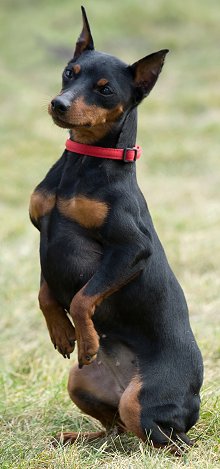
The AKC Standard says that characteristic traits of the Miniature Pinscher are "fearless animation, complete self-possession, and spirited presence."
This sleek, elegant breed with the quick, prancing gait is perhaps the "busiest" and most intense of the toy breeds. Assertive and proud, athletic and agile, the Miniature Pinscher is convinced that he's a big dog. He seems to be in perpetual motion and enjoys brisk, vigorous, interactive games.
He also demands cuddling, but you should be careful not to obey HIS commands – in other words, begin and end cuddling on YOUR terms. Otherwise, his demanding behaviors will get worse and worse.
MinPins love comfort, especially snuggling under blankets.
Outdoors, he must be kept on-leash or in a securely fenced area at all times, for he is sharp-eyed, curious, and extremely quick to react. Unless exceptionally well-trained, Min Pins don't come back when you call them.
Often they don't stay where you leave them, either – they are incredible climbers and clever escape artists.
Keenly observant and territorial, the Miniature Pinscher takes his watchdog role seriously. He will show strangers his backside accompanied by vocal threats and defiant kicking of the ground with his rear feet. Early and frequent socialization is required so that your Min Pin doesn't become sharp or shrill.
Miniature Pinschers can be dominant with other dogs, especially larger ones. Smaller creatures such as rodents and birds will be pursued with determination.
In the right hands, this bright breed is very trainable. But he has a mind of his own and can be headstrong and demanding.
Miniature Pinschers are tough on toys and will rip squeakers and stuffed animals to shreds. They love to bark, and housebreaking can be difficult.
If you want a dog who...
- Looks like a tiny, elegant Doberman
- Has a short easy-care coat
- Is energetic and "busy" – frequently on the go
- Is feisty and assertive, not a submissive lap dog
- Makes a keen watchdog
A Miniature Pinscher may be right for you.
If you don't want to deal with...
- A dynamic dog who always seems to be observing and planning what to do next
- Providing enough exercise and activities to keep them busy
- Destructiveness when bored
- Extreme suspiciousness toward strangers
- Potential aggression toward other animals – chasing instincts
- Potential escape attempts and running away from you
- Strong-willed mind of his own, requiring a confident owner who can take charge
- Notorious housebreaking difficulties
- Barking
A Miniature Pinscher may not be right for you.
 |
Dog Breed Traits – Which Traits Are Right For You? In this brand new series, I'll help you decide which dog breed traits would best suit you and your family, your home and yard, and your lifestyle, so you can choose the best dog breed for your family. |
Keep in mind that the inheritance of temperament is less predictable than the inheritance of physical traits such as size or shedding. Temperament and behavior are also shaped by raising and training.
FREE eBooks by Michele Welton
 "Respect Training for Puppies" and "Teach Your Dog 100 English Words" are free step by step guides to teaching your pup to be calm and well-behaved.
 "11 Things You Must Do Right To Keep Your Dog Healthy and Happy" is a free guide to keeping your dog mentally, physically, and emotionally happy and healthy so you can enjoy a longer lifetime of companionship.

- You can avoid some negative traits by choosing an ADULT dog from an animal shelter or rescue group. With an adult dog, you can easily see what you're getting, and plenty of adult Min Pins have already proven themselves not to have negative characteristics.
- If you want a puppy, you can avoid some negative traits by choosing the right breeder and the right puppy.
More traits and characteristics of the Miniature Pinscher
If I was considering a Miniature Pinscher, I would be most concerned about...
- Providing enough exercise and mental stimulation. Miniature Pinschers are active go-getters who need regular opportunities to vent their energy and to use their busy minds to do interesting things. Bored Min Pins can be noisy and destructive.
This breed is an interesting choice for an experienced owner who wants to participate with a smart little dog in agility classes (obstacle course for dogs) or in ongoing obedience classes at the intermediate or advanced level. It's not a good choice for novice owners who just want a quiet little pet.
- Suspiciousness. Standoffish by nature, Miniature Pinschers need extensive exposure to people and to unusual sights and sounds. Otherwise their natural caution can become extreme suspiciousness. Many Min Pins will put on a display of excited ferociousness (i.e. they "pitch a fit") when other people or animals approach what they decide is theirs. It sounds cute and funny, but it's not. If you don't curtail it, your Min Pin may end up suspicious of everyone, which is a short step to aggression.
I do not recommend Miniature Pinschers for homes with small children. Min Pin puppies can be injured by even a well-meaning child who accidentally steps on, or falls over, the puppy. Some Min Pin adults can feel overwhelmed by the loud voices and quick movements of children. And some adults won't tolerate any nonsense and are quick to react to teasing. Many Miniature Pinschers are possessive of their food and toys and will defend these from all comers, including children.
- Potential animal aggression. Most Miniature Pinschers are dominant or aggressive toward other dogs. They're usually fine with the family cat, but I wouldn't keep a pet rodent or small bird.
- Barking. The ever-vigilant Miniature Pinscher is often too quick to sound the alarm at every new sight and sound. You have to be equally quick to stop this from becoming a bad habit. This requires that your MinPin will listen to you, which comes back to the Repect Training I mentioned above.
- Housebreaking. Toy breeds are almost always difficult to housebreak. It is so easy for them to sneak behind a chair or under a small table, and it takes only a few seconds for the deed to be done. The results can be hard to see. When you don't see it, you don't correct it – and so the bad habit becomes established. If you hope to housebreak a Miniature Pinscher, consistent crate training is mandatory. They should not be loosed in the house for many months, until their small internal organs become strong enough for reliable control.
- Fence security. Many Min Pins are clever escape artists who will go over or under fences in search of adventure. You need higher fences than you might imagine for their small size, and I recommend solid wood, not chain link or anything else climbable. Yes, some individuals climb like agile monkeys and will go right up and over a chain link fence of any height.
Oh, and when you take them outside of their yard, keep that leash on. Miniature Pinschers cannot be trusted off-leash. They will take off – oblivious to your frantic shouts – after anything that runs. Or even if they just feel like it.
- Mind of their own. Miniature Pinschers are very bright and willing to work with a confident trainer. But they have an independent mind of their own. They can be manipulative, willful, and dominant (they want to be the boss) and will make you prove that you can make them do things. You must show them, through absolute consistency, that you mean what you say.
To teach your Min Pin to listen to you, "Respect Training" is mandatory. Follow my free online training programs.
 About the author: Michele Welton has over 40 years of experience as a Dog Trainer, Dog Breed Consultant, and founder of three Dog Training Centers. An expert researcher and author of 15 books about dogs, she loves helping people choose, train, and care for their dogs.
My best-selling books – now available FREE on my website
 Respect Training For Puppies: 30 seconds to a calm, polite, well-behaved puppy is for puppies 2 to 18 months old. Your puppy will learn the 21 skills that all family dogs need to know. Click here to read for free.
 Teach Your Dog 100 English Words is a unique Vocabulary and Respect Training Program that will teach your adult dog to listen to you and do what you say. Click here to read for free.
 11 Things You Must Do Right To Keep Your Dog Healthy and Happy helps your dog live a longer, healthier life. Get my honest advice about all 11 Things before you bring home your new puppy, because some mistakes with early health care cannot be undone. Click here to read for free.
Related posts you might enjoy