
Irish Wolfhounds: What's Good About 'Em, What's Bad About 'Em
Irish Wolfhound temperament, personality, training, behavior, pros and cons, advice, and information, by Michele Welton, Dog Trainer, Behavioral Consultant, Author of 15 Dog Books
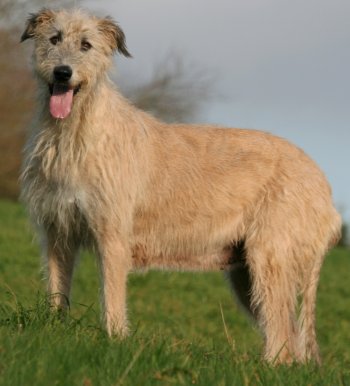
The AKC Standard says, "Of great size and commanding appearance, the Irish Wolfhound is remarkable in combining power and swiftness with sight."
This gentle giant is sometimes calm and dignified, sometimes playful and silly, always easygoing and reliable.
The Irish Wolfhound does best in a suburban or country home with lots of companionship and room to stretch out. He needs regular exercise to stay fit, whether he seems to want it or not. A daily one-hour walk/trot (on-leash) with twice weekly gallops inside a safe enclosed area are necessary for proper development.
Sensible with strangers, most Irish Wolfhounds are friendly and expect to be petted, while some are more wary. This breed does need early, frequent socialization to encourage an outgoing attitude. Not many individuals are guardians; indeed, suspiciousness or aggressiveness should never be encouraged because of his massive size.
With other animals the Irish Wolfhound is usually amiable, but he does love to chase, tackle, and pounce on anything that moves rapidly.
A sweet and sensitive dog, he has his independent side but responds well (slowly and thoughtfully) to patient obedience training. Use positive rewards and gentle, fair corrections.
Irish Wolfhounds remain gawky, clumsy, and potentially destructive (in a big way!) for up to three years.
If you want a dog who...
- Is suited to a suburban or country home with plenty of enclosed space to stretch out and run
- Is a gentle giant with a whiskery face
- Is usually easygoing with everyone
- Responds well to patient, persistent training
An Irish Wolfhound may be right for you.
If you don't want to deal with...
- A dog who takes up a lot of space in your house and car
- A huge dog sitting on your feet, sprawling on your lap, or leaning his considerable weight against your leg
- Exuberant jumping when young
- Destructiveness when bored or left alone too much
- Suspiciousness or fearfulness when not socialized enough
- Aggression toward other animals that run – chasing instincts
- Regular coat care
- Gassiness (flatulence)
- Serious health problems
- A very short lifespan
- A high price tag
An Irish Wolfhound may not be right for you.
 |
Dog Breed Traits – Which Traits Are Right For You? In this brand new series, I'll help you decide which dog breed traits would best suit you and your family, your home and yard, and your lifestyle, so you can choose the best dog breed for your family. |
Keep in mind that the inheritance of temperament is less predictable than the inheritance of physical traits such as size or shedding. Temperament and behavior are also shaped by raising and training.
FREE eBooks by Michele Welton
 "Respect Training for Puppies" and "Teach Your Dog 100 English Words" are free step by step guides to teaching your pup to be calm and well-behaved.
 "11 Things You Must Do Right To Keep Your Dog Healthy and Happy" is a free guide to keeping your dog mentally, physically, and emotionally happy and healthy so you can enjoy a longer lifetime of companionship.

- You can avoid some negative traits by choosing an ADULT dog from an animal shelter or rescue group. With an adult dog, you can easily see what you're getting, and plenty of adult Irish Wolfhounds have already proven themselves not to have negative characteristics.
- If you want a puppy, you can avoid some negative traits by choosing the right breeder and the right puppy.
More traits and characteristics of the Irish Wolfhound
If I was considering an Irish Wolfhound, I would be most concerned about...
- Serious health problems and a short lifespan. Irish Wolfhounds are extremely prone to a life-threatening digestive syndrome called bloat. It comes on suddenly and can kill a dog in just a few hours. In addition, Wolfhounds are frequently stricken at an early age by crippling joint and bone disorders, by heart disease, and by cancer. Read more about Irish Wolfhound Health.
- Providing the proper balance of exercise. Young Irish Wolfhounds need enough exercise to keep them lean and healthy, but not so much that their soft growing bones, joints, and ligaments become over-stressed and damaged. The proper amount of exercise can be difficult to regulate in giant breeds.
Since you need to minimize their exercise, young Irish Wolfhounds can be very rambunctious. They will romp with uncoordinated gawkiness all over your house. You need to substitute extra quantities of companionship and supervision. Otherwise, left alone, young Irish Wolfhounds become bored and destructive and their powerful jaws can literally destroy your living room.
- Providing enough socialization. When you own a giant breed, you take on a great responsibility to socialize your dog thoroughly so that he gets along peacefully with the world. Irish Wolfhounds need extensive exposure to people. Otherwise they may be suspicious of everyone, which can lead to either aggression or shyness. Both attitudes are dangerous in a giant breed because fearful dogs can react defensively if they feel frightened or cornered.
- Potential animal aggression. Irish Wolfhounds are usually good with the other pets in their family. But some Irish Wolfhounds are dominant or aggressive toward other dogs of the same sex. Some have strong instincts to chase and seize cats and other fleeing creatures. Remember that these were hunting hounds who brought down wolves. The speed and power of this breed should never be underestimated.
- Mind of his own. Such a large dog must be under your control. Irish Wolfhounds do have a mind of their own and are not particularly eager to please. But they are willing to listen to you if you show them, through patience and persistence and consistency, that you mean what you say. Obviously this is best accomplished while they are very young and still small enough to be physically controlled.
To teach your Irish Wolfhound to listen to you, "Respect Training" is mandatory. Follow my free online training programs.
- High price tag. Well-bred Irish Wolfhounds are very expensive.
 About the author: Michele Welton has over 40 years of experience as a Dog Trainer, Dog Breed Consultant, and founder of three Dog Training Centers. An expert researcher and author of 15 books about dogs, she loves helping people choose, train, and care for their dogs.
My best-selling books – now available FREE on my website
 Respect Training For Puppies: 30 seconds to a calm, polite, well-behaved puppy is for puppies 2 to 18 months old. Your puppy will learn the 21 skills that all family dogs need to know. Click here to read for free.
 Teach Your Dog 100 English Words is a unique Vocabulary and Respect Training Program that will teach your adult dog to listen to you and do what you say. Click here to read for free.
 11 Things You Must Do Right To Keep Your Dog Healthy and Happy helps your dog live a longer, healthier life. Get my honest advice about all 11 Things before you bring home your new puppy, because some mistakes with early health care cannot be undone. Click here to read for free.
Related posts you might enjoy