
Greater Swiss Mountain Dogs: What's Good About 'Em, What's Bad About 'Em
Greater Swiss Mountain Dog temperament, personality, training, behavior, pros and cons, advice, and information, by Michele Welton, Dog Trainer, Behavioral Consultant, Author of 15 Dog Books
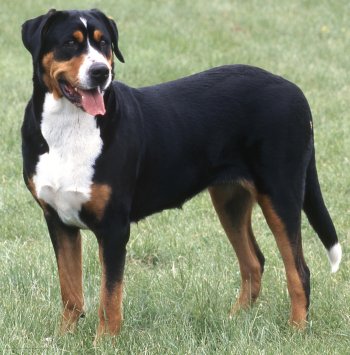
As with most giant breeds, the Greater Swiss Mountain Dog doesn't need hours of hard running. Yet he is much more athletic than you might think, so he definitely needs regular moderate exercise.
Pulling a cart or sled is a wonderful productive outlet for his energy, especially when children are involved.
Greater Swiss Mountain Dogs thrive on your companionship, though their determination to jump up into your face, shove their body against your leg, or slap a massive paw into your lap can be disconcerting.
This vigilant watchdog will sound off in a loud, deep voice to announce visitors – or simply to let you know that your neighbor has stepped outdoors.
Most Swissys are friendly with guests, but some are more wary, and some are shy and spooky. Early and ongoing socialization is essential to develop a stable Greater Swiss Mountain Dog.
Some Swissys are peaceful with other animals. Others have a high prey drive and aren't safe with small animals such as cats, while still others are downright aggressive with strange dogs.
Obedience training should start at three months old and include praise and food. Walking nicely on a leash is an imperative lesson, for these powerful dogs can literally pull you off your feet.
During adolescence when their hormones will kick in, many Swissys, especially males, will start to test your rules. You must respond with assertive, consistent leadership.
Slower to mature (both physically and mentally) than many other breeds, the Greater Swiss Mountain Dog remains playfully puppy-like for many years. This sounds delightful, but can wear away your patience when that "puppy" weighs over 100 pounds!
For example, you must control the tendency of this breed to mouth your hands. Similarly, he may try to ingest everything in his path, from sticks to gravel.
Frankly, with all of his special needs, the Greater Swiss is "too much dog" for the average household.
If you want a dog who...
- Is giant, robust, and powerfully built
- Has a short easy-care coat
- Prefers that his exercise be hiking, carting, or weight-pulling, rather than hard running
- Is usually polite with people, but makes a vigilant watchdog
A Greater Swiss Mountain Dog may be right for you.
If you don't want to deal with...
- A huge dog who takes up a lot of space in your house and car
- A heavy dog who wants to sit on your feet and lean his weight against your leg
- Rowdiness and exuberant jumping when young
- Destructiveness when bored or left alone too much
- Aggression or fearfulness toward strangers when not socialized enough
- Potential aggression toward other animals
- Strong-willed mind of his own, requiring a confident owner who can take charge
- Excessive barking
- A short lifespan
- Waiting lists and a high price tag
A Greater Swiss Mountain Dog may not be right for you.
 |
Dog Breed Traits – Which Traits Are Right For You? In this brand new series, I'll help you decide which dog breed traits would best suit you and your family, your home and yard, and your lifestyle, so you can choose the best dog breed for your family. |
Keep in mind that the inheritance of temperament is less predictable than the inheritance of physical traits such as size or shedding. Temperament and behavior are also shaped by raising and training.
FREE eBooks by Michele Welton
 "Respect Training for Puppies" and "Teach Your Dog 100 English Words" are free step by step guides to teaching your pup to be calm and well-behaved.
 "11 Things You Must Do Right To Keep Your Dog Healthy and Happy" is a free guide to keeping your dog mentally, physically, and emotionally happy and healthy so you can enjoy a longer lifetime of companionship.

- You can avoid some negative traits by choosing an ADULT dog from an animal shelter or rescue group. With an adult dog, you can easily see what you're getting, and plenty of adult Swissys have already proven themselves not to have negative characteristics.
- If you want a puppy, you can avoid some negative traits by choosing the right breeder and the right puppy.
More traits and characteristics of the Greater Swiss Mountain Dog
If I was considering a Greater Swiss Mountain Dog, I would be most concerned about...
- Providing the proper balance of exercise. Young Greater Swiss Mountain Dogs need enough exercise to keep them lean and healthy, but not so much that their soft growing bones, joints, and ligaments become over-stressed and damaged. Adult Swissies need more exercise to keep them in shape, but not in hot or humid weather for fear of overheating. The proper amount of exercise can be difficult to regulate in giant breeds.
Since you have to minimize their exercise, young Greater Swiss Mountain Dogs can be very rambunctious. They will romp with uncoordinated gawkiness all over your house. You need to substitute extra quantities of companionship and supervision. Otherwise, left alone, young Swissies become bored and destructive.
- Providing enough socialization. Many Greater Swiss Mountain Dogs have protective instincts toward strangers. They need extensive exposure to friendly people so they learn to recognize the normal behaviors of "good guys." Then they can recognize the difference when someone acts abnormally. Without early careful socialization, they may be suspicious of everyone, which could lead to aggression or shyness.
- Potential animal aggression. Some Greater Swiss Mountain Dogs are dominant or aggressive toward other dogs of the same sex. Some have strong instincts to chase and seize cats and other fleeing creatures.
- The strong temperament. Greater Swiss Mountain Dogs have a lovely nature, but they are not pushovers to raise and train. Some Swissys are willful and bossy and will make you prove that you can make them do things. You must show them, through absolute consistency, that you mean what you say. To teach your Swissy to listen to you, "Respect Training" is mandatory. Follow my free online training programs.
- Barking. Vigilant watchdogs are sometimes too vigilant! Greater Swiss Mountain Dogs are often too quick to sound the alarm at every new sight and sound. You have to be equally quick to stop them. This is not a breed to leave outside, unsupervised. Their booming barks will have your neighbors calling the cops to report the nuisance, or quietly letting your Swissy out of his yard so he'll wander away.
- Slobbering. Greater Swiss Mountain Dogs with very loose lips may drool, especially when food is present. And most Swiss Mountain Dogs are messy drinkers who slobber water everywhere.
- Serious health problems. The lifespan of a Greater Swiss Mountain Dog is short. An alarming number are crippled by bone and joint diseases and/or succumb to cancer in middle age. Read more about Greater Swiss Mountain Dog Health.
- Finding one and paying the price. In the United States, not many Greater Swiss Mountain Dog puppies are born each year. Expect a waiting list and a hefty price tag.
 About the author: Michele Welton has over 40 years of experience as a Dog Trainer, Dog Breed Consultant, and founder of three Dog Training Centers. An expert researcher and author of 15 books about dogs, she loves helping people choose, train, and care for their dogs.
My best-selling books – now available FREE on my website
 Respect Training For Puppies: 30 seconds to a calm, polite, well-behaved puppy is for puppies 2 to 18 months old. Your puppy will learn the 21 skills that all family dogs need to know. Click here to read for free.
 Teach Your Dog 100 English Words is a unique Vocabulary and Respect Training Program that will teach your adult dog to listen to you and do what you say. Click here to read for free.
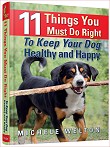 11 Things You Must Do Right To Keep Your Dog Healthy and Happy helps your dog live a longer, healthier life. Get my honest advice about all 11 Things before you bring home your new puppy, because some mistakes with early health care cannot be undone. Click here to read for free.
Related posts you might enjoy