
German Shepherds: What's Good About 'Em, What's Bad About 'Em
German Shepherd temperament, personality, training, behavior, pros and cons, advice, and information, by Michele Welton, Dog Trainer, Behavioral Consultant, Author of 15 Dog Books
Jump directly to:
| Temperament | Exceptionally intelligent, loyal, confident, can learn almost anything |
| Pros and Cons | What's good... What's bad... |
| Size | Large (22-26 inches, 65-110 lbs) |
| "Types" | Working lines, show lines, short and long coats |
| Exercise | Moderate to high |
| Training | Easy to moderate |
| With strangers | Aloof but approachable |
| With children | Fine when raised with well-behaved children |
| With other pets | Usually fine with family pets, can be aggressive toward other dogs of the same sex |
| Shedding | Constant |
| Grooming | Easy to moderate |
| Lifespan | 10-12 years |
| Colors | Black with tan/red/cream/silver markings; sable; solid black; solid white |
| Puppies | Easy to find |
| Rescue dogs | Easy to find |
| Similar breeds | Shiloh Shepherd, White Shepherd, Belgian Shepherd |
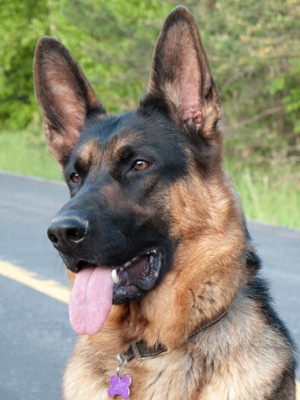
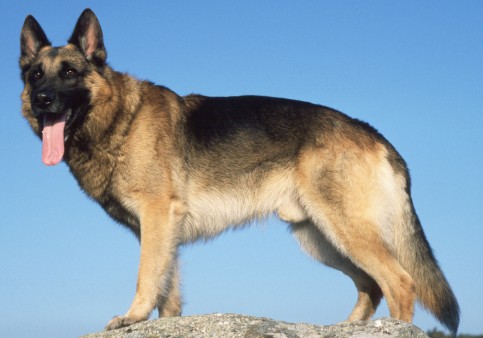
German Shepherds were my very first breed. This noble-looking male has a beautiful rugged head, intelligent expression, and rich coloration.
My experience with German Shepherd temperament
Temperament and behavior stem from what the breed was designed for
To understand a breed's temperament and behavior, ask, "What was he developed to do?" Whichever traits help him accomplish his intended work have likely been "hard-wired" into his genes – not perfectly, but generally.
The German Shepherd was developed from various sheepherding dogs. So you would expect sheepherding traits such as athleticism, a compulsion to chase things that move, and swift responsiveness to their human shepherd/master.
German Shepherds were also developed as military messenger and sentry dogs, and as personal protection and police dogs. So expect traits such as aloofness toward strangers and protective/territorial instincts.
The breed also excels at search and rescue, bomb and drug detection, and guiding the blind. Certainly you would expect high intelligence, high self-confidence, trainability, and an ability to focus.
All of those traits are what you get in an ideal German Shepherd. One of the most capable and trainable breeds in all of dogdom, an ideal German Shepherd, when properly raised by a confident owner, can be a magnificent companion. There's a good reason my first dogs were German Shepherds!
Unfortunately, it can be difficult today to find a German Shepherd with an ideal temperament. Or at least an ideal temperament to be a good family companion.
Different lines have different temperaments
Today, the temperament of a German Shepherd often depends largely upon what kind of line he comes from.
Some breeders, you see, produce working lines of German Shepherds with high-drive temperaments – vigorous and intense. These dogs are ideal for competitive protection-dog sports. But not so much for the average family companion – unless you looked carefully for an individual pup in one of those litters who didn't inherit that high-drive temperament.
Other breeders produce show lines that match a detailed standard of conformation for the show ring. These dogs are softer-tempered than those from working lines. That sounds nice and yet....
I've worked with far too many German Shepherds from show lines who were hyperactive, skittish, spooky, or downright dopey. This happens when breeders focus on appearance more than temperament and trainability.
My recommendation for a good family dog
If you're looking for an easygoing family companion, I would avoid both strict show lines and strict working lines.
Instead, you might look for more of a generalist breeder who focuses on calmness and high trainability. These breeders might prove their dogs' trainability by participating in non-protection dog sports such as obedience, rally, or agility.
Or, if you want a truly mellow Shepherd, you might consider a longhaired or perhaps a solid white German Shepherd. These dogs are seldom bred for aggressive dog sports, so they tend to have a milder temperament that fits well into many families.
Just be careful with the whites. A good number of them are too soft, which can result in timidity or skittishness.
I hope you can see....
....that with German Shepherds more than most other breeds, you must know what you want before you start calling breeders or looking at litters.
Because if you don't know what you want, and what you don't want, and if you don't ask the right questions, you're likely to end up with a German Shepherd that isn't at all what you were looking for – and possibly one who is too much for you to handle.
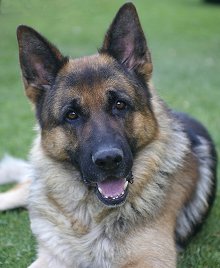
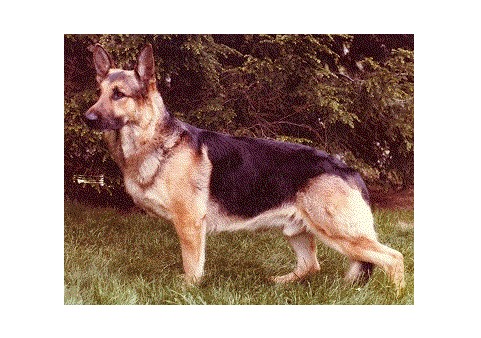
Such an intelligent expression – confident and inquiring.
Pros and cons of German Shepherds
The Good
- Handsome, natural-looking, athletic
- Thrives on challenging activities and exercise
- Loyal to his own family
- Looks imposing and has a reputation that bad guys don't want to fool with, so makes an effective deterrent
- Highly intelligent and versatile – can learn almost anything
The Bad
- Can be hard to find one with a family-oriented temperament and a decent chance of staying healthy
- Needs plenty of exercise and interesting things to do
- Needs careful socialization
- Destructiveness when bored or not exercised enough
- Potential aggression toward other animals
- Constant shedding – 365 days a year
- Legal liabilities (insurance issues, increased chance of lawsuits)
- High risk of serious health problems
 |
Dog Breed Traits – Which Traits Are Right For You? In this brand new series, I'll help you decide which dog breed traits would best suit you and your family, your home and yard, and your lifestyle, so you can choose the best dog breed for your family. |
Keep in mind that the inheritance of temperament is less predictable than the inheritance of physical traits such as size or shedding. Temperament and behavior are also shaped by raising and training.
FREE eBooks by Michele Welton
 "Respect Training for Puppies" and "Teach Your Dog 100 English Words" are free step by step guides to teaching your pup to be calm and well-behaved.
 "11 Things You Must Do Right To Keep Your Dog Healthy and Happy" is a free guide to keeping your dog mentally, physically, and emotionally happy and healthy so you can enjoy a longer lifetime of companionship.

- You can avoid some negative traits by choosing an ADULT dog from an animal shelter or rescue group. With an adult dog, you can easily see what you're getting, and plenty of adult German Shepherds have already proven themselves not to have negative characteristics.
- If you want a puppy, you can avoid some negative traits by choosing the right breeder and the right puppy.
How big are German Shepherds?
Males stand about 24-26 inches at the shoulder and weigh 75-110 pounds.
Females stand about 22-24 inches and weigh 65-90 pounds.
Some German Shepherds are considerably larger than that, but shouldn't be. This breed is supposed to be athletic and agile, not giant-sized and ponderous. Larger dogs can have more joint problems and a shorter lifespan.
Are there different "types" of German Shepherds?
Officially there's only the one breed. But I explained in the Temperament section that there are different lines of German Shepherds with different temperaments. Those lines can also LOOK very different from each other.
Show lines
Those of us who admired the strong, noble look of German Shepherds from decades ago are saddened at what has been done to the appearance of modern show dogs.
If you go to a German Shepherd specialty show in the United States or Canada, you'll see tall narrow bodies, long narrow heads, and such excessive curvature of the rear legs that the dog's back slopes downward from shoulders to tail. You could roll a ball down that back.
In my opinion, these are misshapen caricatures of a German Shepherd. To make matters worse, show lines produce more than their share of spooky and low-intelligence dogs, which is what happens when you over-focus on appearance rather than temperament and trainability.
In contrast, the West German show line has a more normal shape. Best of all, German Shepherds in West Germany cannot win show ring ribbons or be bred without passing a temperament/trainability test.
There are many West German bloodlines in the United States. So if you're interested, you can look for show breeders who emphasize West German lines instead of American/Canadian.
Just be aware that these dogs aren't couch potatoes: they do have plenty of energy and some working drives that will need to be exercised.
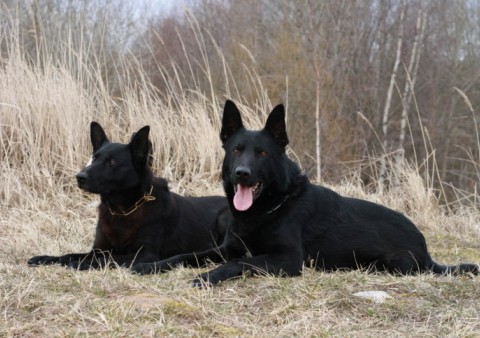
Solid black German Shepherds are less common, but when combined with a rugged build, makes for a very handsome dog.
Working/protection lines
I love these lines because the dogs look and behave more like German Shepherds.
It's true that working lines are often too strong-tempered and intense for the average family. But if you're an experienced owner who knows how to be in charge and if you provide firm rules and plenty of physical and mental exercise, working lines can make great companions.
Knowledgeable working dog breeders can point you toward the pups in their litters who are calmer and have less working drive.
In the United States, working lines stem predominantly from West Germany or East Germany.
I don't recommend East German (often called DDR) lines. DDR stands for Deutsches Demokratische Republik, the name by which East Germany was known while the Berlin Wall was up. These dogs were used by the military and border patrol, so they're tough, not recommended for the average family.
Pet lines?
You might be thinking, "Must I choose show line or working line? Isn't there another choice, like a line specifically bred to be a good pet?"
Some breeders blend show and working lines, trying to produce a more moderate build and temperament.
Some breeders emphasize high trainability, competing with their intelligent dogs in non-protection sports such as obedience or agility.
Other breeders emphasize "old style" German Shepherds with a more rugged build. But avoid breeders who boast about their "giant" German Shepherds. Packing more weight onto the frame and joints of a breed that's supposed to be medium to large is a huge (pun intended) mistake.
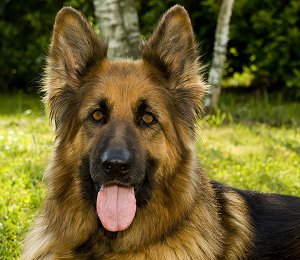
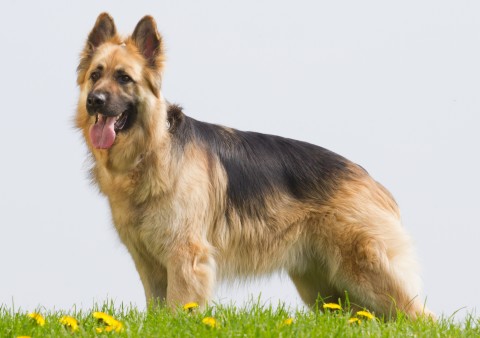
German Shepherd with long hair. This particular dog has a minimalist long coat – just some ear tufts and a body coat that's slightly longer than normal.
Shorthaired or longhaired
When you're thinking about the different types of German Shepherds, you should also consider the two types of COAT:
The normal coat is short hair. But German Shepherds also come in a longer coat. Both coats are the same breed.
Unfortunately, in the United States, long coats are frowned upon by the official clubs and show-dog breeders. Long-coated dogs can be registered, bred, and shown in certain activities such as obedience and agility. But they're not welcome in the conformation ring, where judging is based on appearance.
Some long-coated Shepherds have essentially a short body coat with only minor feathering around their ears, on the backs of their legs, and on their bum and tail. Other long-coated German Shepherds have long hair across most of their body.
Do long haired German Shepherds have a different build or temperament? Yes, often they do. Because they're not welcome in the conformation ring, their structure hasn't been deformed like that of their shorthaired brothers.
And because they're seldom seen in protection dog sports, their temperament tends to be softer and milder, which fits well into many families.
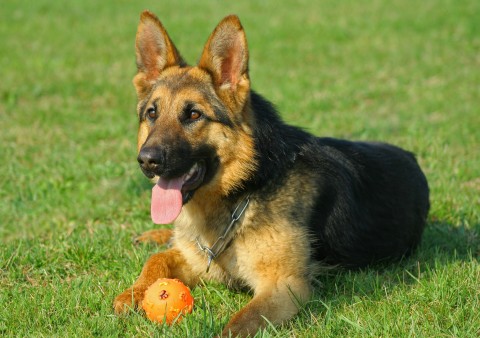
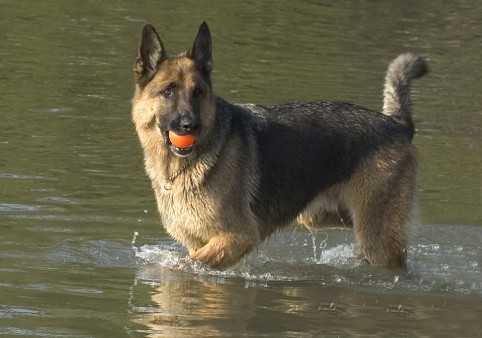
German Shepherds are active dogs, but should not be hyperactive. Fetch games are a great way to exercise this breed.
How much exercise do German Shepherds need?
German Shepherd puppies and adolescents (up to 18 months old) should have moderate exercise only – multiple walks, fetch games, or (if there is a compatible playmate) playing with another dog.
But the growing bones and ligaments in a young dog can be irreparably damaged by too much exercise or the wrong kind of exercise. At this age, there should be no forced running (beside a jogger or bicyclist). Restrict jumping as much as possible.
Once the dog is mature, the amount of exercise needed will vary according to the dog's energy level. But all German Shepherds, to maintain fitness, need brisk walking every day and all-out running in a safe, enclosed area as often as possible.
Dogs from working lines typically want a lot more exercise.
Mental exercise is even more important for German Shepherds. Mental exercise means the dog gets to participate in interesting activities that keep his intelligent mind stimulated.
This might be a dog sport such as agility, rally obedience, musical freestyle, tracking, flyball, herding, or schutzhund. It might be interactive dog toys, or a homemade obstacle course, or learning tricks, or playing games such as Hide 'n Seek.
Some of these activities are included in my free online training book, Teach Your Dog 100 English Words.
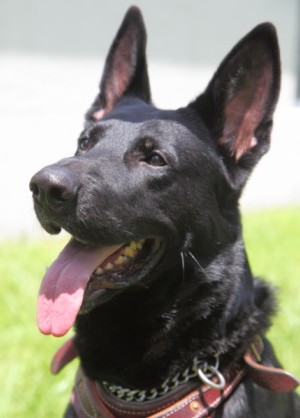
Handsome black German Shepherd, attentively awaiting your next words.
Are German Shepherds easy to train?
Some are easy to train, while others are more moderate.
As we've seen, different lines have different temperaments. German Shepherds from working lines are typically more assertive and stronger-willed. A "tougher" German Shepherd will be more challenging to train unless you pay closer attention to building the right Leader-Follower relationship with the dog.
That doesn't mean "softer" German Shepherds are automatically easy to train. Some dogs with soft temperaments are skittish or shy, making them just as challenging as a strong-tempered dog.
In general, though, a sound-tempered German Shepherd who is a good fit for family life should be easy to train. Just establish the right Leader-Follower relationship and the dog will be happy to work with you.
This is taught in my free puppy training book, Respect Training For Puppies (30 seconds to a calm, polite, well-behaved puppy).
How sociable are German Shepherds?
Are they friendly with strangers?
Most German Shepherds are reserved with strangers. As the breed's national club says, a good German Shepherd has:
"a certain aloofness that does not lend itself to immediate and indiscriminate friendships. The dog must be approachable, quietly standing its ground and showing confidence and willingness to meet overtures without itself making them."
As you might imagine, this can be a fine line to walk. Without proper guidance from the owner, a German Shepherd's natural aloofness can morph over the line to suspiciousness, distrust, and even aggression or fearfulness.
When you own an aloof breed, you need to socialize the dog thoroughly. This means a careful program of teaching him to pay attention to you and mind you in the presence of other people and other dogs. He doesn't have to like them, but he must accept them.
One thing I should mention: many German Shepherds who bark and lunge at strangers or other dogs aren't being either protective or aggressive. Rather, this kind of reactivity can be the dog's attempt to hide his own insecurities behind a blustering facade.
At the other end of the spectrum are German Shepherds who tuck their tail between their legs, and try to hide behind you or run away whenever a stranger or another dog approaches. Sometimes this is just inexperience with the world, but sometimes it's an inherited form of shyness. German Shepherds who are genetically shy can be helped by socialization – but not "cured." Yet another reason to be very careful when acquiring this breed.
There are also legal liabilities to consider when you acquire a German Shepherd. For example, your homeowner insurance policy might be cancelled or the rates hiked, because people are often quicker to sue if a "guard dog breed" does anything even remotely questionable.
Are German Shepherds good with children?
If the dog was raised with childen and if the children are well-behaved, most German Shepherds with a normal temperament are fine with them.
But if you have young children, you need to be especially careful about bringing an adult German Shepherd with an unknown background into your home. That dog should have a stellar temperament vouched for by experienced rescue personnel.
Also I wouldn't be comfortable with some high-drive German Shepherds around toddlers. These vigorous, intense dogs could send a toddler flying without even meaning to.
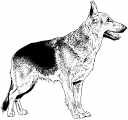
Are German Shepherds good with other pets?
Most German Shepherds are fine with other dogs and cats in their own family, if introduced to them when the dog is young. I've had multiple German Shepherds living harmoniously with my Chihuahuas and cats.
However, some German Shepherds show strong predatory/chasing behavior toward cats and other animals that run.
And some German Shepherds are dominant, or aggressive, toward other dogs of the same sex. My dog Luke, for example, would never dream of harming a female dog – but he would have loved to engage any strange male. Only a firm Respect Training program kept his behavior under control.
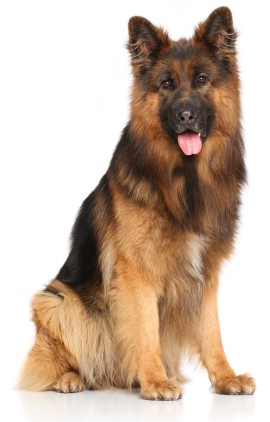
Long-coated German Shepherd. Keep their feathering combed out to avoid painful mats and tangles.
Grooming: Do German Shepherds shed a lot? Are they easy to groom?
About shedding....
I have good news and bad news.
The good news is that German Shepherds have only one shedding period a year.
The bad news is.... their shedding period lasts for 365 days. In other words, German Shepherds shed constantly.
How is this different from most breeds?
Most breeds shed a few hairs here and there throughout the year. But the vast bulk of their shedding occurs only twice a year – for three weeks in the spring as their thicker winter coat switches over to a cooler summer coat, and for three weeks in the fall as the summer coat switches over to a winter coat.
Not German Shepherds. They shed a TON during those spring and fall coat-switching seasons. Plus they shed moderately the rest of the year.
So year-round, you'll find hair on your clothing, on your carpets, and under your refrigerator. Frequent vaccuming will become a way of life.
You might be wondering, "How can a shorthaired dog shed so much?" The answer is that German Shepherds have a double coat. They have a short outer coat (harsh to the touch), plus a woolly undercoat (for insulation). Breeds with a double coat always shed more than breeds who simply have an outer coat but no undercoat.
German Shepherds come in a long coat, as well as a short coat. Both coats shed heavily.
Now, about grooming....
How much grooming is required depends on whether a German Shepherd is shorthaired or longhaired.
We've already talked about the temperament (usually good) of longhaired German Shepherds. As far as grooming goes, they obviously need regular brushing and combing to prevent mats and tangles. The longer the coat, the more work it will be.
But even if your Shepherd has a short coat, you're not off the hook when it comes to brushing. With a constant shedder, you should brush as often as possible to pull out the shed hairs before they end up on your floor and furnishings.
Ironically, longhaired German Shepherds often seem to shed less than the shorthaired. That's because some shed hair gets caught in the long coat instead of falling out. The trade-off is that you need to brush out that accumulated hair regularly or it will tangle and fuse into a matted mess.
Longhaired dogs need trimming
Along with brushing and combing, longhaired German Shepherds need trimming every few months.
Focus on the longish hair around the dog's private parts. Otherwise whenever he goes to the bathroom, the result is going to be unsanitary, both for the dog and for your house. Remember, anything that sticks to long hair eventually ends up on your floor or furnishings. So keep your dog's private parts trimmed short.
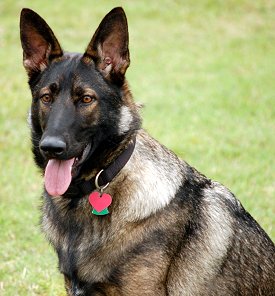
Gray sable pattern
How long do German Shepherds live? Are they a healthy breed?
German Shepherds typically live 10-12 years. Some do live to 13 or 14, but usually with chronic health issues such as arthritis.
And sadly, many don't even make it to age 10.
As a long-time German Shepherd owner, I know first-hand how many health problems this breed suffers from. Crippling joint diseases, autoimmune diseases, digestive diseases, skin diseases, heart and eye diseases.... truly a breed with serious health problems.
Here is a complete list of health problems in German Shepherds.
Or see my advice on → keeping your dog healthy
(feeding, vaccinations, neutering, veterinarians, and more).
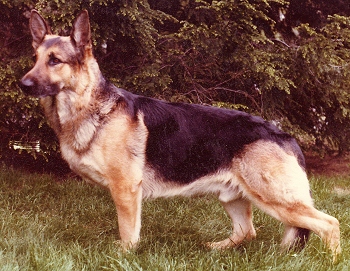
The most common color in German Shepherds – black and tan, in the saddleback pattern
What colors do German Shepherds come in?
The most common colors are black and tan, black and red, black and cream, or black and silver. These colors cover the dog in one of these three patterns:
- Saddleback – the black overlays the dog's back and sides (like a saddle). The rest of the dog is tan, red, cream, or silver. Usually there's some black on the face, as well.
- Blanketback – the black extends further down the shoulders and hips.
- Bicolor – like a Doberman or Rottweiler, which is mostly black with small tan/red/cream markings specifically confined to the head, chest, and legs. Honestly I don't know why this pattern is called bicolor, which simply means two colors. As we've just seen, the other two patterns also have just two colors.
Another common color is sable, which is an overall shade of gray, golden, or red, with black-tipped hairs that create a "dusted with black" effect.
A less common, but perfectly acceptable, color is solid black.
"Faulty" colors
Then there are two controversial colors: blue and liver:
- Blue German Shepherds have inherited a color-modifying gene that changes their black pigment to smoky gray. Many blue dogs look as though they've been dusted with flour.
- Liver German Shepherds have inherited a color-modifying gene that changes their black pigment to brown (any shade from light to dark).
If a dog has inherited either of these color-modifying genes, all of his black pigment is changed to blue/gray or brown, including his nose and the pads of his feet. For example, if a German Shepherd would have been a black and tan saddleback – except that he inherited a modifying gene – he becomes a blue and tan saddleback, or a liver and tan saddleback.
Blue and liver are considered serious faults by the official German Shepherd clubs and breeders who show their dogs in the conformation ring. But you can still register these dogs and compete with them in activities such as obedience and agility.
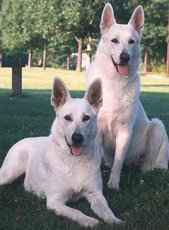
Controversial color: solid white
As with blue and liver, you can register a white German Shepherd and show him in competitive activities such as obedience and agility. But you can't show him in the conformation ring.
Why? Well, the Powers-That-Be say white is an unacceptable color because German Shepherds were developed to be herding and guard dogs. White dogs, they say, are too visible to make effective guard dogs. On the other hand, white dogs blend in too much with the sheep or snow instead of being clearly visible to the human shepherd.
If you love the white color, you might be pleased to hear that White Shepherd enthusiasts have formed their own club, which holds its own conformation shows.
Do German Shepherd ears stand up on their own, or do they have to be cut or taped to make them stand up?
Ah, you're thinking about cropping, a surgical procedure to make the ears stand up. That's done with Doberman Pinschers, but not with German Shepherds. A Shepherd puppy's ears prick up naturally – they're never cropped.
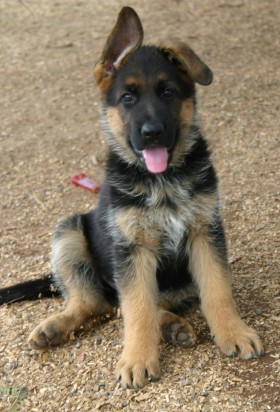
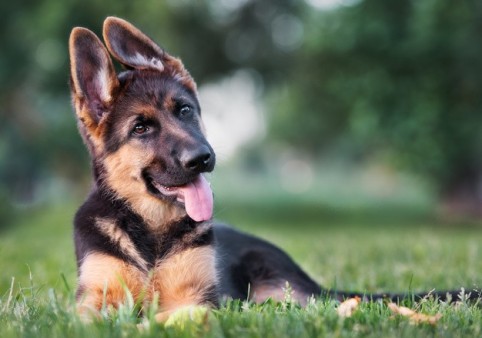
German Shepherd puppy with perfectly normal ears at this age. If the pup inherited normal genes, the other ear should come up shortly.
But German Shepherd puppies aren't born with pricked ears. In some pups, the ears start to prick up at 6 or 8 weeks old, while others don't start until 12 or 14 weeks old.
Often the ears don't go up smoothly. In other words, they don't suddenly pop straight up. Typically one ear will go up halfway, and stay like that for a few days. Then the other ear may start to prick while the first ear straightens all the way up. A few days later, just as the second ear straightens up, the first one suddenly flops back down.
This can be a trying time for new owners who worry that their pup's ears will never stand properly. Rest assured, it's normal for German Shepherd puppy ears to go up and down for a month or two, especially during the teething period.
Unfortunately, some puppies do inherit poor genes for ear strength and often those ears will never come all the way up. They're called "soft ears." Sometimes taping a weak ear can help it stand erect, but often not.
I had a German Shepherd with one soft ear. It flopped sideways on top of his head, while the other ear stood up beautifully. Of course I loved him dearly anyway!
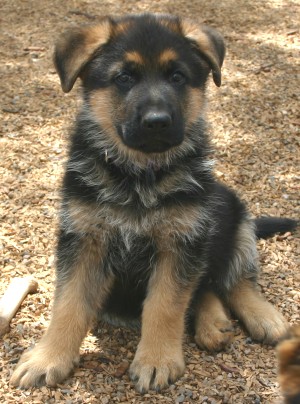
Most German Shepherd puppies start out with floppy ears and dark coloration.
German Shepherd Puppies
If you already have a German Shepherd puppy....
Congratulations! I'll be happy to show you how to raise and train your new family member.
- Follow my free puppy training book, Respect Training for Puppies: 30 seconds to a calm, polite, well-behaved puppy.
- Also see my advice on German Shepherd health care, including feeding and vaccinations
If you don't have a German Shepherd puppy, but you want one....
I can help you with that, too.
German Shepherds are extremely common in the United States, the 2nd most common of all breeds.
So they're very easy to find. The problem is finding one with the best chances of developing a stable temperament and the best chances of staying healthy through the years.
THAT is harder to do.
First, you need to think about the different types of German Shepherds we talked about earlier. The different temperament types and the different build and coat types.
You'll remember... show lines, working lines, old-style lines, longhaired lines, solid white lines.... one German Shepherd can be very different from another.
Or you can just hop onto Craigslist and buy a puppy from someone who "just breeds pets" or "just had one litter." But should you?
Not unless the seller has done the proper health certifications on the puppy's parents. One huge difference between a responsible breeder and an irresponsible "puppy producer" is – health certifications.
Both parents of a German Shepherd puppy should have OFA certificates for hips, elbows, and heart. One parent should have a certificate showing them to be clear of degenerative myelopathy. This is the fastest way to rule out all the bad breeders. No certificates equals irresponsible breeding.
BOTH PARENTS of a German Shepherd puppy should have:
- a certificate from the Orthopedic Foundation of America (OFA) or PennHip certifying the dog to have normal hips
- a certificate from the Orthopedic Foundation of America (OFA) certifying the dog to have normal elbows
- a certificate from the Orthopedic Foundation of America (OFA) or a report from a veterinary cardiologist – dated within the past year – certifying that the dog has had an Advanced Cardiac Exam and has a normal heart
Also, at least ONE PARENT of a German Shepherd puppy should have:
- a DNA test proving they are Normal/Clear of a severe neurological disease called degenerative myelopathy. Many years ago, I had a dear German Shepherd with this devastating disease. Believe me, you do not want to go through that.
If a seller can't show you those certificates, the puppies are higher risk for health problems. You might choose to accept that risk. But then you need to be willing (and able) to pay a couple thousand bucks for future surgeries and lifelong meds if your German Shepherd ends up crippled, paralyzed, or stricken with heart disease.
See my advice on → finding a good dog
How do I adopt a German Shepherd?
Because of their popularity, and because so many owners acquire one without doing diligent research, German Shepherds are often available from dog rescue groups.
German Shepherd crosses and mixes are frequently found in animal shelters.
However, shelter personnel can be over-zealous in labeling every medium- to large dog with a vaguely shepherd-ish look as a "German Shepherd cross." Be aware that a dog can look like a German Shepherd without having any Shepherd genes at all.
What breeds are similar to German Shepherds?
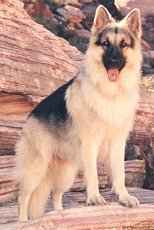
The Shiloh Shepherd looks like a large German Shepherd, which is not surprising since the Shiloh was developed 50 years ago by crossing German Shepherds with larger breeds. Compared to German Shepherds, Shiloh Shepherds tend to have a calmer, more easygoing personality.
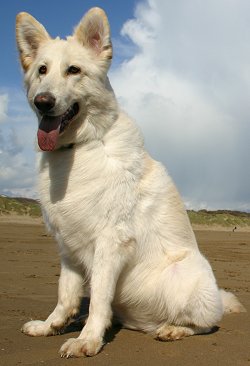
Compared to German Shepherds, most White Shepherds have a softer, more sensitive personality. White Shepherds are fine watchdogs, but seldom aggressive. In fact, if a White Shepherd is going to have any temperament fault, it's more likely to be timidity or skittishness.
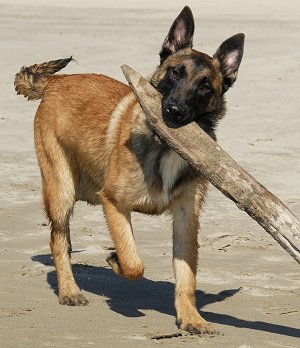
The Belgian Shepherd is recommended only for experienced owners. Compared to the German Shepherd, a Belgian is more agile, graceful, and elegant. Belgian Shepherds are highly intelligent, but also easily bored and prone to obsessive behaviors. This is a demanding breed that needs ongoing supervision and structured activities.
 About the author: Michele Welton has over 40 years of experience as a Dog Trainer, Dog Breed Consultant, and founder of three Dog Training Centers. An expert researcher and author of 15 books about dogs, she loves helping people choose, train, and care for their dogs.
My best-selling books – now available FREE on my website
 Respect Training For Puppies: 30 seconds to a calm, polite, well-behaved puppy is for puppies 2 to 18 months old. Your puppy will learn the 21 skills that all family dogs need to know. Click here to read for free.
 Teach Your Dog 100 English Words is a unique Vocabulary and Respect Training Program that will teach your adult dog to listen to you and do what you say. Click here to read for free.
 11 Things You Must Do Right To Keep Your Dog Healthy and Happy helps your dog live a longer, healthier life. Get my honest advice about all 11 Things before you bring home your new puppy, because some mistakes with early health care cannot be undone. Click here to read for free.
Related posts you might enjoy