

English Setters: What's Good About 'Em, What's Bad About 'Em
English Setter temperament, personality, training, behavior, pros and cons, advice, and information, by Michele Welton, Dog Trainer, Behavioral Consultant, Author of 15 Dog Books
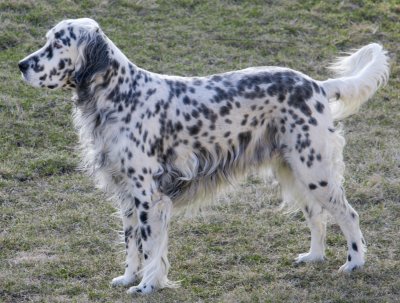
There are two distinct types of English Setter.
The original field/hunting type (sometimes called the "Llewellin Setter") is smaller, with a broader, natural-looking head and much less hair. These dogs have strong hunting instincts and need vigorous exercise.
The "bench" or "show" type of English Setter is quite tall, with a long narrow head and a profusion of silky hair that needs plenty of brushing and trimming. These dogs are more laid-back than field lines and are content with long daily walks and occasional running and fetching games.
Whatever their type, English Setters tend to be the mildest-mannered of the three setter breeds (English, Irish, and Gordon).
These very sociable dogs should not be left alone all day without the company of people or other pets, else barking and destructiveness may result.
English Setters have an obstinate streak that takes the form of resistance rather than wild disobedience. If pushed too hard, they'll simply brace their legs and refuse to walk. Your corrections must be persistent and consistent, but never heavy-handed.
English Setters have long memories, which means that once they learn something (whether right or wrong), they remember it. On the negative side, this means bad habits can be more difficult to break.
If you want a dog who...
- Is medium to large, elegant and graceful in build and motion
- Has a lovely feathered coat
- Is gentle with everyone – definitely not a guard dog
- Is peaceful with other animals
An English Setter may be right for you.
If you don't want to deal with...
- Providing enough exercise to keep him satisfied
- Exuberant jumping, especially when young
- "Separation anxiety" (destructiveness and barking) when left alone too much
- Stubbornness
- Slowness to housebreak
- Frequent brushing and combing
- Shedding
An English Setter may not be right for you.
 |
Dog Breed Traits – Which Traits Are Right For You? In this brand new series, I'll help you decide which dog breed traits would best suit you and your family, your home and yard, and your lifestyle, so you can choose the best dog breed for your family. |
Keep in mind that the inheritance of temperament is less predictable than the inheritance of physical traits such as size or shedding. Temperament and behavior are also shaped by raising and training.
FREE eBooks by Michele Welton
 "Respect Training for Puppies" and "Teach Your Dog 100 English Words" are free step by step guides to teaching your pup to be calm and well-behaved.
 "11 Things You Must Do Right To Keep Your Dog Healthy and Happy" is a free guide to keeping your dog mentally, physically, and emotionally happy and healthy so you can enjoy a longer lifetime of companionship.

- You can avoid some negative traits by choosing an ADULT dog from an animal shelter or rescue group. With an adult dog, you can easily see what you're getting, and plenty of adult English Setters have already proven themselves not to have negative characteristics.
- If you want a puppy, you can avoid some negative traits by choosing the right breeder and the right puppy.
More traits and characteristics of the English Setter
If I was considering an English Setter, I would be most concerned about...
- Providing enough exercise. English Setters bred for the show ring are content with long daily walks and occasional running and fetching games to vent their energy. English Setters bred for hunting are much more athletic and need more vigorous exercise. Without enough exercise, English Setters become rambunctious and bored, which they usually express by destructive chewing, especially when young or adolescent.
- Separation anxiety. More than most other breeds, English Setters need a great deal of companionship and do not like being left alone for more than a few hours. They tend to express their unhappiness through destructive chewing and barking. If you work all day, this is not the breed for you.
- Stubbornness. English Setters are sweet-natured but have a strong stubborn streak. You must show them, through absolute consistency, that you mean what you say. Read my free online training programs.
- Grooming. Coat care is a big responsibility in the English Setter. To keep the silky coat free of mats and tangles, English Setters require regular brushing and combing, and also clipping and trimming every few months. English Setters from show lines typically have more profuse coats that need much more extensive grooming than English Setters from field lines.
- Shedding. English Setters shed a lot, so be prepared for dog hair on your clothing and furniture, and regular vacuuming.
 About the author: Michele Welton has over 40 years of experience as a Dog Trainer, Dog Breed Consultant, and founder of three Dog Training Centers. An expert researcher and author of 15 books about dogs, she loves helping people choose, train, and care for their dogs.
My best-selling books – now available FREE on my website
 Respect Training For Puppies: 30 seconds to a calm, polite, well-behaved puppy is for puppies 2 to 18 months old. Your puppy will learn the 21 skills that all family dogs need to know. Click here to read for free.
 Teach Your Dog 100 English Words is a unique Vocabulary and Respect Training Program that will teach your adult dog to listen to you and do what you say. Click here to read for free.
 11 Things You Must Do Right To Keep Your Dog Healthy and Happy helps your dog live a longer, healthier life. Get my honest advice about all 11 Things before you bring home your new puppy, because some mistakes with early health care cannot be undone. Click here to read for free.
Related posts you might enjoy