
Doberman Pinschers: What's Good About 'Em, What's Bad About 'Em
Doberman Pinscher temperament, personality, training, behavior, pros and cons, advice, and information, by Michele Welton, Dog Trainer, Behavioral Consultant, Author of 15 Dog Books
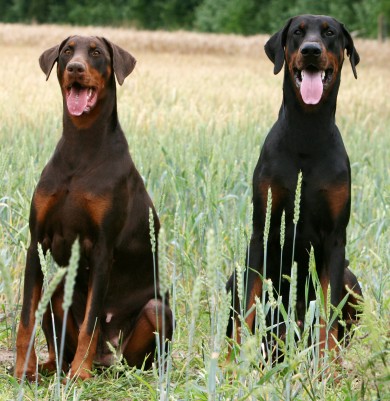
In most countries, this breed is called just plain Dobermann (with two n's, after the breeder's founder, Louis Dobermann). Only in the US and Canada is the name pinscher tacked on, as well as dropping one of the n's from Dobermann.
This athletic dog needs brisk walking every day and all-out running as often as possible. Too little exercise and too little companionship can lead to restlessness and other behavioral problems.
Mental exercise (advanced obedience, agility, tracking, Schutzhund) is just as important to this thinking breed.
Although some Doberman Pinschers are big ol' softies who love everyone, most are reserved with strangers and protective of their family. Early and extensive socialization is mandatory to avoid either shyness or sharpness.
Some Doberman Pinschers are dominant with other dogs. Some are confirmed cat chasers, while others love small animals.
Some excel in advanced obedience competition, while others are hardheaded and will test to find their place in the pecking order.
Calm, consistent leadership is a must, and obedience training must be upbeat and persuasive rather than heavy-handed. This breed is very sensitive and does not tolerate teasing or mischief.
If you want a dog who...
- Is large and strong, yet sleek- and elegant-looking
- Has a short easy-care coat
- Thrives on exercise, athletic activities, and challenging things to do
- Looks serious and imposing, so makes an effective deterrent even when friendly
A Doberman Pinscher may be right for you.
If you don't want to deal with...
- Providing enough exercise and activities to keep him satisfied
- Aggression, sharpness, or shyness when not socialized enough
- Possible aggression toward other animals
- Emotional sensitivity to stress and loud voices
- Physical sensitivity (tendency to react defensively when startled or mishandled)
- A multitude of serious health problems that can equate to a short lifespan
- Potential legal liabilities (public perception, future breed bans, insurance problems, increased chance of lawsuits)
A Doberman Pinscher may not be right for you.
 |
Dog Breed Traits – Which Traits Are Right For You? In this brand new series, I'll help you decide which dog breed traits would best suit you and your family, your home and yard, and your lifestyle, so you can choose the best dog breed for your family. |
Keep in mind that the inheritance of temperament is less predictable than the inheritance of physical traits such as size or shedding. Temperament and behavior are also shaped by raising and training.
FREE eBooks by Michele Welton
 "Respect Training for Puppies" and "Teach Your Dog 100 English Words" are free step by step guides to teaching your pup to be calm and well-behaved.
 "11 Things You Must Do Right To Keep Your Dog Healthy and Happy" is a free guide to keeping your dog mentally, physically, and emotionally happy and healthy so you can enjoy a longer lifetime of companionship.

- You can avoid some negative traits by choosing an ADULT dog from an animal shelter or rescue group. With an adult dog, you can easily see what you're getting, and plenty of adult Dobermans have already proven themselves not to have negative characteristics.
- If you want a puppy, you can avoid some negative traits by choosing the right breeder and the right puppy.
More traits and characteristics of the Doberman Pinscher
If I was considering a Doberman Pinscher, I would be most concerned about...
- Providing enough exercise and mental stimulation. Doberman Pinschers don't need tremendous running exercise. But they were bred to be working dogs, so they do need regular opportunities to vent their energy and do interesting things.
I always feel sorry when I meet a smart-as-a-whip Doberman Pinscher whose life consists of walks around the block and being let out into the yard. This is a waste of such a capable breed. To really provide the best life for a Doberman Pinscher, I recommend getting him involved in a canine activity where he can use his athletic skills and intelligent mind. Agility classes, for example. Or advanced obedience classes (not a basic beginners class, but ongoing classes). Or join a tracking or schutzhund club. The Doberman Pinscher was never intended to be just a casual pet.
- Providing enough socialization. Many Dobermann Pinschers have protective instincts toward strangers. They need extensive exposure to friendly people so they learn to recognize the normal behaviors of "good guys." Then they can recognize the difference when someone acts abnormally. Without careful socialization, they may be suspicious of everyone, which could lead to aggression. Some Dobermans go in the opposite direction – without enough socialization, they become fearful of strangers, which is very difficult to live with.
- Taking charge. In the right hands, Dobermans are very trainable. But they are observant dogs who can tell if you're a wishy-washy person. Doberman Pinschers need a confident owner. To teach your Doberman to listen to you, "Respect Training" is mandatory. Read my free online training programs.
- Potential animal aggression. Some Doberman Pinschers are dominant or aggressive toward other dogs of the same sex. Some Dobermans have strong instincts to chase and seize cats and other fleeing creatures. Being able to control your Doberman's behavior with other animals is another reason for a thorough respect training program.
- Emotional sensitivity. Be honest.... is there tension in your home? Are some family members likely to be loud or angry or emotional? Are there arguments? Doberman Pinschers are sensitive to stress and can end up literally sick to their stomachs, with digestive upsets and nervous behaviors, if the people in their home are having family problems.
A good Doberman is fine with their family's children. But some Dobermans may try to protect their own children from other children, even if the kids are simply roughhousing. More concerning is the number of Dobermans who are so sensitive that they become nervous and hyper-reactive with the loud voices and quick movements that children can't help making. So if you have children, you need to be extremely careful when evaluating Doberman Pinscher lines.
- Serious health problems. A heartbreaking number of Doberman Pinschers die of inherited heart disease and cancer before 7 years old. Read more about Doberman Pinscher Health.
- Legal liabilities. Doberman Pinschers may be targeted for "banning" in certain areas, or refusal of homeowner insurance policies. Your friends and neighbors may be uncomfortable around this breed. In this day and age, the legal liabilities of owning any breed that looks intimidating and has a history as a guard dog should be seriously considered. People are quicker to sue if such a dog does anything even remotely questionable.
Frankly, most Doberman Pinschers are "too much dog" for the average household. The breed is best suited in a calm household with experienced owners who are interested in participating in some sort of canine activity.
 About the author: Michele Welton has over 40 years of experience as a Dog Trainer, Dog Breed Consultant, and founder of three Dog Training Centers. An expert researcher and author of 15 books about dogs, she loves helping people choose, train, and care for their dogs.
My best-selling books – now available FREE on my website
 Respect Training For Puppies: 30 seconds to a calm, polite, well-behaved puppy is for puppies 2 to 18 months old. Your puppy will learn the 21 skills that all family dogs need to know. Click here to read for free.
 Teach Your Dog 100 English Words is a unique Vocabulary and Respect Training Program that will teach your adult dog to listen to you and do what you say. Click here to read for free.
 11 Things You Must Do Right To Keep Your Dog Healthy and Happy helps your dog live a longer, healthier life. Get my honest advice about all 11 Things before you bring home your new puppy, because some mistakes with early health care cannot be undone. Click here to read for free.
Related posts you might enjoy