
Coonhounds: What's Good About 'Em, What's Bad About 'Em
Coonhound temperament, personality, training, behavior, pros and cons, advice, and information, by Michele Welton, Dog Trainer, Behavioral Consultant, Author of 15 Dog Books
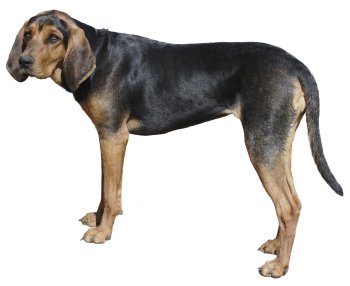
There are a number of coonhound breeds, the most popular being the Black and Tan Coonhound (pictured), Bluetick Coonhound, Redbone Coonhound, Plott Hound, Treeing Walker Coonhound, English Coonhound, and American Leopard Hound.
These dogs are first and fundamentally working dogs – they hunt large and small game. Though good-natured and easygoing, these hardy hounds are so in need of hard physical exercise that they belong with an owner who will take them hunting, jogging (on dirt or grass, not concrete), hiking, and/or swimming.
The problem with providing exercise is that, unless well-trained for hunting, it is a major risk to allow coonhounds off-leash. They are inveterate explorers who will follow their nose over hill, over dale, through the woods – and onto the highway. An enclosed dog park is probably your safest option.
When well-exercised, coonhounds are calm and undemanding dogs, apt to sprawl and snore in front of the fire. Without exercise, on the other hand, a coonhound can be a rambunctious handful.
Coonhounds get along very well with other dogs, though some can be dominant and pushy as they test each other for favorable positions in the pecking order.
Befitting their predator ancestry, coonhounds may stalk smaller pets, though they may get along fine with the family cat (as long as he doesn't run!).
It is in a coonhound's nature to constantly figure out ways to outwit his prey, so he often does the same with people. In other words, following commands blindly is not part of a coonhound's genetic makeup. Put yet another way.... coonhounds can be very stubborn! Consistent leadership is a must, and obedience training must be upbeat and persuasive (include occasional food rewards).
If you want a dog who...
- Is medium to large and about as athletic as you can get!
- Has a short easy-care coat
- Is energetic and loves to hunt and work outdoors
- When well-exercised, is easygoing and laid-back indoors
- Is good-natured with people and other dogs
A Coonhound may be right for you.
If you don't want to deal with...
- Vigorous exercise requirements
- Rowdiness and exuberant jumping, especially when young
- Destructiveness when bored or not exercised enough
- Strong instincts to chase other living creatures that run
- "Selective deafness" whenever his tremendous nose and exploratory instincts send him running after adventure
- Stubbornness
- LOUD baying
- Shedding and a houndy odor
A Coonhound may not be right for you.
 |
Dog Breed Traits – Which Traits Are Right For You? In this brand new series, I'll help you decide which dog breed traits would best suit you and your family, your home and yard, and your lifestyle, so you can choose the best dog breed for your family. |
Keep in mind that the inheritance of temperament is less predictable than the inheritance of physical traits such as size or shedding. Temperament and behavior are also shaped by raising and training.
FREE eBooks by Michele Welton
 "Respect Training for Puppies" and "Teach Your Dog 100 English Words" are free step by step guides to teaching your pup to be calm and well-behaved.
 "11 Things You Must Do Right To Keep Your Dog Healthy and Happy" is a free guide to keeping your dog mentally, physically, and emotionally happy and healthy so you can enjoy a longer lifetime of companionship.

- You can avoid some negative traits by choosing an ADULT dog from an animal shelter or rescue group. With an adult dog, you can easily see what you're getting, and plenty of adult Coonhounds have already proven themselves not to have negative characteristics.
- If you want a puppy, you can avoid some negative traits by choosing the right breeder and the right puppy.
More traits and characteristics of the Coonhound
If I was considering a Coonhound, I would be most concerned about...
- Providing enough exercise. These large hounds require plenty of running exercise. With enough exercise, Coonhounds are content to sprawl and sleep. Without such exercise, they will become rambunctious and bored, which they usually express by baying and destructive chewing. Bored Coonhounds are famous for chewing through drywall, ripping the stuffing out of sofas, and turning your yard into a moonscape of giant craters.
Coonhounds were never intended to be simply household pets. Their working behaviors (following scents, chasing things that run, exploring, baying) can be a nuisance in a normal household setting. Trying to suppress these "hardwired" behaviors, without providing alternate outlets for their energy, can be difficult and is not fair to the dog.
- Chasing smaller animals. As hunting hounds, Coonhounds have strong instincts to chase small fleeing creatures.
- Stubbornness. Again, as hunting hounds, Coonhounds are independent thinkers who don't particularly care about pleasing you. You must show them, through absolute consistency, that you mean what you say. Read my free online training programs.
- Noise. The deep voice of a Coonhound is extremely LOUD and carries a LONG way – it has to, so the hunter can locate him in the woods. But his baying will have your neighbors calling the cops to report the nuisance or quietly letting your Coonhound out of his yard so he'll wander away.
- Shedding and houndy odor. Coonhounds shed more than you might think for such a shorthaired dog. Also note that Coonhounds tend to have a strong "doggy" odor that some people find distasteful.
 About the author: Michele Welton has over 40 years of experience as a Dog Trainer, Dog Breed Consultant, and founder of three Dog Training Centers. An expert researcher and author of 15 books about dogs, she loves helping people choose, train, and care for their dogs.
My best-selling books – now available FREE on my website
 Respect Training For Puppies: 30 seconds to a calm, polite, well-behaved puppy is for puppies 2 to 18 months old. Your puppy will learn the 21 skills that all family dogs need to know. Click here to read for free.
 Teach Your Dog 100 English Words is a unique Vocabulary and Respect Training Program that will teach your adult dog to listen to you and do what you say. Click here to read for free.
 11 Things You Must Do Right To Keep Your Dog Healthy and Happy helps your dog live a longer, healthier life. Get my honest advice about all 11 Things before you bring home your new puppy, because some mistakes with early health care cannot be undone. Click here to read for free.
Related posts you might enjoy