
Briards: What's Good About 'Em, What's Bad About 'Em
Briard temperament, personality, training, behavior, pros and cons, advice, and information, by Michele Welton, Dog Trainer, Behavioral Consultant, Author of 15 Dog Books
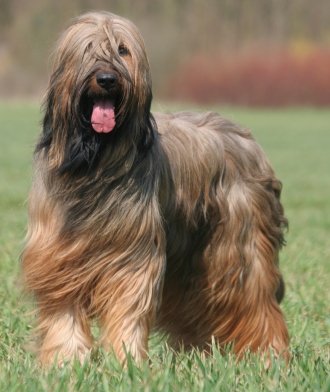
Vigorous and spirited in body, independent and purposeful in mind, the Briard can be serious ("a reserved philosopher") or a humorous clown.
His light, supple gait, like that of a large feline, has been described as "quicksilver," permitting him to make the springing starts, abrupt turns, and sudden stops required of a shepherd dog.
Athletic and agile under that long coat, the Briard needs some hard exercise each day. Mental exercise (herding, agility, tracking) is just as important to this thinking breed.
Matching his stern appearance, he is aloof and discriminating with strangers, keen-eyed and watchful. Socialization must be early and frequent so that his watchfulness does not shade into aggression or shyness. Spookiness is unfortunately present in some lines.
Most Briards are territorial with other animals, but usually good with the pets in their own family, if raised with them.
You should discourage his habit of poking or pushing people and other pets with his huge, powerful head in an attempt to keep them within boundaries.
Briards like to control situations and require a confident, consistent owner who knows how to lead.
However, they are very sensitive (sometimes overly so) and must be treated with a light hand. This breed has a long memory and doesn't easily forgive or forget harsh handling.
If you want a dog who...
- Is large and powerful – yet also quick-moving and agile
- Has a shaggy, tousled, rustic coat
- Thrives on vigorous athletic activities
- Is watchful and aloof with strangers
A Briard may be right for you.
If you don't want to deal with...
- Vigorous exercise requirements
- Rowdiness and exuberant jumping, especially when young
- Destructiveness when bored or not exercised enough
- Suspiciousness or fearfulness when not socialized enough
- Potential aggression toward other animals
- Stubbornness (mind of his own)
- Chasing and nipping at things that move: children, joggers, other animals, bikes
- Frequent brushing and combing – or regularly trimming the coat short
- "Shaggy dog syndrome," i.e. debris clinging to the coat, water soaking into the beard and dripping on your floors
- Waiting lists and a high price tag
A Briard may not be right for you.
 |
Dog Breed Traits – Which Traits Are Right For You? In this brand new series, I'll help you decide which dog breed traits would best suit you and your family, your home and yard, and your lifestyle, so you can choose the best dog breed for your family. |
Keep in mind that the inheritance of temperament is less predictable than the inheritance of physical traits such as size or shedding. Temperament and behavior are also shaped by raising and training.
FREE eBooks by Michele Welton
 "Respect Training for Puppies" and "Teach Your Dog 100 English Words" are free step by step guides to teaching your pup to be calm and well-behaved.
 "11 Things You Must Do Right To Keep Your Dog Healthy and Happy" is a free guide to keeping your dog mentally, physically, and emotionally happy and healthy so you can enjoy a longer lifetime of companionship.

- You can avoid some negative traits by choosing an ADULT dog from an animal shelter or rescue group. With an adult dog, you can easily see what you're getting, and plenty of adult Briards have already proven themselves not to have negative characteristics.
- If you want a puppy, you can avoid some negative traits by choosing the right breeder and the right puppy.
More traits and characteristics of the Briard
If I was considering a Briard, I would be most concerned about...
- Providing enough exercise and mental stimulation. Briards need regular opportunities to vent their energy and do interesting things. Otherwise they will become bored, which they may express by destructive chewing.
- Providing enough socialization. Standoffish by nature, Briards need extensive exposure to people and to unusual sights and sounds. Otherwise their natural caution can become shyness or suspiciousness, which are difficult to live with
- Potential animal aggression. Some Briards are dominant or aggressive toward other dogs of the same sex. Some are not good with cats – remember, these are herding dogs with strong instincts to chase.
- Stubbornness. Briards are capable of learning a great deal, but they can be stubborn and manipulative. You must show them, through absolute consistency, that you mean what you say. But Briards are also so sensitive that if you correct them too harshly, they may "shut down" and become even more resistant.
To teach your Briard to listen to you, I recommend "Respect Training." Read my free online training programs.
- "Shaggy dog syndrome." Without frequent brushing, Briards become a matted mess. Like all shaggy dogs, the Briard is a messy dog. Leaves, mud, snow, fecal matter, and other debris cling to his long wavy coat and ends up all over your house. When he drinks, his beard absorbs water, which drips on your floors when he walks away. When he eats, his beard absorbs food so that when he sniffs your face or presses his head against your leg, YOU end up dirty, too. Shaggy dogs are not suited to fastidious housekeepers.
But Briards don't need to be shaggy. You can shear or trim the coat so it's short, neat, and healthy. Problem solved!
- Finding one and paying the price. Not many Briard puppies are born each year and not many adults are available for adoption. Expect a long waiting list and a high price tag.
 About the author: Michele Welton has over 40 years of experience as a Dog Trainer, Dog Breed Consultant, and founder of three Dog Training Centers. An expert researcher and author of 15 books about dogs, she loves helping people choose, train, and care for their dogs.
My best-selling books – now available FREE on my website
 Respect Training For Puppies: 30 seconds to a calm, polite, well-behaved puppy is for puppies 2 to 18 months old. Your puppy will learn the 21 skills that all family dogs need to know. Click here to read for free.
 Teach Your Dog 100 English Words is a unique Vocabulary and Respect Training Program that will teach your adult dog to listen to you and do what you say. Click here to read for free.
 11 Things You Must Do Right To Keep Your Dog Healthy and Happy helps your dog live a longer, healthier life. Get my honest advice about all 11 Things before you bring home your new puppy, because some mistakes with early health care cannot be undone. Click here to read for free.
Related posts you might enjoy