
Boston Terriers: What's Good About 'Em, What's Bad About 'Em
Boston Terrier temperament, personality, training, behavior, pros and cons, advice, and information, by Michele Welton, Dog Trainer, Behavioral Consultant, Author of 15 Dog Books
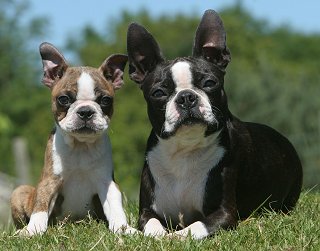
Boston Terriers are very individualistic: Some are high-spirited and clownish, while some are calm and dignified, even placid. Some are stubborn characters, while others are sweet and gentle.
But in general, the Boston Terrier is an altogether dapper and charming little dog. Playing games and chasing balls are (typically) two of his passions.
Seeking companionship is another, for the Boston always wants to be with his family. His large expressive eyes, attentively cocked head, and snorting and snuffling sounds bring out parental feelings in many people.
Extremely sensitive to his owner's moods, some Boston Terriers are one-person dogs, with a special affinity for the elderly. But many are outgoing with everyone, and even the ones who are a bit standoffish are polite. Yet he is a dependable watchdog who will let you know when someone is at the door.
Fine with other family pets, Boston Terriers may put on a blustery show upon spying a larger dog across the street, but they are seldom truly aggressive.
This breed is often a good choice for first-time owners – as long as you can deal with the health issues resulting from their unnaturally short face.
If you want a dog who...
- Is small yet sturdy – not a delicate lapdog
- Has large expressive eyes
- Has a sleek easy-care coat
- Is usually polite with everyone, including other pets
- Typically loves to play games and chase balls
A Boston Terrier may be right for you.
If you don't want to deal with...
- Snorting, snuffling, wheezing, snoring, some slobbering
- Gassiness (flatulence)
- Slowness to housebreak
- Many potential health problems due to his deformities
A Boston Terrier may not be right for you.
 |
Dog Breed Traits – Which Traits Are Right For You? In this brand new series, I'll help you decide which dog breed traits would best suit you and your family, your home and yard, and your lifestyle, so you can choose the best dog breed for your family. |
Keep in mind that the inheritance of temperament is less predictable than the inheritance of physical traits such as size or shedding. Temperament and behavior are also shaped by raising and training.
FREE eBooks by Michele Welton
 "Respect Training for Puppies" and "Teach Your Dog 100 English Words" are free step by step guides to teaching your pup to be calm and well-behaved.
 "11 Things You Must Do Right To Keep Your Dog Healthy and Happy" is a free guide to keeping your dog mentally, physically, and emotionally happy and healthy so you can enjoy a longer lifetime of companionship.

- You can avoid some negative traits by choosing an ADULT dog from an animal shelter or rescue group. With an adult dog, you can easily see what you're getting, and plenty of adult Bostons have already proven themselves not to have negative characteristics.
- If you want a puppy, you can avoid some negative traits by choosing the right breeder and the right puppy.
More traits and characteristics of Boston Terriers
If I was considering a Boston Terrier, I would be most concerned about...
- Health problems. Many Boston Terriers live a good long life. Unfortunately, breeders deliberately breed these dogs to be deformed, with a short face and domed head. As such, they suffer more than their share of health problems – not only with their breathing, but also eye diseases, epilepsy, cancer, joint diseases, heart disease, and more. See Boston Terrier Health.
- Boston Terrier "sounds". Most Boston Terriers snort, snuffle, wheeze, grunt, and snore loudly. The sounds are endearing to some people; nerve-wracking to others.
- Potential gassiness (flatulence). All short-faced breeds gulp air when they eat, and that air has to go somewhere, after all. However, commercial diets make flatulence worse by including hard-to-digest ingredients such as corn, soy, and other grains. Boston Terriers who are fed a heavily meat-based diet have much less trouble with gassiness.
- Potential slobbering. Boston Terriers with especially loose lips may slobber when they drink, or when they get overheated and need to pant heavily.
- Housebreaking. Bostons can be slow to pick up the concept of housebreaking. Expect several months of consistent crate training. Read more about housebreaking.
- Stubbornness. Most Boston Terriers are mildly stubborn. You must show them, through absolute consistency, that you mean what you say. Food is a great motivator with this breed, but too many cookies equals a fat Boston Terrier. Also you don't want a dog who only obeys when you're waving a biscuit at him!
Instead you should establish the right relationship between the two of you, where you are the leader and he is the follower. In other words, you must teach your Boston Terrier to respect you. Read my free online training programs.
 About the author: Michele Welton has over 40 years of experience as a Dog Trainer, Dog Breed Consultant, and founder of three Dog Training Centers. An expert researcher and author of 15 books about dogs, she loves helping people choose, train, and care for their dogs.
My best-selling books – now available FREE on my website
 Respect Training For Puppies: 30 seconds to a calm, polite, well-behaved puppy is for puppies 2 to 18 months old. Your puppy will learn the 21 skills that all family dogs need to know. Click here to read for free.
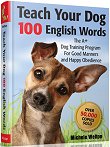 Teach Your Dog 100 English Words is a unique Vocabulary and Respect Training Program that will teach your adult dog to listen to you and do what you say. Click here to read for free.
 11 Things You Must Do Right To Keep Your Dog Healthy and Happy helps your dog live a longer, healthier life. Get my honest advice about all 11 Things before you bring home your new puppy, because some mistakes with early health care cannot be undone. Click here to read for free.
Related posts you might enjoy