
Border Collies: What's Good About 'Em, What's Bad About 'Em
Border Collie temperament, personality, training, behavior, pros and cons, advice, and information, by Michele Welton, Dog Trainer, Behavioral Consultant, Author of 15 Dog Books
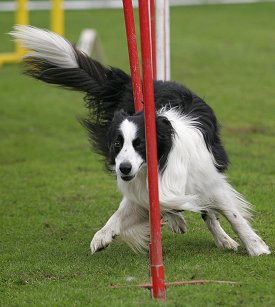
This working farm dog is famous for his intimidating "eye" – a fixed, hypnotic stare as he crouches low and creeps up on the sheep.
One of the most intelligent of all breeds, the Border Collie is also one of the most challenging to live with.
His superior intellect, combined with his intensity and obsessive zeal for working, are his most impressive features – and also the ones that make him unsuitable for most homes.
This sharp-eyed, quick-thinking, fanatical workaholic has been bred for endless miles of sprinting and stop-and-go action.
If it isn't possible for him to work livestock, you must substitute several LONG (45 minute) walks per day, plus off-leash romps in a safe area like a dog park. Plus fetching balls or frisbee. Plus weekly classes in advanced obedience or agility (obstacle course for dogs). Yes, this is a lot!
Without physical and mental stimulation, Border Collies become hyperactive and will drive you up the wall with obsessive and destructive behaviors as they seek creative outlets for their physical and mental energy.
High intelligence does mean they learn very quickly - but that includes learning how to do anything they set their minds to. They are master escape artists who can virtually pick the lock on your gate.
Trying to train a Border Collie, in fact, can be frustrating, because they are constantly thinking, analyzing, and reacting to every tiny movement you make. They can be a bit high-strung and oversensitive to sound and touch.
Border Collies are passionate gatherers of cars, bikes, joggers, cats, other dogs, livestock, deer, and running children – poking, pushing, and nipping if the pursued person or animal or object doesn't cooperate.
You must stay one step ahead of this challenging breed, and most households are simply not up to the task.
If you want a dog who...
- Is medium-sized and natural-looking
- Has a handsome, easy-groom coat
- Is very athletic and thrives on TONS of exercise and training
- Is exceptionally intelligent and versatile – when well-trained, can learn and do almost anything
- Will play fetch for hours and hours....
A Border Collie may be right for you.
If you don't want to deal with...
- An intense athlete who can drive you up the wall with obsessive and destructive behaviors if you don't provide lots of exercise and creative outlets for his energy
- Compulsive staring, chasing, poking, and nipping at things that move: children, other animals, joggers, bicylists
- Shyness when not socialized enough
A Border Collie may not be right for you.
 |
Dog Breed Traits – Which Traits Are Right For You? In this brand new series, I'll help you decide which dog breed traits would best suit you and your family, your home and yard, and your lifestyle, so you can choose the best dog breed for your family. |
Keep in mind that the inheritance of temperament is less predictable than the inheritance of physical traits such as size or shedding. Temperament and behavior are also shaped by raising and training.
FREE eBooks by Michele Welton
 "Respect Training for Puppies" and "Teach Your Dog 100 English Words" are free step by step guides to teaching your pup to be calm and well-behaved.
 "11 Things You Must Do Right To Keep Your Dog Healthy and Happy" is a free guide to keeping your dog mentally, physically, and emotionally happy and healthy so you can enjoy a longer lifetime of companionship.

- You can avoid some negative traits by choosing an ADULT dog from an animal shelter or rescue group. With an adult dog, you can easily see what you're getting, and plenty of adult Border Collies have already proven themselves not to have negative characteristics.
- If you want a puppy, you can avoid some negative traits by choosing the right breeder and the right puppy.
More traits and characteristics of the Border Collie
If I was considering a Border Collie, I would be most concerned about...
- Providing enough exercise and mental stimulation. Most Border Collies need many (very many) opportunities to vent their energy and to use their busy minds to do interesting things. I can't emphasize this enough. Otherwise you should expect to see chewed drywall and baseboards, the stuffing ripped out of sofas, escape attempts, and more.
Border Collies were never intended to be simply household pets. Get them involved in herding, or agility (obstacle course), or advanced obedience. Play frisbee with them. Throw their ball over and over and over. They must have physical outlets for their energy and mental outlets for their intelligent minds. Trying to suppress their "hardwired" working behaviors, without providing alternate outlets for their high energy level, is virtually impossible and not fair to the dog.
- Potential training problems. Border Collies are one of smartest breeds in the world and many individuals are eager to please and learn quickly. Yet many Border Collies are frustratingly difficult for the average person to train.
Some Border Collies use their intelligence to coax you into doing what they want – yes, they might out-think you! Some Border Collies are so sensitive that if your training techniques aren't close to perfect, they may freeze and "shut down." Some Border Collies are hyper-reactive to the slightest sound or movement you make; they are "anticipators" who keep trying to guess what comes next instead of paying attention to what you actually want. Read my free online training programs.
- Providing enough socialization. Standoffish by nature, Border Collies need extensive exposure to people and to unusual sights and sounds. Otherwise their natural caution can become shyness.
- Yard security. Quite a few Border Collies are brilliant escape artists. If you have one of these dogs, your fences should be 6-8 feet high, with wire sunk into the ground along the fence line to thwart digging. Gates should be extra-secure, as clever Border Collies can virtually pick the lock.
I hope you can see that most Border Collies are "far too much dog" for the average household. This is a dedicated working dog with a complex personality and special needs. It takes a lot of time and effort to keep this breed satisfied and well-behaved.
 About the author: Michele Welton has over 40 years of experience as a Dog Trainer, Dog Breed Consultant, and founder of three Dog Training Centers. An expert researcher and author of 15 books about dogs, she loves helping people choose, train, and care for their dogs.
My best-selling books – now available FREE on my website
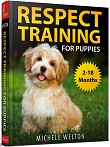 Respect Training For Puppies: 30 seconds to a calm, polite, well-behaved puppy is for puppies 2 to 18 months old. Your puppy will learn the 21 skills that all family dogs need to know. Click here to read for free.
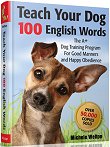 Teach Your Dog 100 English Words is a unique Vocabulary and Respect Training Program that will teach your adult dog to listen to you and do what you say. Click here to read for free.
 11 Things You Must Do Right To Keep Your Dog Healthy and Happy helps your dog live a longer, healthier life. Get my honest advice about all 11 Things before you bring home your new puppy, because some mistakes with early health care cannot be undone. Click here to read for free.
Related posts you might enjoy