
Alaskan Malamutes: What's Good About 'Em, What's Bad About 'Em
Alaskan Malamute temperament, personality, training, behavior, pros and cons, advice, and information, by Michele Welton, Dog Trainer, Behavioral Consultant, Author of 15 Dog Books
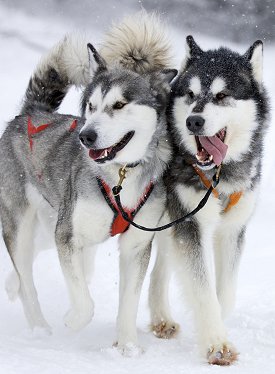
The rugged Alaskan Malamute is a working dog, best suited to people who love the great outdoors. He plays vigorously and is most content when pulling or packing a load (sledding, ski-joring, weight pulling, backpacking), especially in cold weather. This breed should not be kept in a hot climate.
Alaskan Malamutes are very challenging to train and live with. Without sufficient exercise and challenging things to do, Malamutes become rambunctious and bored, which they usually express by chronic howling and destructive chewing. Bored Alaskan Malamutes are famous for chewing through drywall, ripping the stuffing out of sofas, and turning your yard into a moonscape of giant craters.
Potential aggression toward other animals is a real concern. When this breed fights, the battles can be serious and bloody. The Alaskan Malamute can be so dominant toward other dogs of the same sex that two males or two females should not be kept together unless you are a very experienced owner.
Malamutes can be predatory with smaller pets. I would not keep a Malamute with a cat unless the pair has grown up together.
When outdoors, Malamutes must be securely confined behind a high fence, for they can be escape artists with strong exploratory instincts. Once loose, they won't come back when you call them and they may run deer and molest livestock.
On the other hand, Alaskan Malamutes are usually great with people. From their wolfish appearance, they may look like intimidating protectors, but most Mals are friendly with everyone and make miserable watchdogs.
Still, this is a substantial, powerful breed, so it is essential to socialize youngsters so they grow up to trust and respect people.
This self-reliant breed will test for position in the family pecking order. Unless you establish yourself as the leader (number one), he can be headstrong and demanding. Unneutered males, especially, can be very dominant and possessive of their food.
If you want a dog who...
- Is large, rugged, and furry, with a wolf-like appearance
- Loves the great outdoors and thrives on vigorous activities in cool climates
- Looks imposing, so makes an effective deterrent, yet is usually friendly with everyone
An Alaskan Malamute may be right for you.
If you don't want to deal with...
- Vigorous exercise requirements
- Rowdiness and exuberant jumping, especially when young
- Destructiveness and howling when bored or not exercised enough
- Aggression toward other animals
- Escaping from your yard in search of adventure
- Strong-willed mind of his own, requiring a confident owner who can take charge
- Extreme possessiveness of food – children and other animals should not approach an Alaskan Malamute who is eating
- Very heavy shedding
An Alaskan Malamute may not be right for you.
 |
Dog Breed Traits – Which Traits Are Right For You? In this brand new series, I'll help you decide which dog breed traits would best suit you and your family, your home and yard, and your lifestyle, so you can choose the best dog breed for your family. |
Keep in mind that the inheritance of temperament is less predictable than the inheritance of physical traits such as size or shedding. Temperament and behavior are also shaped by raising and training.
FREE eBooks by Michele Welton
 "Respect Training for Puppies" and "Teach Your Dog 100 English Words" are free step by step guides to teaching your pup to be calm and well-behaved.
 "11 Things You Must Do Right To Keep Your Dog Healthy and Happy" is a free guide to keeping your dog mentally, physically, and emotionally happy and healthy so you can enjoy a longer lifetime of companionship.

- You can avoid some negative traits by choosing an ADULT dog from an animal shelter or rescue group. With an adult dog, you can easily see what you're getting, and plenty of adult Alaskan Malamutes have already proven themselves not to have negative characteristics.
- If you want a puppy, you can avoid some negative traits by choosing the right breeder and the right puppy.
More traits and characteristics of the Alaskan Malamute
If I was considering an Alaskan Malamute, I would be most concerned about...
- Providing enough exercise. Alaskan Malamutes MUST have regular opportunities to vent their energy. Unless you specifically want a large, rugged dog for sledding, carting, weight-pulling, or other outdoor-related activities, preferably in a cold climate, I do not recommend this breed. Alaskan Malamutes were never intended to be simply pets. Trying to suppress their "hardwired" drive to work, without providing alternate outlets for their energy, can be difficult.
- Bounciness. Young Alaskan Malamutes (up to about two years old) can be bulls in a china shop. When they romp and jump, they do so with great vigor, and things can go flying, including people.
If you have small children, or if you or anyone who lives with you is elderly or infirm, I do not recommend Alaskan Malamute puppies. The temptation to play roughly is too strong in many young Alaskan Malamutes.
- Potential animal aggression. Most Alaskan Malamutes will not tolerate another dog of the same sex, and some won't tolerate the opposite sex either. Many Alaskan Malamutes have strong instincts to chase and seize cats and other fleeing creatures, including deer and livestock. If anything goes wrong in the breeding, socializing, training, handling, or management of this breed, it is capable of seriously injuring or killing other animals.
To keep your Alaskan Malamute in, and to keep other animals out, fences should be high, with wire sunk into the ground along the fence line to thwart digging. Gates should have the highest quality locks. Many Alaskan Malamutes are clever escape artists who will go over, under, or through fences in search of adventure.
- The strong temperament. Alaskan Malamutes have an independent mind of their own. They can be manipulative, willful, obstinate, and dominant (they want to be the boss) and will make you prove that you can make them do things. You must show them that you mean what you say. To teach your Malamute to listen to you, "Respect Training" is mandatory. Read my free online training programs.
- Heavy shedding. Alaskan Malamutes shed a LOT. You'll find hair and fur all over your clothing, upholstery, carpeting, under your furniture, on your countertops – even in your food. Heavy shedding is why some owners give their Malamute to the animal shelter or rescue group. So make sure you're really up for this.
- Potential noise. Unless you live way out in the boondocks and have no neighbors, Alaskan Malamutes should never be left outside in your yard, unsupervised. Their mournful howling will have your neighbors calling the cops to report the nuisance, or quietly letting your dog out of his yard so he'll disappear.
Frankly, most Alaskan Malamutes are "too much dog" for the average household. This is a serious working dog with tremendous strength. Very few people really have the knowledge, facilities, or skills necessary to manage this breed, or to provide the types of activities that keep him satisfied.
 About the author: Michele Welton has over 40 years of experience as a Dog Trainer, Dog Breed Consultant, and founder of three Dog Training Centers. An expert researcher and author of 15 books about dogs, she loves helping people choose, train, and care for their dogs.
My best-selling books – now available FREE on my website
 Respect Training For Puppies: 30 seconds to a calm, polite, well-behaved puppy is for puppies 2 to 18 months old. Your puppy will learn the 21 skills that all family dogs need to know. Click here to read for free.
 Teach Your Dog 100 English Words is a unique Vocabulary and Respect Training Program that will teach your adult dog to listen to you and do what you say. Click here to read for free.
 11 Things You Must Do Right To Keep Your Dog Healthy and Happy helps your dog live a longer, healthier life. Get my honest advice about all 11 Things before you bring home your new puppy, because some mistakes with early health care cannot be undone. Click here to read for free.
Related posts you might enjoy