
Puppy Training Schedule: What to Teach Puppies, and When
By Michele Welton, Dog Trainer, Breed Selection Consultant, Author of 15 Dog Books
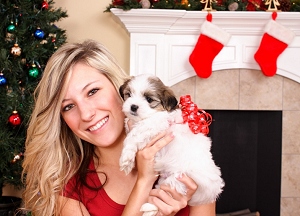
Puppy training starts the moment you bring your puppy home. Whatever he does, you must react properly or he will learn the wrong things.
We always anticipate the joys of all that's good about owning a puppy.
But often it doesn't work out as well as we'd hoped. Puppies are delightful bundles of energy and curiosity.... but they can also be exasperating and frustrating.
If you respond properly to everything the puppy does, the adjustment period will be much shorter and less stressful for both of you.
If you do not respond properly.... well, unfortunately that's why so many teenage dogs are turned over to rescue groups and animal shelters. Many well-meaning owners simply don't understand how to train a puppy, or when to start training a puppy.
So let's look at my puppy training schedule by age. I use this puppy training schedule with my own pups and with all of the pups in my training classes.
Starting at 7 weeks old....
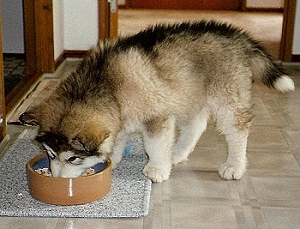
Routines are reassuring to puppies. For example, his food bowl should be placed in the same place every time he eats.
Teach your puppy the daily routines that will govern his life.
- Where his food and water dishes are located.
- What times of day he will eat.
- Where his bed is.
- What time he goes to bed.
- What time he will be taken out in the morning.
- Where he should go to the bathroom.
- Where his grooming spot is (for brushing, trimming, nail clipping, teeth cleaning).
Be consistent, consistent, consistent.
Dogs thrive on sameness, routines that are familiar, predictable, repeated. As much as possible, do the same things with your puppy every day – the same things in the same order, using the same words.
For example... here's a good mealtime routine:
- Cue your pup when you're ready to prepare his meal. "Are you hungry? Want your food?" Exaggerate the key words.
- Have him come with you to the kitchen. Get his bowl from the same cupboard and set it on the same counter every time. He should be right there watching you. You want him to see that YOU are the source of his food.
- If he's acting excitable, don't put his food down, else he'll learn that excitable behavior makes the food appear! If he's racing around, barking, or jumping, he should be on leash so you can stop those behaviors.
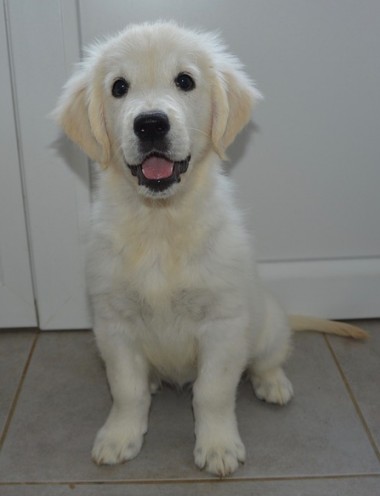
"Sit" before meals encourages calmness and patience – two valuable traits that will make other training much easier.
- When he is calm, the bowl is ready to go down. If he already knows how to sit, have him sit first – it's a subtle and gentle leadership thing. Then say "Okay!" and place the bowl on the floor, in the same spot every time. "Here's your food."
- If you have multiple dogs, each should have his own eating spot away from the others. Place the bowls down in the same order each time, saying the dog's name as his bowl goes down. "Buffy... here's your food. Kelly... food."
- During mealtime, don't let kids or other pets approach any dog who is eating. If one of your dogs is not well-behaved enough to obey this rule, he should be dragging his leash so you can get hold of him. If necessary, feed the dogs in separate crates or separate rooms. Bullying or stealing food is completely unacceptable in a multi-dog household.
- If a pup walks away from his bowl, pick it up. If there is still food left, make a mental or written note, as it could suggest illness.
- After 10 minutes, all the bowls should be picked up to avoid picky eating habits or food guarding habits to develop.
- The final part of the routine is a potty break immediately after every meal. If you're still housebreaking, take the pup out on leash. If he's already 100% housebroken and eliminates reliably when you send him out himself, that's fine. In either case, announce the potty break: "Do you need to go OUT? Time to go OUT."
As you can see, you're not only showing your puppy what YOU will do as part of the routine, you're also showing him what you expect HIM to do as his part of the routine.
Once your pup learns the routine for, say, meal time, if you do your part every time, he will do his part every time. Automatically. Day in and day out. Training a puppy goes very smoothly when you establish good routines starting the moment the pup joins your household.
The trick is to make sure the routines your puppy is learning are good ones that lead to good behavior.
Because if he learns bad routines, he will repeat them just as readily.
Most behavior problems in dogs are caused by the owner (inadvertently) teaching the pup bad routines.
Good routines should cover as many of the 24 hours in your pup's day as possible. You want a good routine for meal time, potty breaks, grooming, play time, bed time, getting up in the morning, and so on. I recommend the best routines for training puppies in my book, Respect Training For Puppies (available free on my website).
The easiest way to raise and train your puppy is to establish choreographed routines – same things, same order, same words – with yourself as the director, the one in charge. Create good routines, stick to them, and your pup's behavior will be predictable and good.
More things to teach your puppy starting at 7 weeks old
Along with establishing good routines....
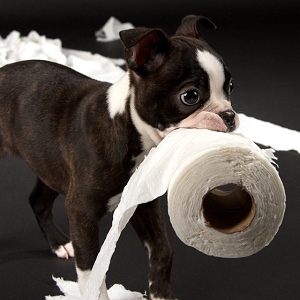
Teach Puppy which behaviors are allowed in your house and which behaviors aren't. This particular behavior would be a "No."
- Teach your puppy that "No" or "AH-AH" means "Stop doing that behavior."
- Teach your puppy that "Yes" or "Good" means "I like that behavior."
- Begin a proven housebreaking program where your puppy can only go to the bathroom in the right place.
At 2-3 months old, puppies are infants and won't have reliable control of their bladder for several months. (Tiny breeds are notoriously difficult to housebreak and take even longer.)
Still, housebreaking begins the day you bring your puppy home.
Establish the right pattern from the very beginning and Puppy will be housebroken as soon as his internal organs can cooperate.
But if you do it wrong, housebreaking will become a nightmare. And sadly, many owners don't realize they're doing something wrong until Puppy's "accidents" have become a bad habit.... and bad habits are hard to undo. So when training a puppy, you want to establish the right pattern from the very beginning.
There are several options for housebreaking, including using a crate, an exercise pen ("ex-pen"), a doggy door leading into a small potty yard, or a litter box (for tiny breeds).
You'll find detailed housebreaking directions in my free puppy training book (see bottom of page) – and yes, I cover each one of those housebreaking options so you can choose which one works best for your pup and your lifestyle.
- Teach your puppy to go into his crate or pen and to stay quietly when the door is closed.
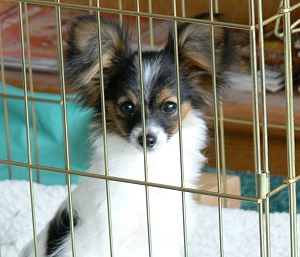
A crate protects your puppy from household dangers and is an invaluable aid in housebreaking.
Your puppy's crate is his safe and secure den.
Some people mistakenly refer to a crate as "doggie jail" but that is not the way Puppy will view his crate.
Oh, at first he might be unhappy to have his movements curtailed, but it won't be long at all before he goes into the crate on his own, to take a nap or just to get away from household activity.
For a new puppy, a crate helps with housebreaking and provides a safe den for sleeping.
When your puppy is used to his crate, it will be easy to take him visiting, or for trips in the car, or to the vet.
When we watch TV, we sit in our favorite chairs and our dogs typically choose to lie down in their crates (doors open), watching the same shows we watch (sort of).
Pups who are not yet housebroken should NOT be loose in your house. Unless you are interacting closely with him, your pup should be in a crate or pen, or connected to you via a leash.
The #1 mistake owners make when training puppies is giving them too much freedom in the house, too soon. Loose pups either get hurt or develop bad habits. For their own safety and to prevent future behavior problems, your puppy should not be loose in your house.
Starting at 8 weeks old....
Teach everything above (routines, housebreaking, crate training, Good, No), plus...
- Teach your puppy to be calm indoors. Pups who are allowed to be excitable indoors are far more likely to have behavior problems. Don't allow racing around the house, rushing the doorbell, attacking the vacuum cleaner, or lots of rough play, barking, or jumping.
- Teach your puppy to take food and toys gently from your hand. Don't let him have anything if he grabs at it.
- Teach your puppy NOT to mouth or nip at anyone's hands or feet.
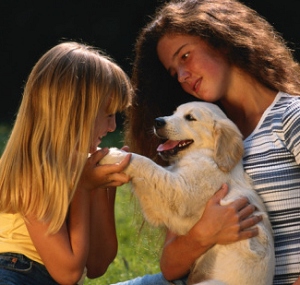
Teach your puppy to be gentle when interacting with people. He must not nip or chew on people's hands.
Puppy's mother (and siblings) began teaching gentleness by firmly correcting Puppy when he played too roughly.
Your job is to take over from where they left off and teach Puppy to restrain himself when he plays with humans. Puppies who nip and bite should be corrected.
Remember, YOU must be the one who sets the limits of ALL good and bad behaviors.
- Teach your puppy NOT to jump on anyone, including yourself.
- Teach your puppy to give or drop whatever is in his mouth when told.
- Teach your puppy to stay still (more or less!) and not fuss when you're brushing him, bathing him, clipping his nails, or brushing his teeth. Teach him to accept handling of any part of his body.
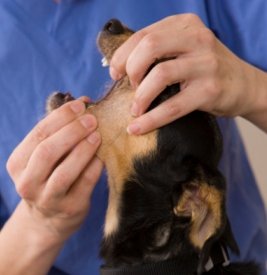
When to start training a puppy to accept handling? Immediately. Start handling your puppy immediately so he learns to accept anything you need to do with him.
Your puppy must accept YOU as the leader in your family. Being the leader simply means you are the one who decides what is okay for Puppy to do and what isn't okay.
For example.... brushing, bathing, clipping nails, cleaning teeth, giving a pill, putting on a collar or harness.
These are all times when YOU – not Puppy – have to be the one to decide what is necessary. Puppy should stand quietly for anything you need to do with him.
- Teach your puppy to respect the other pets in your family. He may not take anything away from another pet. He should "take turns" for treats and attention. No bickering, pestering, pushiness, or jealousy.
Starting at 10 weeks old....
Teach everything from the previous sections, plus...
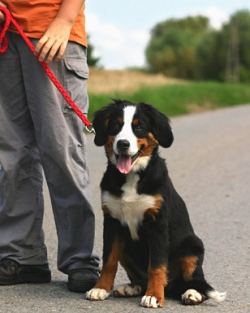
Older puppies are ready to start learning more advanced words after they are obeying basics such as "No." Don't jump ahead!
- Teach your puppy to walk on the leash without pulling. If your pup is currently pulling on the leash, don't take him for any more walks until you've first taught him to stop pulling inside your own home and yard.
- Teach your puppy to wait at open doors and gates until you give permission to go through.
- Teach your puppy to come every time you call. For now, that might mean keeping him on a leash in the house and a long cord in the yard, so you can make sure he comes.
- Teach your puppy to be quiet. Lots of barking makes dogs more excitable. Don't allow barking at harmless things such as your neighbor or your neighbor's dog. Certainly your pup can bark to alert you to something, but he should stop barking when told. He should be quiet when left home alone.
Starting at 12 weeks old....
Teach everything from the previous sections, plus...
- Teach your puppy to Sit and then to stay sitting until you cue him to get up.
- Teach your puppy to go to his dog bed when told, and to stay there until given permission to get up. This valuable exercise teaches calmness, impulse control, and physical and mental relaxation. Every pup should be able to do it.
Starting at 16 weeks old....
Teach everything from the previous sections, plus...
- Teach your puppy to go for a structured walk where he stays close beside you and pays close attention to you, instead of being distracted by everything else.
- Teach your puppy to greet people and other animals politely, or else ignore them. Don't allow him to act excitably, aggressively, or fearfully toward people or other dogs.
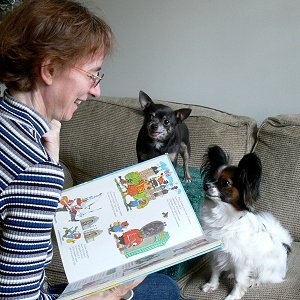
Before they're 6 months old, my pups know how to do everything in the lists above. They pay close attention to me and do whatever I ask of them.
If you're unsure about how to teach everything on my lists, it's all covered in my FREE puppy training book, Respect Training For Puppies (30 seconds to a calm, polite, well-behaved puppy).
Is your pup a little older?
You might be thinking, "But my pup's already 6 months old... what do I do now?"
Simple. Start at the very beginning, as though your 6 month old pup was only 7 weeks old. Start by establishing the routines that will govern everything in your pup's life. Start with housebreaking. Start with crate training. Start with "Good" and "No".
And if your pup is 12 months old? 18 months old? Or even older than that? Is there a separate dog training schedule that I use for adult dogs?
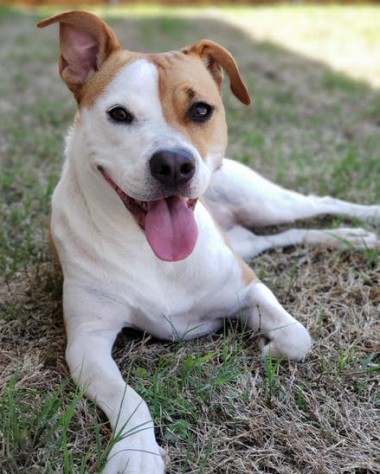
When I foster an older puppy or adult dog, I train him exactly as I would a younger pup – I start at the very beginning, with the basics.
You might think a puppy training schedule (or dog training schedule) should be different for a much older puppy or adult dog.... but it isn't.
Whether your pup is 3 months old, 6 months old, or 18+ months old, the order of training should start with the same routines, the same words, and the same respect training I've been talking about.
Namely.... daily routines, praise and correction words, crate training, housebreaking, acceptance of being handled, gentleness, and household rules.
So if your older puppy (or adult dog) is still mouthing on your hands, or barking back at you when you tell him to do something, or if he doesn't stop whatever he's doing when you say, "No", you need to double down on those basics. Only when he is solid on the foundational basics should you move on to more advanced stuff.
How to train your puppy
"But how?" you want to know. "How do I train my puppy?"
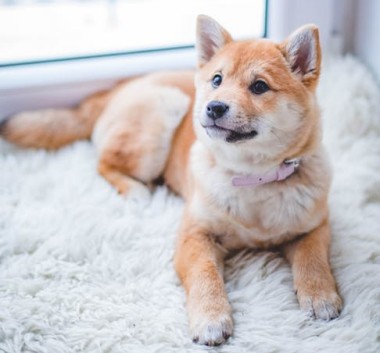
It's best to get this right the first time around, because Puppy won't ever be the same age again.
You get only one chance to teach all the right habits to a "clean slate" puppy. If you try to train your puppy without help, you will probably have to re-do the lessons, only this time with an older puppy with bad habits.
But what kind of help?
Don't sign up for an obedience class, a puppy training class, or a puppy socialization class to learn how to train your puppy. Those classes can be overwhelming for a puppy. Gentle pups can get over-run by bullies, which can completely ruin your pup's temperament. And excitable puppies just get more excitable in those classes.
I don't recommend taking any puppy to any group class. I never take my own pups to such classes. The risk is much too great.
Instead, puppy training should be done at home. I'll help you. My FREE puppy training book is called Respect Training for Puppies.
I'll show you my proven step-by-step training method for teaching your puppy all the words he needs to know, plus consistent household rules and routines, housebreaking, crate training, acceptance of being handled, calmness, gentleness, and general obedience training.
My puppy training method is:
- BASED ON LEADERSHIP AND RESPECT, which means you and your family are the leaders in your household and your pup is the follower. Dogs LOVE to be followers when you show them that you're a confident, consistent leader who makes all the decisions.
- BALANCED, which means positive reinforcement (praise and rewards) for good behaviors, and corrections for bad behaviors.
I don't recommend so-called "purely positive" methods that allow misbehaving pups to continue misbehaving, instead of teaching them which behaviors are and are not allowed. "Purely positive" is fine for teaching tricks and competition exercises.... but NOT for teaching the good behaviors all family dogs need to know, and NOT for stopping behavior problems such as barking, jumping, chewing, nipping, chasing, etc.
 About the author: Michele Welton has over 40 years of experience as a Dog Trainer, Dog Breed Consultant, and founder of three Dog Training Centers. An expert researcher and author of 15 books about dogs, she loves helping people choose, train, and care for their dogs.
My best-selling books – now available FREE on my website
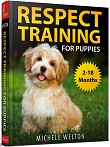 Respect Training For Puppies: 30 seconds to a calm, polite, well-behaved puppy is for puppies 2 to 18 months old. Your puppy will learn the 21 skills that all family dogs need to know. Click here to read for free.
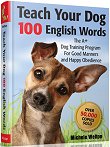 Teach Your Dog 100 English Words is a unique Vocabulary and Respect Training Program that will teach your adult dog to listen to you and do what you say. Click here to read for free.
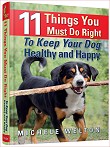 11 Things You Must Do Right To Keep Your Dog Healthy and Happy helps your dog live a longer, healthier life. Get my honest advice about all 11 Things before you bring home your new puppy, because some mistakes with early health care cannot be undone. Click here to read for free.