

Toy Poodle Health Care & Feeding
By Michele Welton, Dog Trainer, Breed Selection Consultant, Author of 15 Dog Books

Start your Toy Poodle off on the right foot by feeding the right food, giving the right vaccinations, finding the right vet, and if you're going to spay or neuter, don't do it too early.
Jump down to this list of
Toy Poodle Health Problems
Or check out my advice for raising a healthy Toy Poodle puppy or adult dog:
 Dog Health Care – The Sensible Way
Read my advice on daily health care so your Toy Poodle lives a long, healthy life and seldom needs to see the vet... [read more]
 3 Best Ways To Feed Your Dog Healthy Food
You can dramatically increase your dog's chances of living a long, healthy life by feeding the right food. Cutting right to the chase, the best foods for your Toy Poodle are... [read more]
 A Quick Way To Make Homemade Dog Food
Your Poodle will love real chicken, turkey, beef, fish, eggs, yogurt, broccoli.... this is not just "people food" and I'll tell you why... [read more]
 5 Best Kibble and Canned Dog Foods
Some are better than others, but I must be honest – I'm not a huge fan of dry or canned dog food. Here are my concerns... [read more]
 Vaccinations and Booster Shots: Needed or Not?
How many vaccinations does your Toy Poodle puppy really need? Does your adult dog need yearly booster shots? The vaccination guidelines have changed! Find out what some vets aren't telling you... [read more]
 Spaying Your Female Dog: Pros and Cons
Should your female Toy Poodle be spayed? Current research says, "The AGE at which you spay can be vitally important to your dog's future health." So what's the best age? [read more]
 Neutering Your Male Dog: Pros and Cons
Have you been told that you must neuter your male Poodle? Current research shows that the issue is not so simple. Pet owners are not being told about some risks associated with neutering male dogs, especially neutering too early... [read more]
 Make Sure Your Vet is the Best!
Is your current veterinarian really the best choice for your dog? Here's how to tell... [read more]
 Assisi Loop Review
Does your Poodle suffer from arthritis, hip dysplasia, disk disease, colitis? My honest review of a veterinary device you can use at home to reduce inflammation and pain. [read more]
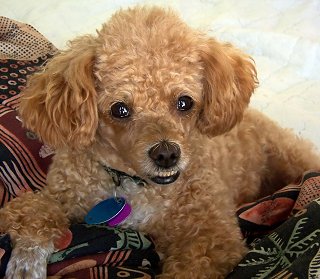
Complete list of Toy Poodle health problems
Eye diseases
Many Poodles are vision-impaired, sometimes completely, sometimes partially. So it's understandable that eye diseases are the major concern in this breed:
- At 3 to 5 years old, progressive retinal atrophy (PRA) can appear and always leads to blindness. Fortunately, there is a simple DNA test you can do to find out (without waiting for symptoms) whether your Poodle has inherited PRA, or not.
- Cataracts can appear at any time in a Toy Poodle. If they show up early (from birth to 3 years of age), they're usually going to be more severe, leading to blindness. Cataracts that show up after age 3 are usually milder.
- Other eye problems in Toy Poodles include tear duct disorders, corneal ulcers, glaucoma, eyelash abnormalities, and retinal dysplasia.
Orthopedic diseases
The most common orthopedic health problem in Toy Poodles is loose knee joints (luxating patella). Sometimes it's severe enough to require surgery, at about $1000 per knee.
Less common, but more serious, is Legg-Calve-Perthes disease, a degenerative hip disease.
Intervertebral disk disease is not uncommon in Toy Poodles, especially in individuals who have a deformity called chondrodysplasia that makes their legs short and their back long. But disk disease can also occur in Poodles with a normal square build.
Neurological diseases in Toy Poodles
Epilepsy (chronic seizures) is a growing concern in many dog breeds today, including Toy Poodles. Epilepsy usually shows up between 2 and 4 years of age and continues throughout the dog's life.
A rare neurological disease in Toy Poodles is called White Shaker Dog Syndrome. It's only called White because Maltese display this syndrome more often than any other breed; they happen to be white. Despite the name, it can occur in any Poodle color. Its symptoms are just like it sounds: full-body tremors. The theory is that it's a stress/excitement-related disorder.
Skin problems in Toy Poodles
It's ironic that Poodles are the best breed for allergic people.... yet Poodles are so prone to having chronic allergies themselves! Allergies cause itchy skin in Poodles, and constant scratching can break open the skin and lead to infections.
Poodles are notorious for having small skin growths peppered around their head and body.
- Fortunately, most growths in Poodles are non-tumorous warts and cysts. But they're a nuisance if you nick them with the grooming clippers and they bleed.
- Some are true tumors, especially sebaceous gland tumors and basal cell tumors. But again, fortunately, these are usually benign.
- Less commonly, a tumor may be malignant.
Ear problems in Toy Poodles
Ear infections and ear mites occur in Poodles more frequently than in most other breeds.
This is because breeders have created an abnormally long and narrow ear canal simply so the breed can look "elegant" in the show ring.
Here's how this abnormal ear canal provides such an inviting home for fungi and parasites.
- The long narrow tube traps wax, providing a sticky medium in which fungi can grow and parasites can feed.
- The folded ear flap blocks air from circulating and provides a dark, moist, dirty cave for fungi and parasites to hide.
- And the long hair inside the ears acts as a magnet for moisture, dirt, and wax.
- Result: ear infections or mites move right in.
Keep your Poodle's ears clean and dry. Remove wax and either pluck out the hair (painful) or trim it short (my preference).
Digestive diseases in Toy Poodles
Poodles are vulnerable to two serious digestive diseases: pancreatitis and hemorrhagic gastroenteritis.
Pancreatitis attacks are especially common in middle-aged female Poodles who are pudgy around the middle, who don't get a lot of exercise, and who suddenly eat something that's very high-fat (like turkey and gravy at Thanksgiving).
The moral is to keep middle-aged and elderly poodles slim and exercised. And DON'T suddenly give them a big mouthful of high-fat food when they're not used to it. No licking of people's plates with butter, oil, or gravy!
Heart and respiratory problems in Toy Poodles
Heart diseases in Toy Poodles includes mitral valve disease (MVD), patent ductus arteriosus, and septal defects.
MVD is the most common; indeed most Toy Poodles, as they age, will develop a mild heart murmur related to MVD. It's usually easy to manage with inexpensive medication.
Poodles are also prone to chronic bronchitis. This can be trickier to manage, often requiring both oral and inhaled medications.
Dental disease
Toy Poodles are very prone to dental disease. To avoid frequent (and risky) dental cleaning under anesthesia, keep their teeth well-brushed and scraped clear of tartar. When brushing, focus on the cheek side of the teeth. The tongue side usually stays clean.
Blood-clotting diseases in Toy Poodles
There are two: von Willebrand's and hemophilia A. Fortunately, a DNA test is available so you can find out at any time (without waiting for symptoms) whether your Poodle has inherited von Willebrand's disease, or not.
Hormonal/endocrine diseases
Most common in Toy Poodles are hypothyroidism, Cushing's disease, and diabetes.
Collapsing trachea
Some Toy Poodles have a collapsing trachea, a weakness in their tracheal tube (windpipe) that makes the tube collapse in on itself when the dog over-exerts himself.
That can trigger an episode of honking coughs or a bit of trouble breathing, until the tracheal tube puffs itself out to a normal cylinder again.
Collapsing trachea may be mild or severe, but it always worsens over time. Surgery is tricky and expensive and often doesn't work. So this disease is usually managed (for a while) with lifestyle changes and medications.
Another condition that causes a honking cough in Toy Poodles is called reverse sneezing, but this condition is harmless.
Hypoglycemia in Tiny Toys
Toy Poodle puppies, and also adults who weigh less than 4 pounds, are susceptible to hypoglycemia (low blood sugar). This should be treated immediately by administering a whacking dose of something sugary, like honey or Nutrical syrup.
An untreated hypoglycemic attack can result in coma and death.
Preventing health problems
Some health problems are inherited. For example, if your dog inherits from his parents the genes for an eye disease called PRA, he will go blind and there's nothing anyone can do about it.
 But most health problems can be prevented by the ways you raise your dog.
FREE eBOOK! My free online health care program, 11 Things You Must Do Right To Keep Your Dog Healthy and Happy shows you how to raise your Toy Poodle in all the right ways that help prevent health problems. Become your dog's health care champion!
 About the author: Michele Welton has over 40 years of experience as a Dog Trainer, Dog Breed Consultant, and founder of three Dog Training Centers. An expert researcher and author of 15 books about dogs, she loves helping people choose, train, and care for their dogs.
My best-selling books – now available FREE on my website
 Respect Training For Puppies: 30 seconds to a calm, polite, well-behaved puppy is for puppies 2 to 18 months old. Your puppy will learn the 21 skills that all family dogs need to know. Click here to read for free.
 Teach Your Dog 100 English Words is a unique Vocabulary and Respect Training Program that will teach your adult dog to listen to you and do what you say. Click here to read for free.11 Things You Must Do Right To Keep Your Dog Healthy and Happy helps your dog live a longer, healthier life. Get my honest advice about all 11 Things before you bring home your new puppy, because some mistakes with early health care cannot be undone. Click here to read for free.