
Teaching Your Dog To Respect You
By Michele Welton, Dog Trainer, Breed Selection Consultant, Author of 15 Dog Books

Frustrated dog owners often call or email me when their dog has behavior problems and needs training. Here is "Kathy" calling about "Jake."
I often get phone calls from distressed owners who are having trouble with their dog.
Let's listen in on a phone conversation between myself and a typical dog owner.... let's call her Kathy Armstrong.
Kathy: "Help me, Michele! My dog Jake is being difficult! I can't make him do anything. He only listens to me when he's in the mood!"
Me: "I see. Would you say Jake is behaving rudely?"
Kathy (surprised): "What do you mean? How can a dog be rude?"
Ah, how indeed! Let us count the ways!
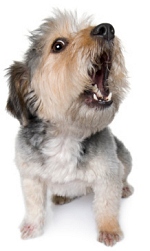
Talking back
Me: "Does Jake sass you when you tell him to do something? Does he bark back at you?"
Kathy: "Well, sometimes. If he doesn't want to do something."
Grumbling when annoyed
Me: "Does he ever growl at you when you wake him up? When you try to move him off his favorite chair? When you reach toward his toy to take it away? When you touch some "sensitive" part of his body, like his tail or paw?"
Kathy: "Yes, he does grumble sometimes. But he's just telling me not to bother him."

Hanging onto objects
Me: "Does he sometimes brace his legs and refuse to let go when you try to take something away from him?"
Kathy: "Yes, if it's something he wants to keep for himself."
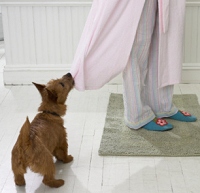
Pestering you
Me: "Does he frequently nudge or pester you for attention when you're trying to read the newspaper or when you talk on the phone or visit with guests?"
Kathy: "Yes, when I'm not paying attention to him."
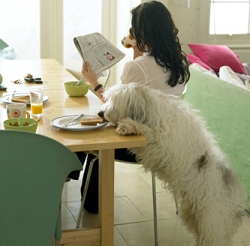
Stealing food
Me: "Does he ever steal food off your plate or off the kitchen counter when you leave it unattended? Does he get into the trash?"
Kathy:: "Um...."
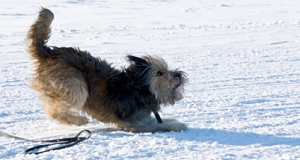
Staying just out of your reach
Me: "When you reach toward him, does he sometimes dart away from you, keeping just out of reach?"
Kathy: "Yes, he doesn't want to be caught."
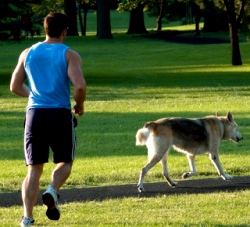
Running away from you
Me: "When you catch him doing something wrong, does he run from you? Does he lead you on a merry chase around the house or yard?"
Kathy:: "Uh-huh. So he can't be scolded. He doesn't always come back when I call him either, unless I have a cookie."
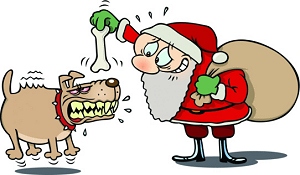
"Telling off" strangers or other dogs
Me: "Does Jake decide who's welcome in your home and who isn't? Does he bark at visitors even after you've let them in?"
Kathy: "Well, if he's excited....or if he doesn't like them...."
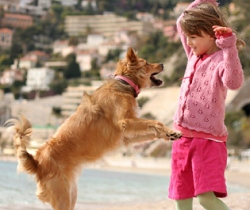
Jumping on people
Me: "Ah, and if he does like them, is he calm and polite? Or does he jump all over them?"
Silence. Then....
Kathy: "I'm beginning to see your point."
Me: "And you said he only obeys when he's in the mood.
Kathy (sighing): "You're right, Michele. Jake does do quite a few of those things. But are they really that bad?"
Why rude behaviors are bad
Me: "I'm afraid so. Those behaviors are disrespectful, you see. If a dog is allowed to do things that are rude and disrespectful, he starts believing that he is more in charge of his behavior than you are.
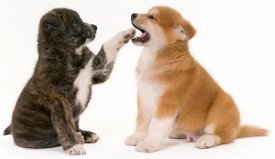
Even young puppies have an instinct to belong to a group and to sort out "Who's Who" in that group.
Dogs have an instinctive desire to belong to a social group – what we might call a family or pack. So when Jake joined your family, his instincts compelled him to seek out its structure:
- Who is the leader who sets the boundaries?
- Who are the followers who follow the leader?
 If you and your other family members don't establish yourselves as the leaders, Jake will assume that role himself."
Kathy (worried): "So dogs want to be in charge?"
Me: "No, the vast majority of dogs don't want to be leaders. They really, really don't want to be leaders. They're much happier as followers.
But a dog isn't comfortable in a world where no one seems to be in charge.
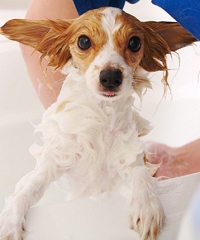
If your dog won't calmly "let" you bathe him, the relationship between the two of you needs to be changed.
So if you don't provide enough guidance and direction and set firm boundaries, if you feel guilty about saying "No" to Jake and making it stick.... well, then you'll see some of those "rude and disrespectful" behaviors as he makes his own decisions about what he wants to do, and not do. Since you haven't assumed the decision-making role, HE has to do it."
Kathy (anxiously): "But I don't want to rule over my dog. I just want him to be my friend."
Me: "But friends are equals, aren't they? Jake is your dependent. He depends on you for his health, his safety, his very life.
There are times when you need to do things with Jake that he doesn't understand and doesn't like.
For example, you might need to give medicine that tastes awful.... or take something dangerous out of his mouth..... or roll him onto his back so you can remove a tick from his belly.
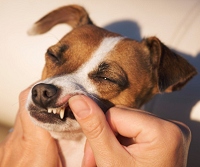
If your dog won't "let" you clean his teeth or take something out of his mouth, the relationship between the two of you needs to be changed.
Kathy: "Oh, that actually happened! He got a twig stuck between his teeth. He was trying to spit it out, but he wouldn't stay still so me or my husband could pull it out. We had to drive a half-hour to the vet's! Fifty dollars just because he wouldn't let us fiddle with his mouth for a few seconds."
Me: "Yes. Jake may be smart, but he can't understand the things that YOU understand. Instead he needs to have complete trust in you, so that when his leader says something is necessary.... then it's necessary, whether he "understands" or not. His understanding is not required – only his trust and acquiescence to whatever you say."
For your own peace of mind as your dog's guardian and caregiver, you must be able to restrain and handle him in any way you see fit, at any time you see fit.
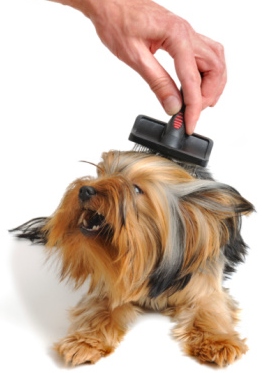
If your dog won't "let" you groom him, the relationship between the two of you needs to be changed.
So.... does your dog view you as his trusted leader?
- When visitors come to the door, does your dog bark a warning, but then look at you, expecting you to take over and handle the situation? That's trusting you as the leader. Or does he rush the door and pitch an ongoing fit, making his own decision about how to deal with this visitor?
- When you're ready to go for a walk and you open the door or gate, does your dog wait for your permission to go through? That's showing polite respect for you as the leader. Or does he lunge through the door or gate the moment it opens, oblivious to your presence at the other end of the leash?
- Does your dog walk nicely on a loose leash, glancing at you regularly to see which direction you want to go in? That's recognizing you as the leader. Or does he pull you around and make his own decisions to go left or right, fast or slow?
- When a stranger or a strange dog approaches, does your dog look at you, expecting you to handle the situation? That's trusting you as the leader. Or does he make his own decision to bark and pull and lunge at other people or other dogs?
You are your dog's guardian. Your relationship with him should be one where he is taught to look trustingly at you for guidance, direction, and permission. That's the relationship that every dog thrives on.
Kathy: "Are you sure he won't resent me for being in charge?"
Me: "He absolutely won't resent you. Dogs LOVE having someone to look up to. When your dog trusts you as the leader, he will behave beautifully for you – and also he'll feel happy and secure, because it's a great load off his shoulders."
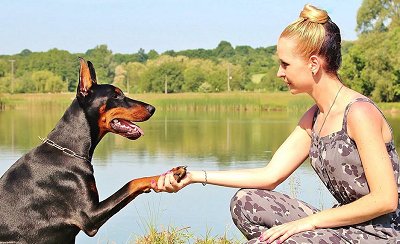
Five reasons dogs LOVE being followers
1. Follower dogs feel secure because they know someone else is in charge.
Your dog craves a leader who has everything under control. Then HE doesn't have to worry about trying to figure out our complicated world. Instead of feeling stressed as they struggle to control you and everything in their environment, they can relax and enjoy life while YOU handle all the decisions.
 2. Follower dogs feel secure because everyone likes them.
Since follower dogs are so willing to listen to you, it's easy to teach them good behaviors. Their positive behavior gets noticed and praised by other people. Dogs recognize smiles and appreciative tones of voice.
3. Follower dogs feel secure because they can go more places.
Well-behaved follower dogs are easy to bring along when you go visiting and are often allowed to remain in places where a dog causing a ruckus would be kicked out.
4. Follower dogs feel secure because they know the consequences of everything they do.
Follower dogs know which behaviors bring them praise, petting, and rewards, and which behaviors bring scolding. This clear distinction helps them make good choices of which behaviors to do, and which behaviors not to do.
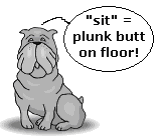 5. Follower dogs feel secure because they know what your "human sounds" mean.
Like anyone who learns a foreign language, dogs feel confident and empowered when they understand what you're saying.
Me: "Now...what dog wouldn't love all that?
Kathy: "Great! I'm really loving this idea! So how do I teach Jake to be a follower dog?"
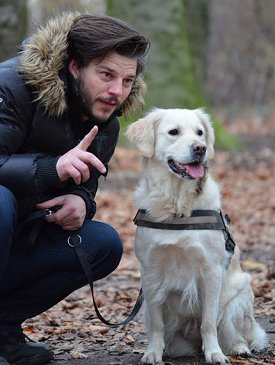
Your relationship with your dog should be one where he is taught to look trustingly at you for guidance, direction, and permission. That's the relationship that every dog thrives on.
How to teach your dog that you're the leader and he's the follower
Me: "You demonstrate leadership by interacting with your dog in specific ways – small actions that equal guidance and direction.
Whenever you do anything with your dog, even just walking through the kitchen, or petting him, or speaking to him.... he is busy judging your body language, your tone of voice, and how you respond when he does X or Y.
All of those seemingly little things are very important to your dog. They're the clues he uses to draw conclusions about you, and to decide whether you're worthy of respect or not.
I cover all the right ways to interact with your dog – and the wrong ways that you should avoid – in my training books. My training program is available free on my website. Scroll down to read it!
 About the author: Michele Welton has over 40 years of experience as a Dog Trainer, Dog Breed Consultant, and founder of three Dog Training Centers. An expert researcher and author of 15 books about dogs, she loves helping people choose, train, and care for their dogs.
My best-selling books – now available FREE on my website
 Respect Training For Puppies: 30 seconds to a calm, polite, well-behaved puppy is for puppies 2 to 18 months old. Your puppy will learn the 21 skills that all family dogs need to know. Click here to read for free.
 Teach Your Dog 100 English Words is a unique Vocabulary and Respect Training Program that will teach your adult dog to listen to you and do what you say. Click here to read for free.
 11 Things You Must Do Right To Keep Your Dog Healthy and Happy helps your dog live a longer, healthier life. Get my honest advice about all 11 Things before you bring home your new puppy, because some mistakes with early health care cannot be undone. Click here to read for free.