

How Long Do Dogs Live? (Dog Lifespan)
By Michele Welton, Dog Trainer, Breed Selection Consultant, Author of 15 Dog Books
Typical lifespan of small dogs

Maltese in a beautiful short clip that's easy to keep neat and clean.
Smaller dogs typically live to be 13 to 16 years old. Smaller dogs generally live longer than large dogs because they don't suffer as many serious skeletal and cardiovascular diseases as larger dogs do.
- The bones and joints of smaller dogs don't need to support as much weight, so don't break down as quickly.
- Their heart doesn't need to pump blood through a large body, so doesn't wear out as quickly.
- Smaller dogs have proportionately fewer "growth hormones" than larger dogs, and studies suggest that growth hormones may shorten life.
However...
Not all small breeds are long-lived. A few small breeds have serious health problems that shorten their life expectancy:

Cavaliers are so lovely... but so prone to heartbreaking health issues.
- The Pug, Pekingese, Shih Tzu, and Brussels Griffon are deliberately bred with deformities in their facial structure and respiratory system, making them vulnerable to many health problems.
- The Cavalier King Charles Spaniel and its cousin, the English Toy Spaniel, suffer from a severe form of inherited heart disease and two inherited neurological diseases. Many Cavaliers, especially, are lost in middle age to these devastating diseases.
- The Norwegian Lundehund suffers from severe inherited intestinal disorders that are embedded in the breed's gene pool.
Most other smallish dogs typically do enjoy a long life. However... they're not necessarily healthy throughout their longer life. On the contrary, many small breeds are vulnerable to a long list of health problems. It's just that their particular health problems tend to affect their QUALITY of life, rather than its length.
 Is there anything you can do to help your small dog live not only a long life, but a healthier life?
Yes! Read my free online health program to learn about keeping your small dog healthy and longer-lived.
Typical lifespan of giant dogs
Giant breeds, unfortunately, have short lifespans.
Giant breeds are rambunctious puppies/teenagers for their first three years. Then dignified adults for a couple of years.
Then their bones and joints break down, their heart weakens, or they develop cancer. Or all of the above.
Giant breeds are elderly at six or seven, and gone by age ten. Not all individuals, of course, but the majority.
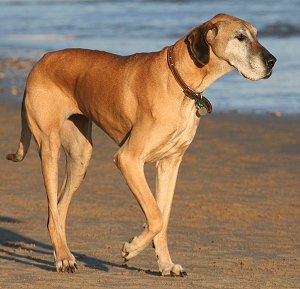
Great Danes are a short-lived breed: roughly 6-8 years, although some do live an extra year or two.
- The typical lifespan of an Irish Wolfhound is 6-8 years.
- Typical lifespan of an Old English Mastiff, Great Dane, Greater Swiss Mountain Dog, or Leonberger is 6-10 years.
- Typical lifespan of a Bloodhound or Bullmastiff is 7-9 years.
- Typical lifespan of a Dogue de Bordeaux, Newfoundland, or St. Bernard is 8-10 years.
- Typical lifespan of a Cane Corso, Great Pyrenees, Neapolitan Mastiff, or Scottish Deerhound is 8-11 years.
Is there anything you can do to help your giant dog live not only a long life, but a healthier life?
Yes! Read my free online health program to learn about keeping your giant dog healthy and longer-lived.
Typical lifespan of medium to large dogs
Most dogs in this size range live 10-13 years.
However...
In certain medium to large breeds, there are serious inherited health problems that can drastically shorten their lifespan. In these breeds, many dogs only live to 6 or 7 years old.
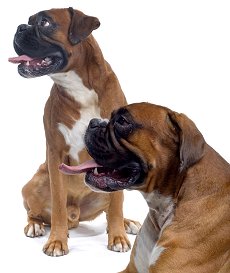
Most Boxers are high-energy youngsters, but sedate oldsters. Inherited cancers and heart diseases frequently cut their lives short.
- Akita – bloat (gastric torsion); autoimmune diseases; cancer
- Bernese Mountain Dog – inherited cancer
- Boxer – inherited cancers; inherited heart diseases
- Chinese Shar-Pei – inherited kidney disease
- Dalmatian – inherited urinary disease
- Doberman Pinscher – inherited heart disease
- Flat-Coated Retriever – inherited cancer
- German Shepherd – bloat (gastric torsion); severe joint diseases; autoimmune diseases
- Golden Retriever – inherited cancers; heart diseases
- Labrador Retriever – inherited cancers; heart diseases
- Rottweiler – cancer; autoimmune diseases; severe joint diseases; bloat (gastric torsion)
- Standard Poodle – autoimmune diseases; bloat (gastric torsion)
- Weimaraner – bloat (gastric torsion)
- Welsh Springer Spaniel – inherited epilepsy
- and others
Is there anything you can do to help your medium to large dog live not only a long life, but a healthier life?
Yes! Read my free online health program to learn about keeping your dog healthy and longer-lived.
To find a healthy dog and KEEP him healthy. . .
- You need to avoid GENETIC health problems. Your pup inherits some health problems from his parents. There are ways to tell whether a particular puppy is likely to have inherited a serious health problem, or not.
Make sure both parents of these puppies have all of the health certifications required for their breed. To find out what those should be, read my Dog Breed Reviews along with the Buying/Adopting pages of the breed you're interested in. That's where you'll find the health certifications the breeder should have done on the parents before breeding them.
For example:
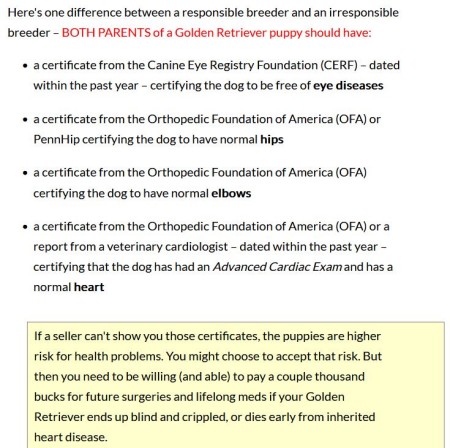
Would I buy a puppy whose parents don't have the required certifications? I would not. First, because I want the best chance of my pup growing up healthy. And second, because it's irresponsible to breed dogs without the appropriate health certifications, and I won't reward irresponsible breeders with my money; that just encourages them to keep on doing what they're doing.
- You need to avoid ENVIRONMENTAL health problems. Your dog's health is affected by everything he puts in his mouth, everything he breathes, everything you put into or onto his body...
.....in other words, virtually everything your dog comes in contact with can affect his health – for better or for worse.
If you want a long-lived and healthy dog, you need to know how to avoid all of these environmental risks. Start here.
 About the author: Michele Welton has over 40 years of experience as a Dog Trainer, Dog Breed Consultant, and founder of three Dog Training Centers. An expert researcher and author of 15 books about dogs, she loves helping people choose, train, and care for their dogs.
My best-selling books – now available FREE on my website
 Respect Training For Puppies: 30 seconds to a calm, polite, well-behaved puppy is for puppies 2 to 18 months old. Your puppy will learn the 21 skills that all family dogs need to know. Click here to read for free.
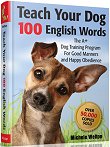 Teach Your Dog 100 English Words is a unique Vocabulary and Respect Training Program that will teach your adult dog to listen to you and do what you say. Click here to read for free.
 11 Things You Must Do Right To Keep Your Dog Healthy and Happy helps your dog live a longer, healthier life. Get my honest advice about all 11 Things before you bring home your new puppy, because some mistakes with early health care cannot be undone. Click here to read for free.