

The Truth About Mixed Breed Dogs
By Michele Welton, Dog Trainer, Breed Selection Consultant, Author of 15 Dog Books
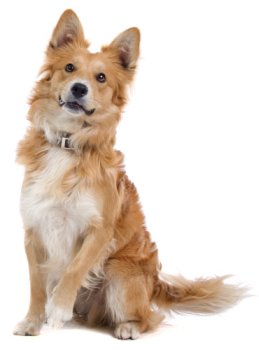
Would this lovely mixed breed dog be a good match for you?
On a website called yourpurebredpuppy, you might be surprised to see an article about mixed breed dogs.
But many people decide to get a purebred dog without considering whether a crossbreed or mixed breed might be better for them.
So I want to tell you the pros and cons of all three kinds of dogs. Then you can make an informed choice of which one is really best for you.
Hence my three articles:
The Truth About Crossbred Dogs
and the article you're reading right now:
The Truth About Mixed Breed Dogs
The most common question people ask me about mixed breed dogs is....
 "Can you look at a mixed breed dog and tell me which breeds he's a mix of?"
Unfortunately the answer is "No."
A mixed breed dog has inherited a jumble of genes (and thus a jumble of traits) from the various breeds in his heritage. There could be half a dozen breeds in his ancestry.
Simply by looking at him, there's no way to tell which of those genes and traits might have come from which breeds.
Let's consider a dog named Spot.
- If both of Spot's parents are purebred and the same breed, Spot is a purebred dog. Dalmatian + Dalmatian = Dalmatian.
- If both of Spot's parents are purebred but different breeds, Spot is a crossbred dog. Dalmatian + Boxer = Dalmatian/Boxer cross.
- If one of Spot's parents is purebred and the other is crossbred.... well, now it starts to get tricky. Dalmatian + Dalmatian/Boxer is still considered a crossbred dog because there are still only two breeds there. Even Dalmatian/Boxer + Dalmatian/Boxer is considered a crossbred dog since there are just two breeds contributing all of Spot's genes.
- But once you introduce a third or fourth breed, such as Dalmatian + Boxer/Poodle.... or Dalmatian/Collie + Boxer/Poodle.... well, now Spot is a mixed breed dog. Multiple breeds are contributing genes and traits, and there is no way to sort out which genes (and traits) might have come from which breed. And often there are more than three or four breeds.
People who look at a mixed breed dog, and then, based on appearance or "how the dog acts", declare which breed's genes are inside that dog, are simply guessing. There are too many possible breed- and gene-combinations.
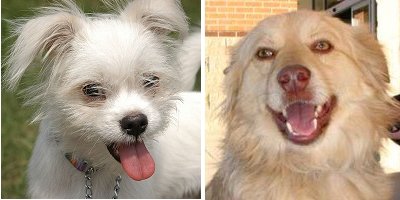
Mixed breed dogs are sometimes called mutts or mongrels. Their uniqueness makes them truly special!
There is one way to know which breeds make up your mixed breed dog.
You can have his DNA tested.
There are two veterinary companies online, Embark Vet and Wisdom Panel, that will test your dog's DNA and tell you which breed(s) are in his ancestry.
You can do this right from your own home. No vet visit. No blood tests.
These companies will mail you a little kit with cotton swabs, which you simply swirl inside your dog's cheek. His saliva contains his DNA. Mail the swabs back, and the company will tell you whether your dog is a crossbred or mixed breed, and which breeds are in his genetic make-up.
I think it's a lot of fun to find this out. You might believe that your dog is "mostly Lab" or "half shepherd" or "a poodle/terrier cross." Now you can find out whether you were right or wrong!
Does it help to know which breeds are "in" a mixed breed dog?
Let's say you've just gotten a mixed breed puppy. Will finding out his breed composition mean you can predict what he will grow up to look like or act like? Will it help you raise or train your dog?
No, not really. Because even if you know which breeds are in him, you don't know whether those individual DOGS were typical for their breed. There are many purebred dogs who don't look or act like their breed is supposed to.
For example, many Rottweilers love strangers. Many Pit Bulls love other dogs. Some Golden Retrievers are shy or aggressive instead of friendly. Some Chihuahuas weigh 15 pounds instead of 6 pounds. When these dogs produce puppies, their atypical genes and traits can be passed on – to your puppy.
So just because your mixed breed puppy "has pure breeds" in his ancestry doesn't tell you what those individual dogs were like. Therefore you don't know which genes and traits they had available to pass on.
Finally, since your puppy's ancestors include several different breeds, many of their genes will be conflicting. Suppose one of his breeds has genes for friendliness. Another has genes for standoffishness. Another has genes for aggression. When your puppy inherits a jumble of conflicting genes, you don't know which genes will "trump" the others, or which ones will blend together to form some intermediate result.
To paraphrase Forrest Gump, "A mixed breed puppy is like a box of chocolates. You never know what you're gonna get."
Mixed breed dogs do tend to have moderate temperaments
 The extremes of temperament and behavior often seen in purebreds are less common in mixed breeds. This is because many purebreds were specifically bred to be very energetic, or very independent, or to have strong chasing or barking or digging instincts. These traits helped the breed perform his work (herding, hunting, guarding, and so on).
Whereas in mixed breeds, extreme temperaments and behaviors are by happenstance rather than deliberate design.
In general, the temperament and behavior of a mixed breed tends to be more middle-of-the-road. They are often more flexible and may adjust to a greater variety of households and lifestyles.
 Potential negative: A mixed breed is not the best choice if you want a dog with specific skills, such as herding sheep, or hunting pheasants or rabbits. Doing a specific type of work is where purebreds (and some specific crossbreeds) excel.
Mixed breed dogs do tend to be healthier
Most mixed breed dogs have good genetic diversity. When parents are unrelated, their genes include a little of this and a little of that. Biologists tell us this is good for health. In fact, many serious health problems only occur when the same genes from related parents are paired up in their puppies. That happens a lot when you breed two purebreds together.
Left to her own devices (without the interference of breeders), Mother Nature tends to make dogs moderately sized (about 30 to 60 pounds) with natural builds. Mixed breeds are seldom 5 pounds or 120 pounds. They seldom have smooshed-in faces like Pugs. Or bodies as long as a Dachshund or as barrel-shaped as a Bulldog. All of these unnatural sizes and shapes and physical features are connected with serious health problems.
Potential negative: The parents of a mixed breed puppy have not been medically screened for inherited health problems. If you're looking for a purebred or crossbred dog and you search very carefully, you can find good breeders who have done the proper tests on the parents. Whereas with a mixed breed dog, you have to put your faith in his genetic diversity, rather than in medical testing.
Potential negative: Some mixed breed dogs are blends of purebreds that share similar health problems. This means the same bad genes could easily come over from both parents and pair up in their puppies.
For example, suppose a mixed breed puppy has Cocker Spaniel, Poodle, and Bichon Frise genes. Although he has much more genetic diversity than a purebred Cocker or Poodle, or Bichon, he could still inherit hip problems, knee problems, eye diseases, or chronic ear infections – because ALL of those breeds are prone to the same problems.
To sum up, a mixed breed dog can be a fine choice...
- if you're willing to accept whatever characteristics he grows up to have. Or if you adopt an adult so you can see what he already looks like and acts like.
- if you're willing to put your faith in his genetic diversity to help protect him against health problems, since neither of his parents was medically tested for them.
- if you don't want to pay a high purchase price.
- and if you like the idea of saving a life that no one else may want.
 About the author: Michele Welton has over 40 years of experience as a Dog Trainer, Dog Breed Consultant, and founder of three Dog Training Centers. An expert researcher and author of 15 books about dogs, she loves helping people choose, train, and care for their dogs.
My best-selling books – now available FREE on my website
 Respect Training For Puppies: 30 seconds to a calm, polite, well-behaved puppy is for puppies 2 to 18 months old. Your puppy will learn the 21 skills that all family dogs need to know. Click here to read for free.
 Teach Your Dog 100 English Words is a unique Vocabulary and Respect Training Program that will teach your adult dog to listen to you and do what you say. Click here to read for free.
 11 Things You Must Do Right To Keep Your Dog Healthy and Happy helps your dog live a longer, healthier life. Get my honest advice about all 11 Things before you bring home your new puppy, because some mistakes with early health care cannot be undone. Click here to read for free.