
Vizslas: What's Good About 'Em, What's Bad About 'Em
Vizsla temperament, personality, training, behavior, pros and cons, advice, and information, by Michele Welton, Dog Trainer, Behavioral Consultant, Author of 15 Dog Books
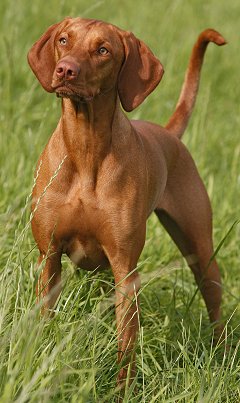
The AKC Standard calls the Vizsla "lively, gentle-mannered, demonstrably affectionate, and sensitive."
The good-natured Vizsla has also been called a "Velcro" dog because he is so tactile – he likes to attach himself to people, preferably in their laps.
Athletic, agile, and light on his feet, the Vizsla is a robust hunting dog who needs vigorous daily exercise and lots of personal attention. Too much confinement and too little companionship can lead to neurotic behaviors such as hyperactivity and destructiveness. Bored Vizslas are notorious chewers.
Most Vizslas get along well with everyone, including strangers and other animals, but they do need a lot of early socialization to build confidence. Some Vizslas are excitable and/or easily startled in new situations.
The Vizsla has the independent spirit of all pointing breeds, but responds to training more willingly than most and is a capable performer in advanced obedience competition. However, training can still be a bit challenging, especially training outdoors, because Vizslas are easily distracted. They find it difficult to pay attention to you in the presence of exciting sights, sounds, and smells.
You may need to control his tendency to mouth your hands – provide a box filled with toys so he can carry things around in his mouth.
If you want a dog who...
- Is medium-sized, sleek-coated, tautly-muscled, a true athlete
- Is packed with energy and thrives on vigorous exercise and athletic activities
- Responds to training more willingly than most pointing breeds
- Is gentle and sensitive, typically a "soft" dog
- Is very sociable and demonstrative with his family – likes to lean against you
- Is usually polite with everyone, including other animals
A Vizsla may be right for you.
If you don't want to deal with...
- Vigorous exercise requirements
- Exuberant jumping, especially when young or not exercised enough
- "Separation anxiety" (destructiveness and barking) when left alone too much
- Timidity in some lines, or when not socialized enough
- A distractable mind of his own – tends to ignore calls and commands when an interesting sight or scent catches his attention
A Vizsla may not be right for you.
 |
Dog Breed Traits – Which Traits Are Right For You? In this brand new series, I'll help you decide which dog breed traits would best suit you and your family, your home and yard, and your lifestyle, so you can choose the best dog breed for your family. |
Keep in mind that the inheritance of temperament is less predictable than the inheritance of physical traits such as size or shedding. Temperament and behavior are also shaped by raising and training.
FREE eBooks by Michele Welton
 "Respect Training for Puppies" and "Teach Your Dog 100 English Words" are free step by step guides to teaching your pup to be calm and well-behaved.
 "11 Things You Must Do Right To Keep Your Dog Healthy and Happy" is a free guide to keeping your dog mentally, physically, and emotionally happy and healthy so you can enjoy a longer lifetime of companionship.

- You can avoid some negative traits by choosing an ADULT dog from an animal shelter or rescue group. With an adult dog, you can easily see what you're getting, and plenty of adult Vizslas have already proven themselves not to have negative characteristics.
- If you want a puppy, you can avoid some negative traits by choosing the right breeder and the right puppy.
More traits and characteristics of the Vizsla
If I was considering a Vizsla, I would be most concerned about...
- Providing enough exercise. Vizslas are athletic dogs who need regular opportunities to vent their energy and gallop. Otherwise they will become rambunctious and bored, which dogs usually express by barking and destructive chewing. Bored Vizslas are famous for chewing through drywall, ripping the stuffing out of sofas, and turning your yard into a moonscape of giant craters.
If you simply want a pet for your family, and don't have the time or inclination to take your dog running or hiking or biking or swimming, or to get involved in hunting, or agility (obstacle course) classes, or advanced obedience, I do not recommend this breed (unless you adopt an older adult with a mellow temperament).
- Bounciness. Young Vizslas (up to about two years old) romp and jump with great vigor, and things can go flying, including small children and infirm people.
- Separation anxiety. More than most other breeds, Vizslas need a great deal of companionship and do not like being left alone for more than a few hours. They tend to express their unhappiness through destructive chewing and barking.
- Providing enough socialization. Vizslas need extensive exposure to people and to unusual sights and sounds. Otherwise their natural caution can become shyness, which is difficult to live with.
- Potential training difficulties. Vizslas are capable of learning a great deal. Yet they are not the easiest breed to train because most Vizslas are easily distracted by exciting sights, sounds, and scents. It takes some experience to hold the dog's attention throughout a training session. Follow my free online training programs.
- Health problems. Epileptic seizures are a major inherited problem in Vizslas. Also occurring are hip and eye disorders, bleeding disorders, skin diseases, and cancer. See Vizsla Health.
 About the author: Michele Welton has over 40 years of experience as a Dog Trainer, Dog Breed Consultant, and founder of three Dog Training Centers. An expert researcher and author of 15 books about dogs, she loves helping people choose, train, and care for their dogs.
My best-selling books – now available FREE on my website
 Respect Training For Puppies: 30 seconds to a calm, polite, well-behaved puppy is for puppies 2 to 18 months old. Your puppy will learn the 21 skills that all family dogs need to know. Click here to read for free.
 Teach Your Dog 100 English Words is a unique Vocabulary and Respect Training Program that will teach your adult dog to listen to you and do what you say. Click here to read for free.
 11 Things You Must Do Right To Keep Your Dog Healthy and Happy helps your dog live a longer, healthier life. Get my honest advice about all 11 Things before you bring home your new puppy, because some mistakes with early health care cannot be undone. Click here to read for free.
Related posts you might enjoy