
Toy Poodles: What's Good About 'Em, What's Bad About 'Em
Toy Poodle temperament, personality, training, behavior, pros and cons, advice, and information, by Michele Welton, Dog Trainer, Behavioral Consultant, Author of 15 Dog Books
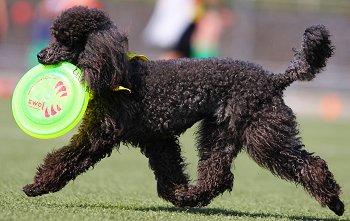
Many people have misconceptions about Poodles – that they look and act like "sissy" dogs.
That is one of the biggest myths in dogdom.
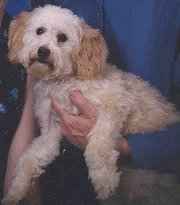 First, ignore the silly show-ring clips. Poodles can be clipped to look like normal dogs. See the pic of my cream Poodle, Buffy? It takes me 15 minutes every 6 weeks to run over her coat with a handheld clipper (#5 blade) and turn her into a shorthaired, normal-looking dog who is a snap to brush.
Poodles also have the advantage of being the lightest-shedding, most hypoallergenic of all coated breeds. If you have allergies, a Poodle is the safest breed for you.
Second, far from being sissy cushion-sitters, Toy Poodles are miniature athletes. They excel in advanced obedience competition, where retrieving and jumping skills are required, and in agility (obstacle course) competitions, where they fly over and under and through the obstacles with a strength and grace that is breathtaking to watch.
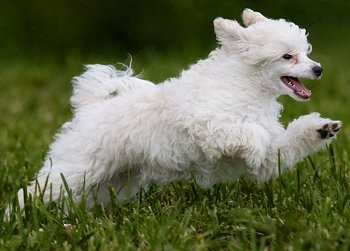
I do need to mention the two different builds, though. The correct build for the breed is "square", which means their legs are long enough that their height is approximately equal to their length. These Toy Poodles are both elegant and athletic, moving with a light, springy gait.
Other Toy Poodles are built lower to the ground, with short legs and a long back – these dogs have inherited a physical deformity called chondrodysplasia. They don't have the same elegance or agility as square Toy Poodles and they are more susceptible to disk disease. But of course they still make wonderful pets!
Whatever their build, a good Toy Poodle is one of the smartest and most trainable of all breeds. He is a "thinking" dog who pays rapt attention to his owner, learns quickly, and responds eagerly to positive training methods. Indeed, Toy Poodles NEED some sort of mental stimulation in order to be happy, even if it's just challenging games such as hide 'n seek, or fetching a variety of named toys. This intelligent breed cannot simply sit in the backyard and be ignored.
Most Toy Poodles make great watchdogs they will bark sharply at the door and they tend to be reserved (though polite and non-aggressive) with strangers. But there are also individuals like my dog Buffy, "who never met a stranger". In other words, she loves everyone!
With other dogs and cats, Toy Poodles are peaceful and accepting.
However, this breed is by no means perfect. Besides the regular clipping, they do need daily exercise, as they are lively dogs. And they do need a lot of daily companionship. They suffer from loneliness and separation anxiety if left alone too much.
Poodles also learn "patterns" so quickly that they tend to anticipate everything you're going to do next, which can be disconcerting. They expect their routines to always be the same, and they can get flustered if you change things.
Poodles are "soft" and sensitive dogs, sometimes hypersensitive. If you touch them unexpectedly or startle them with a sudden loud sound, they tend to flinch.
Similarly, Toy Poodles can get emotionally upset if there's too much activity or conflict or roughhousing in your household – they prefer peace and harmony.
You do have to watch your lines: some Toy Poodle lines are too high-strung and nervous, and this is where you'll find those neurotic Poodles that people scoff at. But much also depends on socialization and training – in other words, when brought out to experience the world and treated like an intelligent, capable fellow, he is likely to live up to these expectations.
However, Toy Poodles are not for children. Some Toy Poodles are such gentle souls they are overwhelmed by the roughhousing and mischief of small children, while others simply won't put up with it.
If you want a dog who...
- Is very small, light and graceful on his feet, athletic and agile
- Has a short curly coat that is virtually non-shedding (the best coated breed for allergy sufferers)
- Comes in a variety of colors
- Is lively and playful
- Is one of the brightest and most attentive of all breeds
- Is easy to train and housebreak
- Is usually polite with strangers and sociable with other animals
A Toy Poodle may be right for you.
If you don't want to deal with...
- Clipping the curly coat every six weeks
- A careful search to avoid high-strung, neurotic lines
- Timidity when not socialized enough
- Emotional sensitivity to stress, tension, and loud voices
- Barking
A Toy Poodle may not be right for you.
 |
Dog Breed Traits – Which Traits Are Right For You? In this brand new series, I'll help you decide which dog breed traits would best suit you and your family, your home and yard, and your lifestyle, so you can choose the best dog breed for your family. |
Keep in mind that the inheritance of temperament is less predictable than the inheritance of physical traits such as size or shedding. Temperament and behavior are also shaped by raising and training.
FREE eBooks by Michele Welton
 "Respect Training for Puppies" and "Teach Your Dog 100 English Words" are free step by step guides to teaching your pup to be calm and well-behaved.
 "11 Things You Must Do Right To Keep Your Dog Healthy and Happy" is a free guide to keeping your dog mentally, physically, and emotionally happy and healthy so you can enjoy a longer lifetime of companionship.

- You can avoid some negative traits by choosing an ADULT dog from an animal shelter or rescue group. With an adult dog, you can easily see what you're getting, and plenty of adult Toy Poodles have already proven themselves not to have negative characteristics.
- If you want a puppy, you can avoid some negative traits by choosing the right breeder and the right puppy.
More traits and characteristics of the Toy Poodle
If I was considering a Toy Poodle, I would be most concerned about...
- Grooming. A lot of people are attracted to Poodles because they're so light-shedding and hypoallergenic. But light shedding always comes with a trade-off. In the Poodle's case, it's the amount of clipping they require. To keep their curly coat short and free of mats, Toy Poodles require clipping every 4 to 6 weeks. Without fail.
Professional groomers will sculpture your poodle with a shaved face, a topknot on his head, and a pom pom on his tail. That's the frou-frou look that keeps so many people from choosing a poodle. Now, if you like that look, fine.
But if you don't like it, just take control of how the groomer clips your dog. Or learn how to do it yourself – it's really easy. See girl Buffy below. (She is a purebred poodle, but slightly larger than a Toy and slightly smaller than a Miniature.) Short coat, whiskery face, short ears, nothing shaved, no topknot or pompoms. Many people are surprised to find out that she's a Poodle. "She looks like a normal dog," they say. Works for me!

- Avoiding neurotic temperaments. Whenever a breed is common, many people breed them just to make some money, without having enough knowledge of how to produce healthy, stable dogs. As a result, obedience instructors and behavioral consultants, like myself, see lots of Poodles with neurotic behaviors, including hyperactivity and senseless barking. Obviously you want to avoid those dogs!
- Emotional sensitivity. Be honest... is there tension in your home? Are people loud or emotional? Toy Poodles are extremely sensitive to stress. They can end up sick to their stomachs, with digestive upsets and anxiety, if the people in their home are having family problems. Toy Poodles are peaceful, sensitive dogs who want a peaceful, harmonious home.
- Barking. Poodles are very observant. Even Poodles who love everyone will bark when they see or hear something unusual. In fact, they're often too quick to sound the alarm at every new sight and sound. You have to be equally quick to stop them. You can only do that if you have the right relationship with your dog, where you are the leader and he is the follower. In other words, your Toy Poodle must respect you. Fortunately this is very easy to do with Poodles. Follow my free online training programs.
- Health problems. Toy Poodles can live to 15 or 16 years old, but they're not always healthy during that time. Chronic Poodle issues include joint disorders, eye diseases, disk disease, and cardiac/bronchial diseases. Read more about Toy Poodle Health.
 About the author: Michele Welton has over 40 years of experience as a Dog Trainer, Dog Breed Consultant, and founder of three Dog Training Centers. An expert researcher and author of 15 books about dogs, she loves helping people choose, train, and care for their dogs.
My best-selling books – now available FREE on my website
 Respect Training For Puppies: 30 seconds to a calm, polite, well-behaved puppy is for puppies 2 to 18 months old. Your puppy will learn the 21 skills that all family dogs need to know. Click here to read for free.
 Teach Your Dog 100 English Words is a unique Vocabulary and Respect Training Program that will teach your adult dog to listen to you and do what you say. Click here to read for free.
 11 Things You Must Do Right To Keep Your Dog Healthy and Happy helps your dog live a longer, healthier life. Get my honest advice about all 11 Things before you bring home your new puppy, because some mistakes with early health care cannot be undone. Click here to read for free.
Related posts you might enjoy