
Tibetan Terriers: What's Good About 'Em, What's Bad About 'Em
Tibetan Terrier temperament, personality, training, behavior, pros and cons, advice, and information, by Michele Welton, Dog Trainer, Behavioral Consultant, Author of 15 Dog Books
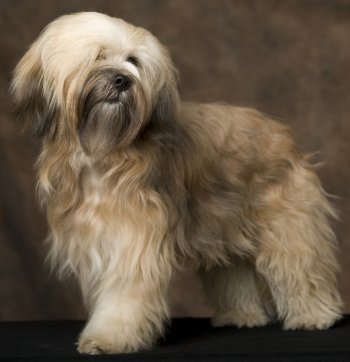
The good-natured Tibetan Terrier is lively and playful, yet also calm and low-key. He is a moderate dog in all respects and can adapt to any home, city or country, so long as he is given brisk daily walks and occasional romps in a safe enclosed area.
He especially enjoys playing in the snow, his large, flat, snowshoe-like feet providing traction, and his long heavy eyelashes protecting his eyes.
He is athletic and agile, a sure-footed climber, and a clever problem-solver who often uses his paws with great adeptness to open doors and hold toys.
Tibetan Terriers are family-oriented: they love to play games and participate in activities with their own people, but most are conservative with strangers. In some individuals, caution can shade into timidity or suspiciousness, so early socialization is important to develop a confident, outgoing temperament.
Most are amiable with other animals, though perhaps a bit bossy. Indeed, the Tibetan Terrier is very stubborn in general and must be shown from Day One that you are in control.
If you want a dog who...
- Is small to medium-sized, sturdy and shaggy, a natural-looking dog
- Is a moderate dog in all respects, being lively and playful at times, yet also calm and low-key
- Makes a good watchdog but is not aggressive with people
- Is usually amiable with other pets
A Tibetan Terrier may be right for you.
If you don't want to deal with...
- Suspiciousness or timidity when not socialized enough
- Stubbornness (mind of his own)
- Regular brushing and combing
- "Shaggy dog syndrome," i.e. debris clinging to the coat, water soaking into the beard and dripping on your floors
- Waiting lists (hard to find)
A Tibetan Terrier may not be right for you.
 |
Dog Breed Traits – Which Traits Are Right For You? In this brand new series, I'll help you decide which dog breed traits would best suit you and your family, your home and yard, and your lifestyle, so you can choose the best dog breed for your family. |
Keep in mind that the inheritance of temperament is less predictable than the inheritance of physical traits such as size or shedding. Temperament and behavior are also shaped by raising and training.
FREE eBooks by Michele Welton
 "Respect Training for Puppies" and "Teach Your Dog 100 English Words" are free step by step guides to teaching your pup to be calm and well-behaved.
 "11 Things You Must Do Right To Keep Your Dog Healthy and Happy" is a free guide to keeping your dog mentally, physically, and emotionally happy and healthy so you can enjoy a longer lifetime of companionship.

- You can avoid some negative traits by choosing an ADULT dog from an animal shelter or rescue group. With an adult dog, you can easily see what you're getting, and plenty of adult Tibetan Terriers have already proven themselves not to have negative characteristics.
- If you want a puppy, you can avoid some negative traits by choosing the right breeder and the right puppy.
More traits and characteristics of the Tibetan Terrier
If I was considering a Tibetan Terrier, I would be most concerned about...
- Stubbornness. Tibetan Terriers have an independent mind of their own and can be stubborn. You must show them, through absolute consistency, that you mean what you say.
In other words, you must teach your Tibetan Terrier to respect you. A dog who respects you will do what you say and will stop what he's doing when you tell him "No." Follow my free online training programs.
- Providing enough socialization. Standoffish by nature, Tibetan Terriers need extensive exposure to people and to unusual sights and sounds so that their natural caution doesn't become suspiciousness or shyness.
- Grooming. If you leave their coat long, Tibetan Terriers require a lot of brushing and combing (also trimming around their bathroom parts, for sanitary reasons). Consider trimming the coat short to make brushing a snap.
- "Shaggy dog syndrome." If you leave the coat long, you should expect leaves, snow, mud, and other debris to cling to it and end up all over your house. When a Tibetan Terrier drinks, his beard absorbs water, which drips on the floor when he walks away. When he eats, his beard absorbs food so that when he sniffs your face or presses his head against your leg, you end up dirty, too. Shaggy dogs are not suited to fastidious housekeepers.
- Shedding. Tibetan Terriers are often billed as "non-shedding" or "hypo-allergenic." Neither claim is true. Tibetan Terriers shed. But most of their shed hairs, instead of falling onto the floor, get caught in the long tousled coat. Whereas if you clip the coat short, that outer barrier is removed.
It's a trade-off, you see. A long coat means much more brushing and messiness, but less hair on your furniture, while a shorter coat means much less brushing and matting and tracked-in debris, but a few more shed hairs on your furniture.
- Finding one. This is not a common breed in the United States, so you should expect to go on a waiting list.
 About the author: Michele Welton has over 40 years of experience as a Dog Trainer, Dog Breed Consultant, and founder of three Dog Training Centers. An expert researcher and author of 15 books about dogs, she loves helping people choose, train, and care for their dogs.
My best-selling books – now available FREE on my website
 Respect Training For Puppies: 30 seconds to a calm, polite, well-behaved puppy is for puppies 2 to 18 months old. Your puppy will learn the 21 skills that all family dogs need to know. Click here to read for free.
 Teach Your Dog 100 English Words is a unique Vocabulary and Respect Training Program that will teach your adult dog to listen to you and do what you say. Click here to read for free.
 11 Things You Must Do Right To Keep Your Dog Healthy and Happy helps your dog live a longer, healthier life. Get my honest advice about all 11 Things before you bring home your new puppy, because some mistakes with early health care cannot be undone. Click here to read for free.
Related posts you might enjoy