
Tibetan Mastiffs: What's Good About 'Em, What's Bad About 'Em
Tibetan Mastiff temperament, personality, training, behavior, pros and cons, advice, and information, by Michele Welton, Dog Trainer, Behavioral Consultant, Author of 15 Dog Books
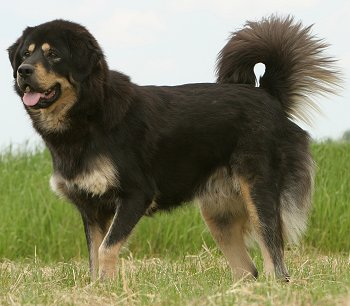
This powerful, rugged breed with the solemn expression is not inclined to play fetch or frisbee or frolic in the yard with you.
Indeed, the Tibetan Mastiff was developed strictly for working purposes, and his instincts to perform that work are ingrained. Livestock guardians bond with flock animals, as well as their own families, with fierce possessiveness, making their own decisions about who is a friend and who is a foe, what is a threat and what is not.
In other words, these strong-willed, self-reliant dogs will attempt to take control of every situation unless you are an assertive leader who demands respect.
The Tibetan Mastiff is serious and dignified, calm and quiet – unless provoked. Aloof with strangers, he will remain watchful every moment they are on his property. This breed is typically patient with his own children and other family pets, but requires careful introduction to those outside the family.
The Tibetan Mastiff often prefers to be outdoors where he can view and patrol his territory. However, despite his bulk, this breed is remarkably agile, skilled at climbing and jumping, and requires a six-foot-high fence. Tibetan Mastiffs also have a deep, impressive bark which they tend to use freely, especially at night when they are most attentive. And they sometimes dig deep holes to lie in.
All in all, most Tibetan Mastiffs are "too much dog" for the average household. Very few people really have the facilities or skills necessary to manage this breed and keep him happy.
If you want a dog who...
- Is large, rugged, and powerful, with a thick coat that comes in a variety of colors
- Has a solemn expression, carries himself with a dignified presence, and is not inclined to play fetch or Frisbee
- Is calm and quiet indoors (as an adult)
- Loves the great outdoors, especially in cold climates, and needs some room to romp
- Looks imposing, so makes an effective deterrent, but is not usually aggressive unless provoked
A Tibetan Mastiff may be right for you.
If you don't want to deal with...
- A large dog who takes up a lot of space in your house and car
- Protective instincts that are firmly ingrained, requiring ongoing socialization, supervision, and control to prevent excessive suspiciousness or aggression toward other people
- Aggression toward other animals
- Strong-willed mind of his own, requiring a confident owner who can take charge
- Barking
- Slobbering water
- Heavy shedding
A Tibetan Mastiff may not be right for you.
 |
Dog Breed Traits – Which Traits Are Right For You? In this brand new series, I'll help you decide which dog breed traits would best suit you and your family, your home and yard, and your lifestyle, so you can choose the best dog breed for your family. |
Keep in mind that the inheritance of temperament is less predictable than the inheritance of physical traits such as size or shedding. Temperament and behavior are also shaped by raising and training.
FREE eBooks by Michele Welton
 "Respect Training for Puppies" and "Teach Your Dog 100 English Words" are free step by step guides to teaching your pup to be calm and well-behaved.
 "11 Things You Must Do Right To Keep Your Dog Healthy and Happy" is a free guide to keeping your dog mentally, physically, and emotionally happy and healthy so you can enjoy a longer lifetime of companionship.

More traits and characteristics of the Tibetan Mastiff
If I was considering a Tibetan Mastiff, I would be most concerned about...
- Providing the proper balance of exercise. Young Tibetan Mastiffs need enough exercise to keep them lean and healthy, but not so much that their soft growing bones, joints, and ligaments become over-stressed and damaged. Adult Tibetan Mastiffs need more exercise to keep them in shape, but not in hot or humid weather for fear of overheating.
Since you have to minimize their exercise, young Tibetan Mastiffs can be very rambunctious. They will romp with uncoordinated gawkiness all over your house. You need to substitute extra quantities of companionship and supervision. Otherwise, left alone, young Tibetan Mastiffs become bored and destructive.
- Providing enough socialization. Tibetan Mastiffs have ingrained protective instincts and are very watchful with other people. They need extensive exposure to friendly people so they learn to recognize the normal behaviors of "good guys." Then they can recognize the difference when someone acts abnormally. Without careful socialization, they may be suspicious or fearful of everyone
- Animal aggression. Tibetan Mastiffs were bred to keep strange animals away from their flock and property. Some Tibetan Mastiffs will not tolerate another dog of the same sex, even in their own family, and some won't tolerate the opposite sex either. Many Tibetan Mastiffs have strong instincts to chase and seize cats and other fleeing creatures.
- The strong temperament. Tibetan Mastiffs are not Golden Retrievers. They have an independent mind of their own and are not pushovers to raise and train. Many Tibetan Mastiffs are willful and dominant (they want to be the boss) and will make you prove that you can make them do things. You must show them, through absolute consistency, that you mean what you say.
In other words, you must teach your Tibetan Mastiff to respect you. Follow my free online training programs.
- Barking. Tibetan Mastiffs have a deep booming bark which they use freely. Unless you live out in the boondocks with a flock of sheep, you should never leave this breed outside unsupervised. They will simply annoy everyone within earshot.
- Heavy shedding. Tibetan Mastiffs shed a lot. Make sure you're okay with this.
- Slobbering. Some Tibetan Mastiffs, especially those with loose jowls, tend to slobber or drool, especially after eating and drinking.
- Finding one. This breed is hard to find and quite expensive.
 About the author: Michele Welton has over 40 years of experience as a Dog Trainer, Dog Breed Consultant, and founder of three Dog Training Centers. An expert researcher and author of 15 books about dogs, she loves helping people choose, train, and care for their dogs.
My best-selling books – now available FREE on my website
 Respect Training For Puppies: 30 seconds to a calm, polite, well-behaved puppy is for puppies 2 to 18 months old. Your puppy will learn the 21 skills that all family dogs need to know. Click here to read for free.
 Teach Your Dog 100 English Words is a unique Vocabulary and Respect Training Program that will teach your adult dog to listen to you and do what you say. Click here to read for free.
 11 Things You Must Do Right To Keep Your Dog Healthy and Happy helps your dog live a longer, healthier life. Get my honest advice about all 11 Things before you bring home your new puppy, because some mistakes with early health care cannot be undone. Click here to read for free.
Related posts you might enjoy