
Soft-Coated Wheaten Terriers: What's Good About 'Em, What's Bad About 'Em
Soft-Coated Wheaten Terrier temperament, personality, training, behavior, pros and cons, advice, and information, by Michele Welton, Dog Trainer, Behavioral Consultant, Author of 15 Dog Books
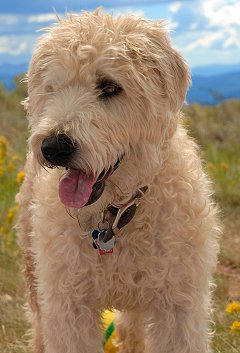
More congenial than most terriers, the Soft Coated Wheaten is cheerful, lively, and very sociable.....which means he needs a lot of daily companionship. Work all day? Don't get a Wheaten.
Wheatens are also known for their high energy – they play hard and vigorously and are renowned "bouncers" who jump up and down in attempts to lick your face. It sounds cute, but it can definitely get out of hand!
The Soft Coated Wheaten Terrier often acts like a joyful puppy throughout his life. Though he will bark to announce strangers, he welcomes them as long-lost friends, usually with exuberant barking, bouncing, and face kissing.
Early socialization is mandatory to develop this outgoing attitude, however. And training is necessary to control it! Indeed, this vigorous jumping can be very difficult to stop – it is one of the chief behavior issues of the breed.
Fences should be high and secure, as this breed is exploratory and athletic and may jump over to greet people on the other side, or to chase passing cats or squirrels.
There is some aggression with other dogs of the same sex; otherwise the Soft Coated Wheaten Terrier is usually gregarious with other family pets.
Bright and sensitive, yet spunky and headstrong, the Soft Coated Wheaten, like most terriers, is not particularly easy to train. He requires a leash at all times, else he will take off on you, and he requires an assertive owner who can set consistent rules and follow through.
If you want a dog who...
- Is medium-sized, sturdy, and athletic
- Has a tousled coat (in natural earthtone shades) that doesn't shed too much
- Is happy and cheerful
- Is energetic, plays vigorously, and acts like a joyful puppy throughout his life
- Barks to announce strangers, then welcomes them as long-lost friends
- Is usually sociable with other family pets
A Soft Coated Wheaten Terrier may be right for you.
If you don't want to deal with...
- The dynamic terrier temperament (see full description below)
- Providing enough exercise and activities to keep them busy
- Rowdiness and exuberant jumping
- "Separation anxiety" (destructiveness and barking) when left alone too much
- Potential aggression toward other animals – strong chasing instincts
- Stubbornness
- Digging holes
- Barking
- Regular brushing and clipping
- "Shaggy dog syndrome," i.e. debris clinging to the coat, water soaking into the beard and dripping on your floors
A Soft Coated Wheaten Terrier may not be right for you.
 |
Dog Breed Traits – Which Traits Are Right For You? In this brand new series, I'll help you decide which dog breed traits would best suit you and your family, your home and yard, and your lifestyle, so you can choose the best dog breed for your family. |
Keep in mind that the inheritance of temperament is less predictable than the inheritance of physical traits such as size or shedding. Temperament and behavior are also shaped by raising and training.
FREE eBooks by Michele Welton
 "Respect Training for Puppies" and "Teach Your Dog 100 English Words" are free step by step guides to teaching your pup to be calm and well-behaved.
 "11 Things You Must Do Right To Keep Your Dog Healthy and Happy" is a free guide to keeping your dog mentally, physically, and emotionally happy and healthy so you can enjoy a longer lifetime of companionship.

- You can avoid some negative traits by choosing an ADULT dog from an animal shelter or rescue group. With an adult dog, you can easily see what you're getting, and plenty of adult Wheatens have already proven themselves not to have negative characteristics.
- If you want a puppy, you can avoid some negative traits by choosing the right breeder and the right puppy.
More traits and characteristics of the Soft Coated Wheaten Terrier
If I was considering a Soft-Coated Wheaten Terrier, I would be most concerned about...
- The dynamic terrier temperament. Most terrier breeds are remarkably similar. The same words are used over and over – quick to bark, quick to chase, lively, bossy, clever, stubborn, persistent, impulsive. But some terrier breeds are more so or less so than others. Overall, as a breed, Soft-Coated Wheatens tend to be in the middle-to-upper section of the terrier spectrum. But of course there are some individuals who will be in the lower end – but if you want one of these, you should adopt an adult from a rescue group. With an adult dog, what you see is what you get.
- Providing regular exercise and mental stimulation. Soft Coated Wheaten Terriers are active go-getters. They require regular opportunities to vent their energy and do interesting things. Otherwise you will end up with a frustrated, bored Wheaten. Frustrated, bored Wheaten can make a shambles of your house and yard. The sport of dog agility can be great fun for high-energy Wheatens.
- Bounciness. Soft-Coated Wheaten Terriers romp and jump with great vigor, and things can go flying, including people. If you have small children, or if you or anyone who lives with you is elderly or infirm, I do not recommend Soft-Coated Wheatens.
Another reason I do not recommend Wheatens for small children is their general terrier "pride." Wheatens can be great fun for teenagers, but many individuals will not tolerate any nonsense and are quick to react to teasing and even to the normal clumsiness that comes with small children (accidental squeezing of their ears or pulling of whiskers or stepping on their paw). Many terriers are possessive of their food and toys and will defend these from all comers, including children.
- Separation anxiety. Soft Coated Wheaten Terriers need a great deal of companionship and do not like being left alone for more than a few hours. They tend to express their unhappiness through destructive chewing and barking. If you're gone much during the day, this is not the breed for you.
- Grooming. To keep their tousled coat free of mats, Soft-Coated Wheaten Terriers require regular brushing, and also trimming every few months. If you can't commit to the brushing, you should shear the coat short several times per year. It stays much cleaner and neater and looks great.
- "Shaggy dog syndrome." Like all shaggy dogs, the Soft-Coated Wheaten Terrier is a messy dog. Leaves, mud, snow, fecal matter, and other debris cling to his rough coat and ends up all over your house. When he drinks, his beard absorbs water, which drips on your floors when he walks away. When he eats, his beard absorbs food so that when he sniffs your face or presses his head against your leg, YOU end up dirty, too. Shaggy dogs are not suited to fastidious housekeepers unless you keep them clipped short.
- Animal aggression. Soft-Coated Wheaten Terriers are less scrappy toward other dogs than many other terrier breeds. But they are still a determined force to reckon with if they decide to initiate or accept a challenge to fight. Toward cats and other small running creatures, many Wheatens have chasing instincts. Some individuals go beyond chasing and will persistently hunt small creatures that run.
Remember that terriers should not be trusted off-leash. They may take off after anything that runs.
- Fence security. Soft Coated Wheaten Terriers are clever and agile dogs, and some individuals will go over or under fences in search of adventure. You may need higher fences than you might imagine for their moderate size.
- Barking. Like all terriers, Soft Coated Wheatens are often too quick to sound the alarm at every new sight and sound. You have to be equally quick to stop them.
- Mind of their own. Though more amenable to training than other terriers, Soft Coated Wheatens must still be taught at an early age that they are not the rulers of the world. The toughness that makes them suited to killing vermin can frustrate you when you try to teach them anything. You must show them, through absolute consistency, that you mean what you say.
In other words, you must teach your Wheaten Terrier to respect you. A dog who respects you will do what you say and will stop what he's doing when you tell him "No." Follow my free online training programs.
- Health problems. The greatest concerns in this breed are a serious digestive disease, two serious kidney diseases, and three eye diseases. Wheatens are also prone to allergic skin disorders and ear infections. Read more about Soft-Coated Wheaten Terrier Health.
 About the author: Michele Welton has over 40 years of experience as a Dog Trainer, Dog Breed Consultant, and founder of three Dog Training Centers. An expert researcher and author of 15 books about dogs, she loves helping people choose, train, and care for their dogs.
My best-selling books – now available FREE on my website
 Respect Training For Puppies: 30 seconds to a calm, polite, well-behaved puppy is for puppies 2 to 18 months old. Your puppy will learn the 21 skills that all family dogs need to know. Click here to read for free.
 Teach Your Dog 100 English Words is a unique Vocabulary and Respect Training Program that will teach your adult dog to listen to you and do what you say. Click here to read for free.
 11 Things You Must Do Right To Keep Your Dog Healthy and Happy helps your dog live a longer, healthier life. Get my honest advice about all 11 Things before you bring home your new puppy, because some mistakes with early health care cannot be undone. Click here to read for free.
Related posts you might enjoy