
Schipperkes: What's Good About 'Em, What's Bad About 'Em
Schipperke temperament, personality, training, behavior, pros and cons, advice, and information, by Michele Welton, Dog Trainer, Behavioral Consultant, Author of 15 Dog Books
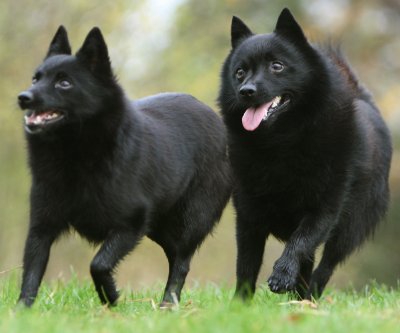
The AKC Standard describes the Schipperke as "questioning, mischievous, impudent... interested in everything around him."
Indeed, this is one of the most inquisitive and impulsive of all breeds. The Schipperke is busy, busy, busy and seldom walks when he can trot or scamper.
The Schipperke should always be kept on-leash (for he is an extremely fast, agile, independent chaser of anything that moves) or in a secure yard, preferably supervised, because his ingenuity and climbing/digging skills may send him over or under the fence.
Possessed of extraordinary senses and an inherent suspicion of strangers, the Schipperke sleeps lightly and makes a keen, vigilant watchdog. He is convinced that he is a big dog and may physically challenge an intruder foolish enough to ignore his sharp, penetrating bark.
With dogs and cats in his own family, he is usually fine. With strange pets who invade his domain, he can be scrappy. He has a high prey drive and is likely to harass small caged pets, and with his quick reflexes and light-footed agility, creatures that run won't get far.
This little rascal does best with owners who are firm, confident, and consistent. He has a marked stubborn streak, strong likes and dislikes, a mischievous sense of humor, and will take clever advantage if indulged.
Schipperkes are proud and sensitive and do not react kindly to being harshly handled or teased. Some can be hard to housebreak, and their barking must be kept under control.
If you want a dog who...
- Is unusual-looking: a small black dog with a foxy face, thick coat, rounded rump, and docked tail
- Is one of the most dynamic, intense, and curious of all breeds
- Is quick-moving and agile and thrives on athletic activites and interactive games
- Makes an extremely keen watchdog
- Is usually hardy and long-lived
A Schipperke may be right for you.
If you don't want to deal with...
- Very high activity level
- Destructiveness when bored or left alone too much
- Suspiciousness toward strangers
- Potential aggression toward other animals – strong chasing instincts
- Escape attempts and running away
- Strong-willed mind of his own, requiring a confident owner who can take charge
- Lots of barking
- Shedding
A Schipperke may not be right for you.
 |
Dog Breed Traits – Which Traits Are Right For You? In this brand new series, I'll help you decide which dog breed traits would best suit you and your family, your home and yard, and your lifestyle, so you can choose the best dog breed for your family. |
Keep in mind that the inheritance of temperament is less predictable than the inheritance of physical traits such as size or shedding. Temperament and behavior are also shaped by raising and training.
FREE eBooks by Michele Welton
 "Respect Training for Puppies" and "Teach Your Dog 100 English Words" are free step by step guides to teaching your pup to be calm and well-behaved.
 "11 Things You Must Do Right To Keep Your Dog Healthy and Happy" is a free guide to keeping your dog mentally, physically, and emotionally happy and healthy so you can enjoy a longer lifetime of companionship.

- You can avoid some negative traits by choosing an ADULT dog from an animal shelter or rescue group. With an adult dog, you can easily see what you're getting, and plenty of adult Schipperkes have already proven themselves not to have negative characteristics.
- If you want a puppy, you can avoid some negative traits by choosing the right breeder and the right puppy.
More traits and characteristics of the Schipperke
If I was considering a Schipperke, I would be most concerned about...
- Providing enough exercise and mental stimulation. Schipperkes may be small, but they are active go-getters who need regular opportunities to vent their energy. Otherwise they will become hyperactive and/or bored – which they usually express by barking and destructive chewing. I recommend that you get your Schipperke involved in agility classes (an obstacle course for dogs).
- Suspiciousness toward strangers. Standoffish by nature, Schipperkes need extensive exposure to people and to unusual sights and sounds. Otherwise their natural caution can become extreme suspiciousness, which is difficult to live with because it can morph into aggression or shyness.
- Animal aggression. Many Schipperkes are dominant (pushy) toward other dogs of the same sex. Some Schipperkes will chase and seize small fleeing creatures. This can make for conflict if you own a cat. It may be much worse than that if you own a pet rabbit or hamster!
- Running away from you. Most Schipperkes should not be trusted off-leash. They can take off, oblivious to your frantic shouts, after anything that runs.
- Fence security. Many Schipperkes are clever escape artists who will go over or under fences in search of adventure. To keep your Schipperke in, you may need higher fences than you might imagine for their small size. You may also need to sink wire into the ground along the fence line to thwart digging.
- The strong temperament. Schipperkes have an independent mind of their own and are not pushovers to raise and train. They can be manipulative, and many are willful and dominant (they want to be the boss) and will make you prove that you can make them do things. You must show them, through absolute consistency, that you mean what you say.
In other words, you must teach your Schipperke to respect you. A dog who respects you will do what you say and will stop what he's doing when you tell him "No." Follow my free online training programs.
- Barking. With their keen senses, Schipperkes are often too quick to sound the alarm at every new sight and sound. You have to be equally quick to stop them. This is not a breed to leave outside in your yard, upsupervised. To make matters worse, many Schipperkes have intense, high-pitched barks that can set your teeth on edge.
- Shedding. Schipperkes shed a goodly amount, mostly during the spring and fall, but in our climate-controlled houses, some hair comes out all through the year.
 About the author: Michele Welton has over 40 years of experience as a Dog Trainer, Dog Breed Consultant, and founder of three Dog Training Centers. An expert researcher and author of 15 books about dogs, she loves helping people choose, train, and care for their dogs.
My best-selling books – now available FREE on my website
 Respect Training For Puppies: 30 seconds to a calm, polite, well-behaved puppy is for puppies 2 to 18 months old. Your puppy will learn the 21 skills that all family dogs need to know. Click here to read for free.
 Teach Your Dog 100 English Words is a unique Vocabulary and Respect Training Program that will teach your adult dog to listen to you and do what you say. Click here to read for free.
 11 Things You Must Do Right To Keep Your Dog Healthy and Happy helps your dog live a longer, healthier life. Get my honest advice about all 11 Things before you bring home your new puppy, because some mistakes with early health care cannot be undone. Click here to read for free.
Related posts you might enjoy