
Salukis: What's Good About 'Em, What's Bad About 'Em
Saluki temperament, personality, training, behavior, pros and cons, advice, and information, by Michele Welton, Dog Trainer, Behavioral Consultant, Author of 15 Dog Books
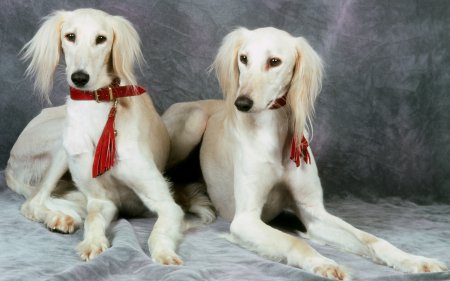
One of the swiftest and most graceful of all breeds, the aristocratic Saluki is possessed of a quiet dignity and independence.
Once past the destructive puppy stage, a Saluki is docile and quiet indoors, a creature of comfort who prefers soft beds and sofas on which he can lounge and survey his domain.
However, his fragile appearance is deceiving.... At full gallop he is so incredibly fast (up to forty-five miles per hour) and has such strong chasing instincts that he must not be let off-leash except in a safe, enclosed area. And he is an agile jumper, so fences should be at least six feet high.
Salukis are aloof (often cautious) with strangers and require early socialization to encourage a confident attitude.
Generally sociable with other dogs, a Saluki will pursue anything that runs, including small pets, and he can react with lightning reflexes.
The Saluki is an independent thinker, yet sensitive to correction, so he should be trained calmly and coaxed with food and games. However, this breed does need firm boundaries or he will take advantage.
Many sighthounds are touch-sensitive, tending to startle if touched unexpectedly and uncomfortable when cuddled excessively.
If you want a dog who...
- Is tall, slender, and elegant
- Has a soft easy-care coat that comes in many colors
- Is extremely athletic and graceful – can run swiftly and jump great heights
- Carries himself in a calm, dignified manner
- Is polite with people
- Doesn't bark much
A Saluki may be right for you.
If you don't want to deal with...
- Providing a safe enclosed area where he can gallop
- Shyness or suspiciousness when not socialized enough
- Emotional sensitivity to stress and abrupt changes in schedule
- Strong instincts to chase other living creatures that run
- Slowness to learn and an independent "what's in it for me?" attitude toward training – can be very stubborn
A Saluki may not be right for you.
 |
Dog Breed Traits – Which Traits Are Right For You? In this brand new series, I'll help you decide which dog breed traits would best suit you and your family, your home and yard, and your lifestyle, so you can choose the best dog breed for your family. |
Keep in mind that the inheritance of temperament is less predictable than the inheritance of physical traits such as size or shedding. Temperament and behavior are also shaped by raising and training.
FREE eBooks by Michele Welton
 "Respect Training for Puppies" and "Teach Your Dog 100 English Words" are free step by step guides to teaching your pup to be calm and well-behaved.
 "11 Things You Must Do Right To Keep Your Dog Healthy and Happy" is a free guide to keeping your dog mentally, physically, and emotionally happy and healthy so you can enjoy a longer lifetime of companionship.

More traits and characteristics of the Saluki
If I was considering a Saluki, I would be most concerned about...
- Providing enough running exercise in a safe area. Salukis don't need miles of running, but they do need regular opportunities to vent their energy through all-out galloping a few times a week. Otherwise they will become bored, which they usually express by destructive chewing.
Salukis need access to a large fenced area – fenced because these independent dogs are likely to take off and not come back. If there is a dog club in your area, get your Saluki involved in lure coursing (chasing a mechanized lure around a track or across an open field). This is an appropriate outlet for the full-speed galloping behaviors that are "hardwired" into his genes.
- Providing enough socialization. Standoffish by nature, Salukis need extensive exposure to people and to unusual sights and sounds. Otherwise their natural caution can become skittishness and timidity, which are difficult to live with.
- Chasing other animals. Most people do not realize just how fast and agile sighthounds are, or how strong their instincts are to chase and seize other creatures that run. A Saluki can seriously injure or kill your neighbor's cat or toy dog. You must take great care to supervise and control your sighthound around smaller animals.
- Emotional sensitivity. Be honest.... is there tension in your home? Are people loud or angry or emotional? Salukis are extremely sensitive to stress and can end up literally sick to their stomachs, with severe digestive upsets and neurotic behaviors, if the people in their home are having family problems. Sighthounds are peaceful, sensitive dogs who need a peaceful, harmonious home.
- The independent temperament. Like all sighthounds, Salukis are not eager to please you. They are independent thinkers who look out for their own best interests. Most Salukis are stubborn and can be manipulative. You must show them, through absolute consistency, that you mean what you say.
In other words, you must teach your Saluki to respect you. A dog who respects you will do what you say and will stop what he's doing when you tell him "No." Follow my free online training programs.
 About the author: Michele Welton has over 40 years of experience as a Dog Trainer, Dog Breed Consultant, and founder of three Dog Training Centers. An expert researcher and author of 15 books about dogs, she loves helping people choose, train, and care for their dogs.
My best-selling books – now available FREE on my website
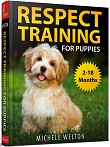 Respect Training For Puppies: 30 seconds to a calm, polite, well-behaved puppy is for puppies 2 to 18 months old. Your puppy will learn the 21 skills that all family dogs need to know. Click here to read for free.
 Teach Your Dog 100 English Words is a unique Vocabulary and Respect Training Program that will teach your adult dog to listen to you and do what you say. Click here to read for free.
 11 Things You Must Do Right To Keep Your Dog Healthy and Happy helps your dog live a longer, healthier life. Get my honest advice about all 11 Things before you bring home your new puppy, because some mistakes with early health care cannot be undone. Click here to read for free.
Related posts you might enjoy