
Rhodesian Ridgebacks: What's Good About 'Em, What's Bad About 'Em
Rhodesian Ridgeback temperament, personality, training, behavior, pros and cons, advice, and information, by Michele Welton, Dog Trainer, Behavioral Consultant, Author of 15 Dog Books
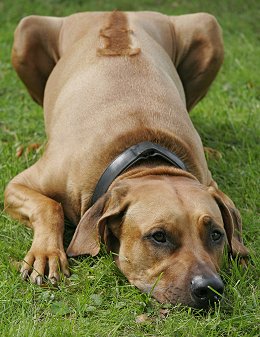
This dignified, muscular dog, a combination of scenthound and sighthound, needs brisk walking every day and the chance to run as often as possible.
This is not a breed to sit quietly in your house or yard all day. Young Rhodesian Ridgebacks are especially rambunctious, bore easily, and can excavate vast holes – in dirt or in couches.
The most territorial of the hound breeds, the Rhodesian Ridgeback is aloof with strangers and should be accustomed to people at an early age so that his guarding instinct remains controlled rather than indiscriminate.
Rhodesian Ridgebacks can be dominant with other animals, especially with other dogs of the same sex. Some individuals are fine with the family cat, while others are predatory chasers of anything that runs.
This breed is confident and independent, inclined to do things his own way, and will test members of the family to find his place in the pecking order. Consistent leadership and obedience training is a must.
Overall, the Rhodesian Ridgeback is a splendid, capable companion for assertive owners. However, without ongoing time and effort, exercise, socialization, and supervision, he is "too much dog."
If you want a dog who...
- Is large, well-muscled, and natural-looking, with one unusual physical characteristic: a ridge of stiff hair along his back
- Has a short easy-care coat
- Thrives on vigorous exercise and athletic activities
- Is the most territorial and protective of the hounds
- Is calm and quiet in the home – as an adult
A Rhodesian Ridgeback may be right for you.
If you don't want to deal with...
- Vigorous exercise requirements
- Rowdiness and exuberant jumping, especially when young
- Destructiveness when bored or not exercised enough
- Providing enough socialization so that protectiveness doesn't become aggression or suspiciousness
- Potential aggression toward other animals and chasing instincts
- Strong-willed mind of his own, requiring a confident owner who can take charge
A Rhodesian Ridgeback may not be right for you.
 |
Dog Breed Traits – Which Traits Are Right For You? In this brand new series, I'll help you decide which dog breed traits would best suit you and your family, your home and yard, and your lifestyle, so you can choose the best dog breed for your family. |
Keep in mind that the inheritance of temperament is less predictable than the inheritance of physical traits such as size or shedding. Temperament and behavior are also shaped by raising and training.
FREE eBooks by Michele Welton
 "Respect Training for Puppies" and "Teach Your Dog 100 English Words" are free step by step guides to teaching your pup to be calm and well-behaved.
 "11 Things You Must Do Right To Keep Your Dog Healthy and Happy" is a free guide to keeping your dog mentally, physically, and emotionally happy and healthy so you can enjoy a longer lifetime of companionship.

More traits and characteristics of the Rhodesian Ridgeback
If I was considering a Rhodesian Ridgeback, I would be most concerned about...
- Providing enough exercise. Rhodesian Ridgebacks are well-muscled athletes. To maintain this healthy condition, they need regular opportunities to vent their energy and do interesting things. Otherwise they will become rambunctious and bored, which they usually express by barking and chewing. Bored Rhodesian Ridgebacks can make a shambles of your house and yard.
- Providing enough socialization. Many Rhodesian Ridgebacks have protective instincts toward strangers. They need extensive exposure to friendly people so they learn to recognize the normal behaviors of "good guys." Then they can recognize the difference when someone acts abnormally. Without enough socialization, Ridgebacks may become either aggressive or shy and nervous.
- Potential animal aggression. Rhodesian Ridgebacks are hunting dogs with predatory instincts. Some Ridgebacks will pursue and seize cats and other fleeing creatures. In addition, Ridgebacks can be dominant or aggressive toward other dogs of the same sex.
- The strong temperament. Like all hunting hounds, Rhodesian Ridgebacks have an independent mind of their own and are not pushovers to raise and train. Rhodesian Ridgebacks are very trainable in the right hands, but they can be willful or dominant (they want to be the boss). You must show them, through absolute consistency, that you mean what you say. Follow my free online training programs.
 About the author: Michele Welton has over 40 years of experience as a Dog Trainer, Dog Breed Consultant, and founder of three Dog Training Centers. An expert researcher and author of 15 books about dogs, she loves helping people choose, train, and care for their dogs.
My best-selling books – now available FREE on my website
 Respect Training For Puppies: 30 seconds to a calm, polite, well-behaved puppy is for puppies 2 to 18 months old. Your puppy will learn the 21 skills that all family dogs need to know. Click here to read for free.
 Teach Your Dog 100 English Words is a unique Vocabulary and Respect Training Program that will teach your adult dog to listen to you and do what you say. Click here to read for free.
 11 Things You Must Do Right To Keep Your Dog Healthy and Happy helps your dog live a longer, healthier life. Get my honest advice about all 11 Things before you bring home your new puppy, because some mistakes with early health care cannot be undone. Click here to read for free.
Related posts you might enjoy