
Papillons: What's Good About 'Em, What's Bad About 'Em
Papillon temperament, personality, training, behavior, pros and cons, advice, and information, by Michele Welton, Dog Trainer, Behavioral Consultant, Author of 15 Dog Books
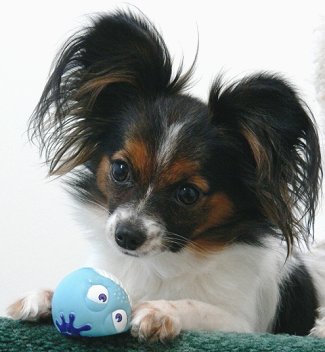
The Papillon shares top billing with the Toy Poodle as the brightest and most trainable of the toy breeds. Indeed, the spirited, athletic Papillon is commonly chosen by obedience or agility trainers who want a top-notch competition dog in a very small package.
Indoors and out, Papillons are lively and playful, yet also light-footed and graceful – not likely to topple lamps.
But that doesn't mean everyone who is looking for a toy breed should acquire a Papillon. They're not the best choice, for example, if you want a calm, cuddly lapdog. Most Papillons are active, inquisitive dogs, especially when they're young. They don't like to sit still for very long.
My own Papillon (that's Jenna in the photo above) is frequently in motion and obsessed with retrieving squeaky balls – for hours. She is also clever and creative and will entertain herself by making up her own games.
The Papillon learns very quickly and responds well to training methods that emphasize praise and food, plus gentle correction. These sensitive dogs wilt if you're heavy-handed.
However, obedience may not be instantaneous. Some Papillons, especially females, can be manipulative and will try to charm you out of making them do things they don't want to do. If that fails, they'll try sulking. You need to be both gentle and persistent if you are to outwit these clever girls.
Papillons are alert dogs with keen senses. That means they not only sound the alarm when people are actually at the door, but also when people are walking along the street or puttering in the garden next door. In other words, excessive barking can occur and must be dealt with. This is a common trait in most toy breeds.
Most Papillons are polite with strangers, though often standoffish. As with all sweet-natured breeds, socialization is very important to build a confident attitude toward people.
Papillons can be touch-sensitive and can be overwhelmed by the roughhousing and mischief of small children. This breed does better in an adult-only home.
With other animals, surprisingly, the Papillon is not as submissive as you might think. In fact, some Papillons are possessive and bossy, especially toward larger dogs. This can be dangerous, as the quick-moving Papillon may be viewed as prey.
Note that I said "quick-moving Papillon." A hallmark of this breed is how quickly they move. These swift little dogs can zip through a cracked door and be gone in an instant. Our petsitter calls our Papillon a "spirit", because "First she's here, then she's there.... but we never actually see her move, she's like a blur!"
Along the same lines, Papillons have lightning-quick reflexes and retain sporting instincts from their spaniel heritage. They will stalk and pursue birds, squirrels, mice, lizards, even flying insects. This is not a breed to let off-leash at the park unless very well-trained.
You do have to watch your lines. Some Papillons are dainty, even high-strung, while others are more confident and outgoing. Much depends on genetics (parents' and grandparents' temperament) and the rest on socialization and training.
If you want a dog who...
- Is easy to carry and doesn't take up much space
- Is fine-boned and elegant, light-footed and graceful
- Has a lovely feathered coat with striking colors
- Is lively and playful
- Is one of the brightest and most trainable of the toy breeds
- Is polite (albeit standoffish) with strangers
A Papillon may be right for you.
If you don't want to deal with...
- The fragility of toy breeds (see below)
- Excessive timidity, suspiciousness, or highstrung temperaments in some lines, or when not socialized enough
- High energy level
- Tendency toward independent standoffishness rather than cuddling
- Regular combing to avoid matting on their heavily fringed ears and legs
- Potential barking
A Papillon may not be right for you.
 |
Dog Breed Traits – Which Traits Are Right For You? In this brand new series, I'll help you decide which dog breed traits would best suit you and your family, your home and yard, and your lifestyle, so you can choose the best dog breed for your family. |
Keep in mind that the inheritance of temperament is less predictable than the inheritance of physical traits such as size or shedding. Temperament and behavior are also shaped by raising and training.
FREE eBooks by Michele Welton
 "Respect Training for Puppies" and "Teach Your Dog 100 English Words" are free step by step guides to teaching your pup to be calm and well-behaved.
 "11 Things You Must Do Right To Keep Your Dog Healthy and Happy" is a free guide to keeping your dog mentally, physically, and emotionally happy and healthy so you can enjoy a longer lifetime of companionship.

- You can avoid some negative traits by choosing an ADULT dog from an animal shelter or rescue group. With an adult dog, you can easily see what you're getting, and plenty of adult Papillons have already proven themselves not to have negative characteristics.
- If you want a puppy, you can avoid some negative traits by choosing the right breeder and the right puppy.
More traits and characteristics of the Papillon
If I was considering a Papillon, I would be most concerned about...
- Fragility. Too many people acquire a toy breed puppy without understanding how incredibly fragile a toy breed is. You can seriously injure or kill a Papillon puppy by stepping on him or sitting on him. Or Papillons can seriously injure themselves by leaping from your arms or off the back of your sofa. A larger dog can grab a Papillon and break his neck with one quick shake; I watched in horror as a Borzoi did exactly that with a Papillon puppy. Owning a toy breed means constant supervision and surveillance of what's going on around your small dog.
Papillon puppies are not suited to toddlers, no matter how well-meaning the child. Children cannot help being clumsy, and that a child meant well is little solace to a Papillon who has been accidentally stepped on, sat on, rolled on, squeezed, or dropped onto the patio. Even adult Papillons may feel overwhelmed by the loud voices and quick movements that children can't help making, and stress and fearfulness may be the result.
- The high energy level. In general, this breed is not a calm lapdog, especially when they're young. There are certainly exceptions – you can find some cuddlebug Paps – but most young Papillons are lively, spirited, agile, and athletic. They like to be on the go, but they need to be kept safe in a secure fenced yard or on-leash. They're just too quick, too fast, and too prone to taking off in pursuit of anything that moves.
- Providing enough socialization. Standoffish by nature, Papillons need extensive exposure to people and to unusual sights and sounds. Otherwise their natural caution could become shyness.
- Potential barking. Papillons are often too quick to sound the alarm at every new sight and sound. You have to be equally quick to stop them. You can only do this successfully if your dog listens to you, which means you need to establish the right relationship with your Papillon, where you are the leader and he is the follower. This is called Respect Training. Follow my free online training programs.
- Grooming. The long ear fringes that are the breed's trademark are prone to matting and must be kept combed or trimmed. Same for their underarm area, which can knot up dreadfully and make it uncomfortable for the dog to move. You also need to trim the hair around their "bathroom parts" for sanitary reasons.
- Shedding. I mention this only because some breeders are marketing their dogs light shedding or hypoallergenic. That isn't true. Papillons shed on the lighter side of average, but considerably more than a truly light-shedding breed like a Toy Poodle or Maltese.
 About the author: Michele Welton has over 40 years of experience as a Dog Trainer, Dog Breed Consultant, and founder of three Dog Training Centers. An expert researcher and author of 15 books about dogs, she loves helping people choose, train, and care for their dogs.
My best-selling books – now available FREE on my website
 Respect Training For Puppies: 30 seconds to a calm, polite, well-behaved puppy is for puppies 2 to 18 months old. Your puppy will learn the 21 skills that all family dogs need to know. Click here to read for free.
 Teach Your Dog 100 English Words is a unique Vocabulary and Respect Training Program that will teach your adult dog to listen to you and do what you say. Click here to read for free.
 11 Things You Must Do Right To Keep Your Dog Healthy and Happy helps your dog live a longer, healthier life. Get my honest advice about all 11 Things before you bring home your new puppy, because some mistakes with early health care cannot be undone. Click here to read for free.
Related posts you might enjoy