
Old English Sheepdogs: What's Good About 'Em, What's Bad About 'Em
Old English Sheepdog temperament, personality, training, behavior, pros and cons, advice, and information, by Michele Welton, Dog Trainer, Behavioral Consultant, Author of 15 Dog Books
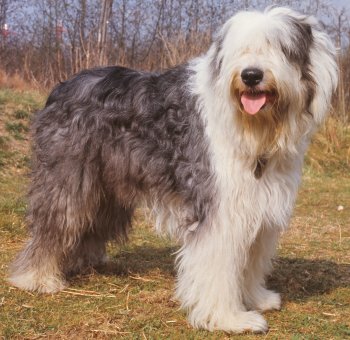
Good-natured and sociable, enthusiastic and bumptious, the Old English Sheepdog does best in the suburbs or country, with at least an hour of daily exercise and space to romp.
The OES (or "Sheepie") loves people, can be quite the clown, and is demanding of attention. If left without the companionship of humans or other pets, he will become unhappy, destructive, and noisy.
Most Old English Sheepdogs are polite with strangers. They make sensible watchdogs with a deep, ringing bark, but they're not guard dogs. In fact, there is timidity and skittishness in some lines, sharpness in others. Extensive socialization is important to develop a confident, stable temperament.
Like other herding breeds, a few Old English Sheepdogs may try to "herd" children and other pets by circling, poking, or nipping at them. However, since the vast majority of Old English Sheepdogs are bred to be show dogs or pets, rather than working sheepdogs, their herding instincts are typically diminished or absent.
The rustic Old English Sheepdog is not for fastidious households. He tracks in mud, splashes in his water bowl, and affectionately thrusts his wet and/or dirty beard into your lap. Some individuals drool.
If you want a dog who...
- Is enthusiastic and bouncy, and loves to romp and play
- Makes a sensible watchdog, but is usually not aggressive
- Is usually peaceful with other family pets
- Is shaggy (unless clipped)
An Old English Sheepdog may be right for you.
If you don't want to deal with...
- A careful search to avoid highstrung, neurotic Old English Sheepdogs
- Rowdiness and exuberant jumping, especially when young
- Strong-willed mind of his own, requiring a confident owner who can take charge
- Lots of grooming: either regular brushing and combing, or regular clipping
- "Shaggy dog syndrome," i.e. debris clinging to the coat, water soaking into the beard and dripping on your floors
- Gassiness (flatulence)
An Old English Sheepdog may not be right for you.
 |
Dog Breed Traits – Which Traits Are Right For You? In this brand new series, I'll help you decide which dog breed traits would best suit you and your family, your home and yard, and your lifestyle, so you can choose the best dog breed for your family. |
Keep in mind that the inheritance of temperament is less predictable than the inheritance of physical traits such as size or shedding. Temperament and behavior are also shaped by raising and training.
FREE eBooks by Michele Welton
 "Respect Training for Puppies" and "Teach Your Dog 100 English Words" are free step by step guides to teaching your pup to be calm and well-behaved.
 "11 Things You Must Do Right To Keep Your Dog Healthy and Happy" is a free guide to keeping your dog mentally, physically, and emotionally happy and healthy so you can enjoy a longer lifetime of companionship.

- You can avoid some negative traits by choosing an ADULT dog from an animal shelter or rescue group. With an adult dog, you can easily see what you're getting, and plenty of adult Old English Sheepdogs have already proven themselves not to have negative characteristics.
- If you want a puppy, you can avoid some negative traits by choosing the right breeder and the right puppy.
More traits and characteristics of the Old English Sheepdog
If I was considering an Old English Sheepdog, I would be most concerned about...
- Unstable temperaments. With an Old English Sheepdog, you should be concerned about what kind of temperament he might have inherited from his parents. This breed has gone through phases of over-popularity where lots of unknowledgeable and irresponsible breeders have produced puppies in volume, trying to make a buck. Obedience instructors and behavioral consultants, like myself, have seen too many Old English Sheepdogs with neurotic behaviors, including hyperactivity, fearfulness, and aggression. So you need to be careful about your sources with this breed.
- Providing enough exercise and mental stimulation. Old English Sheepdogs don't need miles of running exercise, but they do need plenty of opportunities to vent their energy and romp about. Otherwise they will become rambunctious and bored, which they usually express by barking and destructive chewing.
- Grooming. Old English Sheepdogs need lots of coat care. You must be willing to brush and comb the long coat frequently, getting out all the mats. This takes quite a while. You also need to use scissors to cut the hair away from the dog's eyes so he can see, and trim the genital areas for sanitary purposes. The alternative to brushing and combing is to regularly clip the coat short. This is my preferred option, as it keeps the dog cleaner and more comfortable. And it looks great!
If you leave the coat long, the Sheepie manifests "shaggy dog syndrome." This is where leaves, mud, snow, fecal matter, and other debris cling to the coat and ends up all over your house. When he drinks, his beard absorbs water, which drips on your floors when he walks away. When he eats, his beard absorbs food so that when he sniffs your face or presses his head against your leg, YOU end up dirty, too. Big shaggy dogs are not suited to fastidious housekeepers!
- Shedding. Shedding is about average. But if you leave the coat long, the shed hairs that are coming out get tangled in the long hair and mostly stay there until you brush them out. Whereas if you clip the coat short, your brushing chores become minimal to none.... but the shed hair has freer access to fall out onto your floor and furnishings. So it's a trade-off.
- Gassiness (flatulence) that can send you running for cover. Fortunately, Old English Sheepdogs who are fed a heavily meat-based diet have much less trouble with gassiness.
- Stubbornness. Old English Sheepdogs have an independent mind of their own. But they are quite trainable when you know what you're doing and can establish the right relationship where you are the leader and the dog is the follower. Read my free online training programs.
- Slobbering. Some Old English Sheepdogs tend to slobber or drool, especially around mealtimes.
 About the author: Michele Welton has over 40 years of experience as a Dog Trainer, Dog Breed Consultant, and founder of three Dog Training Centers. An expert researcher and author of 15 books about dogs, she loves helping people choose, train, and care for their dogs.
My best-selling books – now available FREE on my website
 Respect Training For Puppies: 30 seconds to a calm, polite, well-behaved puppy is for puppies 2 to 18 months old. Your puppy will learn the 21 skills that all family dogs need to know. Click here to read for free.
 Teach Your Dog 100 English Words is a unique Vocabulary and Respect Training Program that will teach your adult dog to listen to you and do what you say. Click here to read for free.
 11 Things You Must Do Right To Keep Your Dog Healthy and Happy helps your dog live a longer, healthier life. Get my honest advice about all 11 Things before you bring home your new puppy, because some mistakes with early health care cannot be undone. Click here to read for free.
Related posts you might enjoy