
Great Pyrenees: What's Good About 'Em, What's Bad About 'Em
Great Pyrenees temperament, personality, training, behavior, pros and cons, advice, and information, by Michele Welton, Dog Trainer, Behavioral Consultant, Author of 15 Dog Books
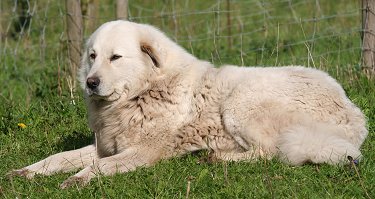
The AKC Standard describes the Great Pyrenees as "strong willed, independent, and somewhat reserved, yet attentive, fearless, and loyal to his charges – both human and animal."
A majestic-looking dog with a kindly, regal expression, the Great Pyrenees is calm, composed, and serious.
As an adult, he is quiet indoors and content with long daily walks and regular opportunities to stretch out. He does love to romp in the snow, and pulling a cart or carrying a backpack gives him a purpose in life.
Aloof with strangers, he should be accustomed to many different people in his early months.
The Great Pyrenees is patient with his own family's children, but some are overprotective when neighbors join in for rough-and-tumble play. Likewise, he may be protective of his own family's pets while aggressively driving off others.
These characteristics stem from his background as a livestock guardian, where he was expected to keep watch over the flock, making his own decisions about friends and foes and appropriate actions. Unless you establish yourself as the leader (number one), the Great Pyrenees will trust his own judgment and do whatever he pleases. This breed is not an eager-to-please Golden Retriever.
Great Pyrenees have a deep, impressive bark, which they tend to use freely, especially at night when they are most vigilant.
Fences must be secure, for Pyrs have a tendency to roam. Some produce "slime" (excessive saliva).
If you want a dog who...
- Is large and rugged, resembling a majestic white bear
- Will protect your horses, llamas, sheep, goats, or chickens
- Can be found with a strong territorial temperament, or a more easygoing temperament
- Tends to be serious and steady, rather than playful and silly
- Is quiet indoors and content with moderate exercise
A Great Pyrenees may be right for you.
If you don't want to deal with...
- A very large dog who takes up a lot of space in your house and car
- Destructiveness when bored or left alone too much
- Aggression toward animals who don't belong to his family
- Strong-willed mind of his own, requiring a confident owner who can take charge
- Providing secure fences and lots of supervision to prevent wandering
- Deep booming barks
- Very heavy shedding
A Great Pyrenees may not be right for you.
 |
Dog Breed Traits – Which Traits Are Right For You? In this brand new series, I'll help you decide which dog breed traits would best suit you and your family, your home and yard, and your lifestyle, so you can choose the best dog breed for your family. |
Keep in mind that the inheritance of temperament is less predictable than the inheritance of physical traits such as size or shedding. Temperament and behavior are also shaped by raising and training.
FREE eBooks by Michele Welton
 "Respect Training for Puppies" and "Teach Your Dog 100 English Words" are free step by step guides to teaching your pup to be calm and well-behaved.
 "11 Things You Must Do Right To Keep Your Dog Healthy and Happy" is a free guide to keeping your dog mentally, physically, and emotionally happy and healthy so you can enjoy a longer lifetime of companionship.

More traits and characteristics of the Great Pyrenees
If I was considering a Great Pyrenees, I would be most concerned about...
- Providing the proper balance of exercise. Young Great Pyrenees need enough exercise to keep them lean and healthy, but not so much that their soft growing bones, joints, and ligaments become over-stressed and damaged. Adult Great Pyrenees need more exercise to keep them in shape, but not in hot or humid weather for fear of overheating. The proper amount of exercise can be difficult to regulate in giant breeds.
Great Pyrenees are most satisfied when guarding livestock. You can substitute pulling a cart or sled, or backpacking, but without something constructive to do, Great Pyrenees are likely to become bored and destructive.
- The strong temperament. As flock guardians, Great Pyrenees are bred to have a a somewhat suspicious and independent mind of their own so they can protect their vulnerable charges from whatever danger appear. They prefer to make their own decisions, which may not line up with yours when you're trying to raise them as an indoor companion. In other words, Great Pyrenees are typically willful dogs. You must show them, through absolute consistency, that you mean what you say. Read my free online training programs.
- Potential animal aggression. Most Great Pyrenees will treat the pets in their own family as members of their flock. But they have strong instincts to drive away animals who do not belong to their family. Many Great Pyrenees are dominant or aggressive toward dogs they don't know. Some Great Pyrenees are not safe with cats. I know personally of TWO separate tragic incidents where a Great Pyrenees reached through the fence and killed a small dog who was simply walking past the Pyr's yard.
- Heavy shedding. Great Pyrenees shed a LOT. You'll find hair and fur all over your clothing and furnishings.
- Noise. Unless you live on a farm away from close neighbors, Great Pyrenees should never be left outside unsupervised. Their booming barks will have your neighbors calling the cops to report the nuisance.
You have probably come to the conclusion that the Great Pyrenees is not suited to most households. And you're absolutely right. Only certain living situations can provide the activities that keep this breed content.
 About the author: Michele Welton has over 40 years of experience as a Dog Trainer, Dog Breed Consultant, and founder of three Dog Training Centers. An expert researcher and author of 15 books about dogs, she loves helping people choose, train, and care for their dogs.
My best-selling books – now available FREE on my website
 Respect Training For Puppies: 30 seconds to a calm, polite, well-behaved puppy is for puppies 2 to 18 months old. Your puppy will learn the 21 skills that all family dogs need to know. Click here to read for free.
 Teach Your Dog 100 English Words is a unique Vocabulary and Respect Training Program that will teach your adult dog to listen to you and do what you say. Click here to read for free.
 11 Things You Must Do Right To Keep Your Dog Healthy and Happy helps your dog live a longer, healthier life. Get my honest advice about all 11 Things before you bring home your new puppy, because some mistakes with early health care cannot be undone. Click here to read for free.
Related posts you might enjoy