
Great Danes: What's Good About 'Em, What's Bad About 'Em
Great Dane temperament, personality, training, behavior, pros and cons, advice, and information, by Michele Welton, Dog Trainer, Behavioral Consultant, Author of 15 Dog Books
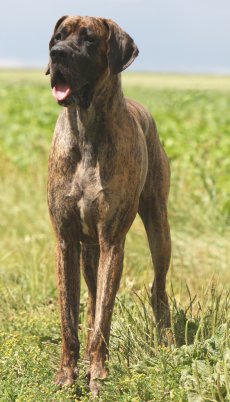
The Great Dane is typically a gentle giant, easygoing and mild-mannered.
He needs only moderate exercise, but does need space and shouldn't be cramped into studio apartments and postage-stamp yards. Above all, this sociable breed needs companionship. He doesn't do well when left alone.
With his deep, resounding voice, a Great Dane won't fail to announce visitors, but guarding and territorial instincts vary. Some lines and individuals are friendly with everyone, some are sensibly protective, while others are standoffish or skittish.
To build their confidence and promote a stable temperament, young Great Danes must be taken out into the world more frequently than most other breeds.
Some Great Danes are peaceful with other pets, while others are dominant and pushy.
Because he is so huge and can be bossy if undisciplined, obedience training is essential, but Great Danes are also very sensitive and should be trained with cheerful methods. Harshness only confuses them and makes them distrustful.
Great Danes drool and slobber and lumber around in a rather bumptious manner. They are not good choices for fastidious housekeepers, or for those with no sense of humor.
Young Great Danes (up to three years old) can be boisterous, and unless supervised, will dismay you with the magnitude of their destructiveness.
If you want a dog who...
- Is a giant mastiff-type, but more elegant in build
- Has a sleek, easy-care coat that comes in a variety of colors
- Is usually easygoing and mild-mannered
- Needs only moderate exercise
- Looks imposing, so makes an effective deterrent, yet is usually non-aggressive with people
A Great Dane may be right for you.
If you don't want to deal with...
- A huge dog who takes up a lot of space in your house and car
- A heavy dog who wants to sit on your feet or lean his weight against your leg
- Rowdiness and exuberant jumping when young
- "Separation anxiety" (destructiveness) when left alone too much
- Aggression or fearfulness in some lines, or when not socialized enough
- Possible aggression toward other animals
- Strong-willed mind of his own, requiring a confident owner who can take charge
- Slobbering and drooling
- Serious health problems and a short lifespan
- Potential legal liabilities (public perception, future breed bans, insurance problems, increased chance of lawsuits)
A Great Dane may not be right for you.
 |
Dog Breed Traits – Which Traits Are Right For You? In this brand new series, I'll help you decide which dog breed traits would best suit you and your family, your home and yard, and your lifestyle, so you can choose the best dog breed for your family. |
Keep in mind that the inheritance of temperament is less predictable than the inheritance of physical traits such as size or shedding. Temperament and behavior are also shaped by raising and training.
FREE eBooks by Michele Welton
 "Respect Training for Puppies" and "Teach Your Dog 100 English Words" are free step by step guides to teaching your pup to be calm and well-behaved.
 "11 Things You Must Do Right To Keep Your Dog Healthy and Happy" is a free guide to keeping your dog mentally, physically, and emotionally happy and healthy so you can enjoy a longer lifetime of companionship.

- You can avoid some negative traits by choosing an ADULT dog from an animal shelter or rescue group. With an adult dog, you can easily see what you're getting, and plenty of adult Great Danes have already proven themselves not to have negative characteristics.
- If you want a puppy, you can avoid some negative traits by choosing the right breeder and the right puppy.
More traits and characteristics of the Great Dane
If I was considering a Great Dane, I would be most concerned about...
- Providing the proper balance of exercise. Young Great Danes need enough exercise to keep them lean and healthy, but not so much that their soft growing bones, joints, and ligaments become over-stressed and damaged. The proper amount of exercise can be difficult to regulate in giant breeds.
Since you need to minimize their exercise, young Great Danes can be very rambunctious. They will romp with uncoordinated gawkiness all over your house. You need to substitute extra quantities of companionship and supervision. Otherwise, left alone, young Great Danes become bored and destructive. Their powerful jaws can destroy your living room.
- Providing enough socialization. Some Great Danes are naturally friendly, but most tend to be a little standoffish with strangers, and some individuals have protective instincts. It's essential to socialize your Great Dane very thoroughly when he is young, so that he learns to recognize the normal behaviors of "good guys." Then he can recognize the difference when someone acts abnormally.
Without careful socialization, a Great Dane may be suspicious of everyone. This can lead to either aggression or shyness, and both attitudes are dangerous in a giant breed. Fearful Danes can bite defensively if they feel cornered. And it's no fun trying to drag a frightened dog along by the leash in public.
- Potential animal aggression. Most Great Danes are good with other family pets, but some are dominant or aggressive toward other dogs of the same sex. Some Great Danes have strong instincts to chase and seize cats and other fleeing creatures.
- The strong temperament. Great Danes are not pushovers to raise and train. Although many individuals are good-natured and willing to please (in a slowish way!), others are willful and and will make you prove that you can make them do things. You must show them, through absolute consistency, that you mean what you say. To teach your Great Dane to listen to you, "Respect Training" is mandatory. Follow my free online training programs.
- Serious health problems. One look at their giant size and comparatively slender legs and you can guess that Great Danes are not a healthy breed. Their bone structure can break down under the heavy weight thrust upon it. They are frequently stricken in middle age by crippling joint and bone disorders, heart disease, cancer, and/or a life-threatening digestive disorder called bloat. Their life span is depressingly short. Read more about Great Dane Health.
- Slobbering. Many Great Danes drool, especially after eating or drinking.
- Legal liabilities. The Great Dane may be targeted for "banning" in certain areas, or refusal of homeowner insurance policies. In this day and age, the legal liabilities of owning any breed that looks intimidating and has a history as a guard dog should be seriously considered. People are quicker to sue if such a dog does anything even remotely questionable.
 About the author: Michele Welton has over 40 years of experience as a Dog Trainer, Dog Breed Consultant, and founder of three Dog Training Centers. An expert researcher and author of 15 books about dogs, she loves helping people choose, train, and care for their dogs.
My best-selling books – now available FREE on my website
 Respect Training For Puppies: 30 seconds to a calm, polite, well-behaved puppy is for puppies 2 to 18 months old. Your puppy will learn the 21 skills that all family dogs need to know. Click here to read for free.
 Teach Your Dog 100 English Words is a unique Vocabulary and Respect Training Program that will teach your adult dog to listen to you and do what you say. Click here to read for free.
 11 Things You Must Do Right To Keep Your Dog Healthy and Happy helps your dog live a longer, healthier life. Get my honest advice about all 11 Things before you bring home your new puppy, because some mistakes with early health care cannot be undone. Click here to read for free.
Related posts you might enjoy