
Wire & Smooth Fox Terriers: What's Good About 'Em, What's Bad About 'Em
Fox Terrier temperament, personality, training, behavior, pros and cons, advice, and information, by Michele Welton, Dog Trainer, Behavioral Consultant, Author of 15 Dog Books
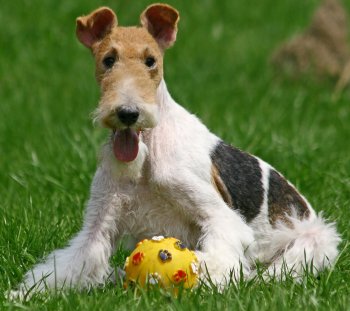
The Fox Terrier (whether smooth or wirehaired) is one of the most curious, intense, and impulsive of the terriers.
Untiringly active and playful, he has a special passion for ball chasing, which really helps with exercise!
The Fox Terrier loves the outdoors but must always be kept on-leash (he is a fast, agile, independent chaser) or in a secure yard, supervised, because his ingenuity and relentless hunting instincts may drive him over or under the fence.
This daredevil does best with active owners who are firm, confident, consistent leaders. He has a marked stubborn streak, a mischievous sense of humor, and will take clever advantage if indulged.
Fox Terriers have a peppery personality and are scrappy and fearless with other animals. They won't back down if challenged, and they may do much of the challenging themselves.
They have a high prey drive and extremely quick reflexes, so little creatures that run won't get far.
This breed has keen vision and acute hearing and can be counted on to sound the alert when anything is amiss & sometimes even when nothing is amiss, but might be in the future!
Fox Terriers love to tunnel and dig and can be possessive of their food and cherished toys.
If you want a dog who...
- Is small, yet dynamic, sturdy, and tough – not a delicate lapdog
- Makes a keen watchdog
- Is easy to groom (Smooth coat)
- Doesn't shed too much (Wirehaired)
A Smooth or Wirehaired Fox Terrier may be right for you.
If you don't want to deal with...
- The dynamic terrier temperament (see full description below)
- Providing enough exercise and activities to keep them busy
- Aggression toward other animals – chasing instincts
- Stubbornness
- Digging holes
- Barking
- Shedding (Smooth coat)
- Regular brushing and clipping (Wire coat)
A Smooth or Wirehaired Fox Terrier may not be right for you.
 |
Dog Breed Traits – Which Traits Are Right For You? In this brand new series, I'll help you decide which dog breed traits would best suit you and your family, your home and yard, and your lifestyle, so you can choose the best dog breed for your family. |
Keep in mind that the inheritance of temperament is less predictable than the inheritance of physical traits such as size or shedding. Temperament and behavior are also shaped by raising and training.
FREE eBooks by Michele Welton
 "Respect Training for Puppies" and "Teach Your Dog 100 English Words" are free step by step guides to teaching your pup to be calm and well-behaved.
 "11 Things You Must Do Right To Keep Your Dog Healthy and Happy" is a free guide to keeping your dog mentally, physically, and emotionally happy and healthy so you can enjoy a longer lifetime of companionship.

- You can avoid some negative traits by choosing an ADULT dog from an animal shelter or rescue group. With an adult dog, you can easily see what you're getting, and plenty of adult Fox Terriers have already proven themselves not to have negative characteristics.
- If you want a puppy, you can avoid some negative traits by choosing the right breeder and the right puppy.
More traits and characteristics of the Fox Terrier
If I was considering a Fox Terrier, I would be most concerned about...
- The dynamic terrier temperament. Most terrier breeds are remarkably similar. The same words are used over and over – quick to bark, quick to chase, lively, bossy, feisty, scrappy, clever, independent, stubborn, persistent, impulsive, intense. Smooth and Wirehaired Fox Terriers are active go-getters. A walk around the block is not enough. They need regular opportunities to vent their energy and to use their busy minds to do interesting things.
- Potential animal aggression. Fox Terriers are a determined force to reckon with if they decide to initiate or accept a challenge to fight. Most terriers have strong instincts to chase and seize small fleeing creatures. This can make for conflict if you own a cat. It may be much worse than that if you own a pet rabbit or hamster!
- Fence security. Many Fox Terriers are clever escape artists who will go over or under fences in search of adventure. You may need higher fences than you might imagine for their small size. You may also need to sink wire into the ground along the fence line to thwart digging. Gates should have the highest quality locks.
Terriers cannot be trusted off-leash. They will take off – oblivious to your frantic shouts – after anything that runs.
- Potential barking. Smooth and Wirehaired Fox Terriers are often too quick to sound the alarm at every new sight and sound. You have to be equally quick to stop them. If you work all day and have close neighbors, terriers are not the best choice for you. For the same reason, terriers should never be left outside in your yard, unsupervised. To make matters worse, some terriers have high-pitched barks that can set your teeth on edge.
- Mind of their own. Fox Terriers, though more amenable to training than many other terriers, must be taught at an early age that they are not the rulers of the world. The toughness that makes them suited to killing vermin can frustrate you when you try to teach them anything. Fox Terriers can be stubborn and dominant (they want to be the boss) and will make you prove that you can make them do things. You must show them, through absolute consistency, that you mean what you say. Follow my free online training programs.
- Defensive reactions. If you need to physically chastise a terrier, and you go beyond what THEY believe is a fair correction, terriers (as a group) are more likely than other breeds to growl or snap. As an obedience instructor, I'm always extra careful when putting my hands on any terrier for a correction.
I do not recommend terriers for homes with small children. Many terriers will not tolerate any nonsense from little life forms whom they consider to be below themselves in importance. Many terriers are quick to react to teasing, and even to the normal clumsiness that comes with small children (accidental squeezing of their ears or pulling of whiskers or stepping on their paw). Many terriers are possessive of their food and toys and will defend these from all comers, including children.
- Shedding. The Wire Fox Terrier sheds lightly, while Smooth Fox Terriers shed a lot. Those short white hairs come off on your hands when you pet them, and stick tenaciously to your clothing and furnishings.
- Grooming. The Wire coat needs much more care: clipping and trimming every few months. Breed purists may say that terrier coats should never be clipped because it makes the coat softer and more prone to matting. Instead they advocate hand-stripping (each dead hair pulled out so a new one can grow in its place). But in my opinion, stripping is too time-consuming and uncomfortable for the dog. Many groomers won't do it anymore. For pet dogs, I think clipping is just fine.
Obviously, Smooth Fox Terriers don't need trimming, but you should brush them frequently when they're shedding, because hairs that end up in the brush don't end up on your clothes and furniture!
 About the author: Michele Welton has over 40 years of experience as a Dog Trainer, Dog Breed Consultant, and founder of three Dog Training Centers. An expert researcher and author of 15 books about dogs, she loves helping people choose, train, and care for their dogs.
My best-selling books – now available FREE on my website
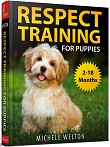 Respect Training For Puppies: 30 seconds to a calm, polite, well-behaved puppy is for puppies 2 to 18 months old. Your puppy will learn the 21 skills that all family dogs need to know. Click here to read for free.
 Teach Your Dog 100 English Words is a unique Vocabulary and Respect Training Program that will teach your adult dog to listen to you and do what you say. Click here to read for free.
 11 Things You Must Do Right To Keep Your Dog Healthy and Happy helps your dog live a longer, healthier life. Get my honest advice about all 11 Things before you bring home your new puppy, because some mistakes with early health care cannot be undone. Click here to read for free.
Related posts you might enjoy