
English Shepherds: What's Good About 'Em, What's Bad About 'Em
English Shepherd temperament, personality, training, behavior, pros and cons, advice, and information, by Michele Welton, Dog Trainer, Behavioral Consultant, Author of 15 Dog Books
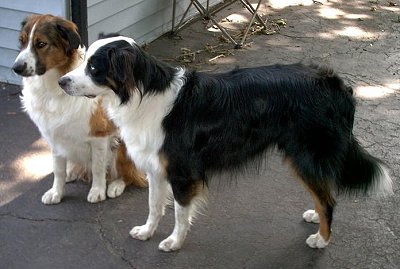
The English Shepherd is noted for his calm dependability and is content to curl up at your feet at the end of the day.
However, that day must include a good amount of physical exercise and mental stimulation. This is an active, athletic dog. Herding, advanced obedience, agility, jogging or biking, chasing balls, and playing Frisbee are productive outlets for his enthusiasm.
Most English Shepherds are polite with strangers and make sensible watchdogs, but extensive socialization is required when young to avoid shyness.
Most are fine with other pets if raised with them, but they can be dominant with strange animals.
This is an attentive, sensitive breed who likes to keep his eye on you. Highly trainable, the English Shepherd is an all-purpose working and competition dog who learns quickly. Yet he does have the typical independence of a herding breed.
In other words, this is not a "push-button" breed. You must have the confidence to establish and enforce rules, or he will make up his own.
English Shepherds prefer their charges (family members and other pets) to be gathered together and may try to accomplish this by circling, poking, and nipping.
If you want a dog who...
- Is medium-sized and natural-looking
- Is very trainable
- Thrives on plenty of exercise and athletic activities such as obedience, agility, and herding
- Is usually polite with strangers, yet makes a sensible watchdog
An English Shepherd may be right for you.
If you don't want to deal with...
- Destructiveness and barking when bored or not exercised enough
- Strong chasing instincts
- Shyness in some lines, or when not socialized enough
- Considerable shedding
- Waiting lists (hard to find)
An English Shepherd may not be right for you.
 |
Dog Breed Traits – Which Traits Are Right For You? In this brand new series, I'll help you decide which dog breed traits would best suit you and your family, your home and yard, and your lifestyle, so you can choose the best dog breed for your family. |
Keep in mind that the inheritance of temperament is less predictable than the inheritance of physical traits such as size or shedding. Temperament and behavior are also shaped by raising and training.
FREE eBooks by Michele Welton
 "Respect Training for Puppies" and "Teach Your Dog 100 English Words" are free step by step guides to teaching your pup to be calm and well-behaved.
 "11 Things You Must Do Right To Keep Your Dog Healthy and Happy" is a free guide to keeping your dog mentally, physically, and emotionally happy and healthy so you can enjoy a longer lifetime of companionship.

- You can avoid some negative traits by choosing an ADULT dog from an animal shelter or rescue group. With an adult dog, you can easily see what you're getting, and plenty of adult English Shepherds have already proven themselves not to have negative characteristics.
- If you want a puppy, you can avoid some negative traits by choosing the right breeder and the right puppy.
More traits and characteristics of the English Shepherd
If I was considering an English Shepherd, I would be most concerned about...
- Providing enough exercise and mental stimulation. English Shepherds are not as high-powered as Border Collies, nor are they intense workaholics. But they MUST have regular opportunities to vent their energy and to use their busy minds to do interesting things. Otherwise they will become rambunctious and bored – which they usually express by barking and destructive chewing.
- Providing enough socialization. Standoffish by nature, English Shepherds need extensive exposure to people and to unusual sights and sounds. Otherwise their natural caution can become suspiciousness or fearfulness, which are difficult to live with.
- Mind of his own. The best English Shepherds are versatile working dogs, capable of learning a great deal. But herding dogs sometimes have to think for themselves, so these are not "push-button" robot dogs. Some English Shepherds are stubborn and dominant (they want to be the boss) and will make you prove that you can make them do things. You must show them, through absolute consistency, that you mean what you say.
This is called Respect Training. Read my free online training programs.
- Shedding. English Shepherds shed a lot. Be prepared for hair on your clothing and furniture.
- Finding one. English Shepherds are not very common, so you will probably have to go on a waiting list.
 About the author: Michele Welton has over 40 years of experience as a Dog Trainer, Dog Breed Consultant, and founder of three Dog Training Centers. An expert researcher and author of 15 books about dogs, she loves helping people choose, train, and care for their dogs.
My best-selling books – now available FREE on my website
 Respect Training For Puppies: 30 seconds to a calm, polite, well-behaved puppy is for puppies 2 to 18 months old. Your puppy will learn the 21 skills that all family dogs need to know. Click here to read for free.
 Teach Your Dog 100 English Words is a unique Vocabulary and Respect Training Program that will teach your adult dog to listen to you and do what you say. Click here to read for free.
 11 Things You Must Do Right To Keep Your Dog Healthy and Happy helps your dog live a longer, healthier life. Get my honest advice about all 11 Things before you bring home your new puppy, because some mistakes with early health care cannot be undone. Click here to read for free.
Related posts you might enjoy