
Dogo Argentino: What's Good About 'Em, What's Bad About 'Em
Dogo Argentino temperament, personality, training, behavior, pros and cons, advice, and information, by Michele Welton, Dog Trainer, Behavioral Consultant, Author of 15 Dog Books
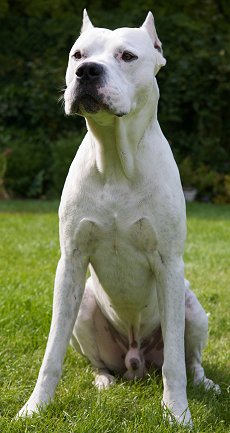
Powerful, yet possessed of an almost feline grace, the Dogo Argentino (or Argentine Dogo) is fearless yet sensitive; energetic outdoors yet calm indoors.
This impressive dog is best owned by active people who will develop his athletic abilities. He must have plenty of physical exercise to maintain his superb muscle structure and plenty of mental exercise to satisfy his desire to work and hunt.
Despite his intimidating appearance, the Dogo Argentino is usually friendly, yet is also a vigilant guardian with a thunderous bark. Early socialization is an absolute requirement to build the stable, discriminating temperament this breed is known for.
Though tough to the core, Dogos love to be petted. They crave close physical contact, leaning against you and lying on your feet.
With his dog-fighting ancestry, dog aggression can be a problem. The Dogo Argentino should be thoroughly socialized with other dogs from an early age. He should not be kept with another dog of the same sex.
With his strong prey drive, Dogos should not be kept with cats, either, unless raised with them.
Strong-willed and independent, but also highly intelligent, the Dogo Argentino will respect an owner who is equally confident and consistent. Because of his hound heritage, the Dogo is constantly intrigued by the exciting smells around him, so you must work to keep his attention during training sessions.
Note that this breed is banned (or has ownership restrictions) in a half-dozen countries.
If you want a dog who...
- Is a large, muscular, mastiff-type dog
- Has a short, easy-care, white coat
- Thrives on vigorous exercise and athletic activities
- Looks imposing, so makes an effective deterrent, yet is usually non-aggressive with people
- Carries himself with a steady, dignified, impressive presence
An Dogo Argentino may be right for you.
If you don't want to deal with...
- A large dog who wants to sit on your feet and lean his weight against your leg
- Vigorous exercise requirements
- Rowdiness and exuberant jumping, especially when young
- Destructiveness when bored or not exercised enough
- Aggression or fearfulness in some lines, or when not socialized enough
- Aggression toward other animals
- Strong-willed mind of his own, requiring a confident owner who can take charge
- Slobbering or drooling
An Dogo Argentino may not be right for you.
 |
Dog Breed Traits – Which Traits Are Right For You? In this brand new series, I'll help you decide which dog breed traits would best suit you and your family, your home and yard, and your lifestyle, so you can choose the best dog breed for your family. |
Keep in mind that the inheritance of temperament is less predictable than the inheritance of physical traits such as size or shedding. Temperament and behavior are also shaped by raising and training.
FREE eBooks by Michele Welton
 "Respect Training for Puppies" and "Teach Your Dog 100 English Words" are free step by step guides to teaching your pup to be calm and well-behaved.
 "11 Things You Must Do Right To Keep Your Dog Healthy and Happy" is a free guide to keeping your dog mentally, physically, and emotionally happy and healthy so you can enjoy a longer lifetime of companionship.

More traits and characteristics of the Dogo Argentino
If I was considering a Dogo, I would be most concerned about...
- Providing enough exercise and mental stimulation. As big-game hunting dogs, Dogos require plenty of opportunities to vent their energy and do interesting things. Otherwise they will become rambunctious and bored, which they usually express by barking and destructive chewing on a massive scale.
I do not recommend this breed if you simply want a pet for your family. You should have the time and inclination to take your Dogo running or hiking or swimming, not just for a few walks around the block. Ideally you would have an interest in a canine activity such as weight-pulling, or tracking, or agility (obstacle course), or advanced obedience, or schutzhund (protection).
- Providing enough socialization. Most Dogos have protective instincts toward strangers. They need extensive exposure to friendly people so they learn to recognize the normal behaviors of "good guys." Then they can recognize the difference when someone acts abnormally. Without careful socialization, they may be suspicious of everyone, which could lead to biting. Some Dogos go in the opposite direction – without enough socialization, they become fearful of strangers.
If you have children, I do not recommend an Dogo Argentino. Young Dogos (up to about two years old) can be bulls in a china shop. When they romp and jump, they do so with great vigor, and things can go flying, including people. In addition, Dogos may try to protect their own children from other children, which could lead to tragedy if kids are simply roughhousing and your Dogo decides to stop it. With such a massive dog, I wouldn't take the risk.
- Animal aggression. The Dogo Argentino was developed to hunt other animals. Most Dogos are dominant or aggressive toward other dogs of the same sex. Many have strong instincts to chase and seize cats and other fleeing creatures. If anything goes wrong in the breeding, socializing, training, handling, or management of this breed, it is capable of seriously injuring or killing other animals.
- The strong temperament. The best Dogos are versatile working dogs, capable of learning a great deal, but they have an independent mind of their own and are not pushovers to raise and train. Some Dogos are willful, obstinate, and dominant (they want to be the boss) and will make you prove that you can make them do things. You must show them, through absolute consistency, that you mean what you say. To teach your Dogo to listen to you, "Respect Training" is mandatory. Follow my free online training programs.
- Slobbering. Individuals with heavy loose lips tend to slobber or drool, especially after eating and drinking.
- Legal liabilities. Because they vaguely resemble pit bulls, Dogos may be targeted for "banning" in certain areas, or refusal of homeowner insurance policies. Your friends and neighbors may be uncomfortable around this breed. In this day and age, the legal liabilities of owning any breed that looks intimidating and has a history as a guard dog should be seriously considered. People are quicker to sue if such a dog does anything even remotely questionable.
Frankly, most Dogos are "too much dog" for the average household. This is a serious working dog with tremendous strength. Very few people really have the knowledge or skills necessary to manage this breed, or to provide the activities that keep him satisfied.
 About the author: Michele Welton has over 40 years of experience as a Dog Trainer, Dog Breed Consultant, and founder of three Dog Training Centers. An expert researcher and author of 15 books about dogs, she loves helping people choose, train, and care for their dogs.
My best-selling books – now available FREE on my website
 Respect Training For Puppies: 30 seconds to a calm, polite, well-behaved puppy is for puppies 2 to 18 months old. Your puppy will learn the 21 skills that all family dogs need to know. Click here to read for free.
 Teach Your Dog 100 English Words is a unique Vocabulary and Respect Training Program that will teach your adult dog to listen to you and do what you say. Click here to read for free.
 11 Things You Must Do Right To Keep Your Dog Healthy and Happy helps your dog live a longer, healthier life. Get my honest advice about all 11 Things before you bring home your new puppy, because some mistakes with early health care cannot be undone. Click here to read for free.
Related posts you might enjoy