
Dachshunds: What's Good About 'Em, What's Bad About 'Em
Standard and Miniature Dachshund temperament, personality, training, behavior, pros and cons, advice, and information, by Michele Welton, Dog Trainer, Behavioral Consultant, Author of 15 Dog Books
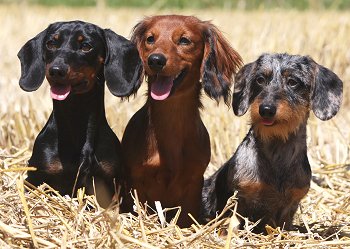
Dachshunds come in an impressive variety of sizes, coats, and colors.
There are Standard Dachshunds (the largest) and Miniature Dachshunds and even "Tweener" Dachshunds (a non-official term for individuals who fit between Standards and Minis.
There are Shorthaired (Smooth), Longhaired, and Wirehaired Dachshunds. The most common colors are reddish brown, or black with a few tan markings, but many colors and patterns are possible.
Curious, lively, charming, and brave, the Dachshund is similar to a terrier in his demands to be in on everything.
This comical clown loves to play games and has a great sense of humor. He is a loyal little dog, very attached to his family, and he firmly believes that sleeping under the bedcovers is in the Dachshund Bill of Rights.
Dachshunds attract devoted followers who would never consider having any other breed. Indeed, Dachshunds are often kept in pairs, which is A-OK with them, since they seem to recognize and prefer being with other "wiener dogs".
They're usually good with other family pets, too, though they can be jealous when they want attention and they can be possessive of their toys. You need to put a firm stop to the first signs of jealousy or possessiveness so that these don't become bad habits.
Though the Dachshund makes a great house dog, he does need his daily walks (on-leash! Dachshunds are chasers who will take off! – and plenty of companionship. Loneliness will lead to excessive barking.
You'll also hear his sharp, persistent bark when people approach, for most Dachshunds are alert watchdogs who do not take kindly to strangers intruding on their domain. Again, you need to put a stop to overt signs of suspiciousness, lest this progress to nastiness.
Though bright and clever, Dachshunds like to do things their own way. In other words, they're stubborn. Cheerful praise and treats should be offered freely, but your Dachsie must also be taught to respect you, else he may decide that he's justified in growling or snapping just because he doesn't like being told what to do.
Other behavioral problems? Well, the Dachshund's hunting and tunneling instincts may lead to holes being dug in your garden. Also, housebreaking may go slowly, as many Dachshunds don't like to go outside in cold or wet weather. A covered potty yard is recommended, if possible.
In general, Miniature Dachshunds are more active than the larger Standard Dachshunds. Comparing the three coat varieties:
- Wirehaired Dachshunds tend to be the most energetic, the most mischievous, and the most obstinate (probably stemming from their strong terrier heritage).
- Longhaired Dachshunds tend to be the quietest and sweetest-natured (probably stemming from their spaniel heritage).
- Smooth Dachshunds are most apt to attach themselves to one person and are often more aloof with strangers.
But remember, these are just generalities!
If you want a dog who...
- Comes in a variety of smallish sizes, coats, and colors
- Is comical and entertaining
- Is loyal to his family
- Needs only moderate exercise
- Makes a keen watchdog
- Is good with other family pets, especially other Dachshunds
- Usually lives a long life
A Dachshund may be right for you.
If you don't want to deal with...
- Stubbornness
- Scrappiness toward strange dogs, especially larger dogs
- Chasing and hunting instincts (chipmunks, birds, etc.)
- Notorious housebreaking difficulties
- Potential for excessive barking
- Potential for digging holes
- Excessive suspiciousness toward strangers when not socialized properly or made to behave
- Worries about the serious spinal problems that afflict 1 out of every 4 Dachshunds and can result in paralysis
A Dachshund may not be right for you.
 |
Dog Breed Traits – Which Traits Are Right For You? In this brand new series, I'll help you decide which dog breed traits would best suit you and your family, your home and yard, and your lifestyle, so you can choose the best dog breed for your family. |
Keep in mind that the inheritance of temperament is less predictable than the inheritance of physical traits such as size or shedding. Temperament and behavior are also shaped by raising and training.
FREE eBooks by Michele Welton
 "Respect Training for Puppies" and "Teach Your Dog 100 English Words" are free step by step guides to teaching your pup to be calm and well-behaved.
 "11 Things You Must Do Right To Keep Your Dog Healthy and Happy" is a free guide to keeping your dog mentally, physically, and emotionally happy and healthy so you can enjoy a longer lifetime of companionship.

- You can avoid some negative traits by choosing an ADULT dog from an animal shelter or rescue group. With an adult dog, you can easily see what you're getting, and plenty of adult Dachshunds have already proven themselves not to have negative characteristics.
- If you want a puppy, you can avoid some negative traits by choosing the right breeder and the right puppy.
More traits and characteristics of Dachshunds
If I was considering a Dachshund, I would be most concerned about...
- Barking. Dachshunds are very alert and often too quick to sound the alarm at every new sight and sound. You have to be equally quick to stop them. This is not a "yard dog" who can be left outside unsupervised.
- Mind of his own. Dachshunds are free thinkers. The strong mindset that makes them suited to killing vermin can frustrate you when you try to teach them anything. They can be manipulative, and some are downright obstinate. In small doses this is amusing and harmless, but you do need to show them, through absolute consistency, that you mean what you say. Read my free online training programs.
- Potential suspiciousness toward strangers. Some Dachshunds are friendly or at least polite with everyone, while others are suspicious of strangers, sometimes even snippy. You need to socialize your Dachshund from an early age so that he becomes accustomed to people. Teaching him to respect you means that if he shows any anti-social behavior, you can tell him "No" and he will stop what he's doing.
- Potential scrappiness toward strange dogs. Dachshunds are usually very good with other pets in their own family – especially with other Dachshunds! But they can be overly feisty toward strange dogs, and because of their size, this can be dangerous and must be stopped early.
- Housebreaking. As a behavioral consultant, I would put the Dachshund on my Top 20 List of "Hard to Housebreak." Consistent crate training is mandatory. A doggy door leading out to a covered potty yard can be very helpful in persuading a Dachshund to go outside when it's raining. Read more about housebreaking.
- Potential health problems. Many Dachshunds live a good long life, but unfortunately 1 in every 4 Dachshunds will become crippled or paralyzed from disk disease in middle age. Their long back, you see, is a deformity – the vertebrae has been stretched to the breaking point and is genetically weak. Your Dachshund may be playing happily one minute, and unable to move the next minute. Without immediate (within a few hours) surgery, he may be paralyzed for life.
I cringe whenever I see owners allowing their Dachshunds to spring up and down on their hind legs like a pogo stick, or to race up and down the stairs, or jump on or off furniture. When you choose a dog with a deformity, you should be taking extra special care to protect his health.
Dachshunds can also suffer from epilepsy, urinary diseases, heart disease, itchy skin conditions, and more. Read more about Dachshund Health.
- Grooming. Longhaired Dachshunds need brushing and combing to prevent mats and tangles, and some minor trimming. Wirehaired Dachshunds need regular clipping.
- Shedding and doggy odor. All three Dachshund coats shed. The wirehaired sheds less than the other two, but even wirehaired Dachshunds are not hypoallergenic dogs. Smooth Dachshunds can have a mild doggy odor.
 About the author: Michele Welton has over 40 years of experience as a Dog Trainer, Dog Breed Consultant, and founder of three Dog Training Centers. An expert researcher and author of 15 books about dogs, she loves helping people choose, train, and care for their dogs.
My best-selling books – now available FREE on my website
 Respect Training For Puppies: 30 seconds to a calm, polite, well-behaved puppy is for puppies 2 to 18 months old. Your puppy will learn the 21 skills that all family dogs need to know. Click here to read for free.
 Teach Your Dog 100 English Words is a unique Vocabulary and Respect Training Program that will teach your adult dog to listen to you and do what you say. Click here to read for free.
 11 Things You Must Do Right To Keep Your Dog Healthy and Happy helps your dog live a longer, healthier life. Get my honest advice about all 11 Things before you bring home your new puppy, because some mistakes with early health care cannot be undone. Click here to read for free.
Related posts you might enjoy