
Curly-Coated Retrievers: What's Good About 'Em, What's Bad About 'Em
Curly-Coated Retriever temperament, personality, training, behavior, pros and cons, advice, and information, by Michele Welton, Dog Trainer, Behavioral Consultant, Author of 15 Dog Books
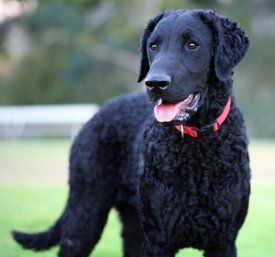
This strong and robust dog is also elegant and graceful, quick and agile. His daily exercise requirement is such that he belongs with an athletic owner who will take him jogging, biking, hiking, and swimming.
Though reserved and sometimes distrustful with strangers, he should remain poised and hold his ground. A Curly Coated Retriever puppy needs more socialization than other retrievers to develop a confident temperament.
Many have sensible protective instincts and may not welcome strangers into their homes as will a Golden or Labrador Retriever.
He relates well to other animals and is playful and accepting.
Described as "wickedly smart," he may use his intelligence in clever, independent ways that suit his own purposes. Thus he needs early obedience training to establish that you are in charge.
All retrievers are slow to mature, and the Curly-Coat remains playfully puppyish for many years. This sounds delightful, but does require patience and control to live with.
If you want a dog who...
- Is the most unusual-looking of the retriever breeds
- Loves the great outdoors and thrives on vigorous athletic activities
- Is steady and dependable
- Is more cautious with strangers than Golden or Labrador Retrievers, but still usually polite
- Is good with other animals
A Curly-Coated Retriever may be right for you.
If you don't want to deal with...
- Vigorous exercise requirements
- Rowdiness and exuberant jumping, especially when young
- Destructiveness when bored or not exercised enough
- Shyness or timidity with strangers when not socialized enough
- Strong-willed mind of his own, requiring a confident owner who can take charge
- Mouthiness – carrying and chewing of objects, mouthing your hands
- Waiting lists (hard to find)
- Health problems
A Curly-Coated Retriever may not be right for you.
 |
Dog Breed Traits – Which Traits Are Right For You? In this brand new series, I'll help you decide which dog breed traits would best suit you and your family, your home and yard, and your lifestyle, so you can choose the best dog breed for your family. |
Keep in mind that the inheritance of temperament is less predictable than the inheritance of physical traits such as size or shedding. Temperament and behavior are also shaped by raising and training.
FREE eBooks by Michele Welton
 "Respect Training for Puppies" and "Teach Your Dog 100 English Words" are free step by step guides to teaching your pup to be calm and well-behaved.
 "11 Things You Must Do Right To Keep Your Dog Healthy and Happy" is a free guide to keeping your dog mentally, physically, and emotionally happy and healthy so you can enjoy a longer lifetime of companionship.

- You can avoid some negative traits by choosing an ADULT dog from an animal shelter or rescue group. With an adult dog, you can easily see what you're getting, and plenty of adult Curlies have already proven themselves not to have negative characteristics.
- If you want a puppy, you can avoid some negative traits by choosing the right breeder and the right puppy.
More traits and characteristics of the Curly-Coated Retriever
If I was considering a Curly-Coated Retriever, I would be most concerned about...
- Providing enough exercise and mental stimulation. Compared to the more familiar Labrador and Golden Retrievers, Curly Coated Retrievers are more active and more athletic. Curlies need more exercise – more opportunities to vent their energy and do interesting things. Otherwise they will become bored, which they usually express by barking and destructive chewing.
- Providing enough socialization. Standoffish by nature, Curly-Coated Retrievers need extensive exposure to people and to unusual sights and sounds. Otherwise their natural caution can become suspiciousness or shyness, which are difficult to live with.
- Stubbornness. Again, compared to Labs and Goldens, Curlycoated Retrievers are more stubborn and can be manipulative. Yet they are smart dogs who are willing to learn if you show them, through absolute consistency, that you mean what you say. To teach your Curly to listen to you, "Respect Training" is mandatory. Read my free online training programs.
- Shedding and trimming. Curly Coated Retrievers do shed, so don't let anyone tell you that they're "light shedding" or hypoallergenic. They're not. Curlies also need occasional trimming to keep their curly locks from becoming too long and shaggy.
- Finding one. Curlies are not a common breed, so you'll need to search hard for a breeder, get on their waiting list, and pay a steep price.
- Potential health problems. All retriever breeds are susceptible to crippling joint and bone problems, and inherited eye diseases that can lead to blindness. In addition, epilepsy and heart disease are serious concerns in the Curly-Coated Retriever.
 About the author: Michele Welton has over 40 years of experience as a Dog Trainer, Dog Breed Consultant, and founder of three Dog Training Centers. An expert researcher and author of 15 books about dogs, she loves helping people choose, train, and care for their dogs.
My best-selling books – now available FREE on my website
 Respect Training For Puppies: 30 seconds to a calm, polite, well-behaved puppy is for puppies 2 to 18 months old. Your puppy will learn the 21 skills that all family dogs need to know. Click here to read for free.
 Teach Your Dog 100 English Words is a unique Vocabulary and Respect Training Program that will teach your adult dog to listen to you and do what you say. Click here to read for free.
 11 Things You Must Do Right To Keep Your Dog Healthy and Happy helps your dog live a longer, healthier life. Get my honest advice about all 11 Things before you bring home your new puppy, because some mistakes with early health care cannot be undone. Click here to read for free.
Related posts you might enjoy