
Cavalier King Charles Spaniels: What's Good About 'Em, What's Bad About 'Em
Cavalier King Charles Spaniel temperament, personality, training, behavior, pros and cons, advice, and information, by Michele Welton, Dog Trainer, Behavioral Consultant, Author of 15 Dog Books
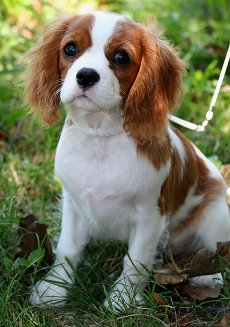
Australian Ch. Kahleyvale Colourmyworld (Tilly)
Often called a "sporting toy breed" because of his combination of spaniel and toy traits, the Cavalier King Charles Spaniel is sweet-tempered, playful, and gentle.
This comfort-loving breed adores cuddling in laps and snuggling on soft pillows, but he also has more athletic instincts than you might think. Indeed, he can be a runner and chaser. A fenced yard or a leash are musts at all times, because many Cavaliers will pursue squirrels, chipmunks, low-flying birds, even butterflies, right into the street.
Cavaliers do need a decent amount of exercise – a couple of long daily walks and definitely a fenced yard in which to run. Otherwise they will become fat and lethargic.
Just as importantly, this breed is VERY dependent on human conpanionship. They need companionship most of the day and become stressed when left alone too long. Separation anxiety is a real problem with Cavaliers. , so should have companionship (either human or other pets) most of the day. A Cavalier who is lonely will whine or bark or chew destructively.
Most Cavaliers are polite with everyone and peaceful with other dogs and cats. As with all sweet-tempered dogs, there is potential for timidity, so Cavalier King Charles Spaniel puppies need plenty of early socialization to build a confident, outgoing temperament.
Though they do have an independent streak, Cavaliers are soft-tempered dogs who are willing to please. They respond well to cheerful training – as long as they respect you.
If you want a dog who...
- Is small, soft, and attractive, with large expressive eyes and a lovely feathered coat in a variety of striking colors
- Adores comfort, cuddling in laps, and snuggling on soft pillows, yet has more athletic and outdoorsy instincts than you might think
- Is peaceful and polite with everyone
- Is willing to please and responds well to praise
A Cavalier King Charles Spaniel may be right for you.
If you don't want to deal with...
- "Separation anxiety" (destructiveness and barking) when left alone too much
- Timidity and shyness in some lines, or when not socialized enough
- Chasing instincts – needs a fenced yard or leash so he doesn't scamper into the road in pursuit of a fluttering bird (or butterfly!)
- Regular brushing and combing
- Lots of shedding
- Serious health problems and a potentially short lifespan
A Cavalier King Charles Spaniel may not be right for you.
 |
Dog Breed Traits – Which Traits Are Right For You? In this brand new series, I'll help you decide which dog breed traits would best suit you and your family, your home and yard, and your lifestyle, so you can choose the best dog breed for your family. |
Keep in mind that the inheritance of temperament is less predictable than the inheritance of physical traits such as size or shedding. Temperament and behavior are also shaped by raising and training.
FREE eBooks by Michele Welton
 "Respect Training for Puppies" and "Teach Your Dog 100 English Words" are free step by step guides to teaching your pup to be calm and well-behaved.
 "11 Things You Must Do Right To Keep Your Dog Healthy and Happy" is a free guide to keeping your dog mentally, physically, and emotionally happy and healthy so you can enjoy a longer lifetime of companionship.

- You can avoid some negative traits by choosing an ADULT dog from an animal shelter or rescue group. With an adult dog, you can easily see what you're getting, and plenty of adult Cavaliers have already proven themselves not to have negative characteristics.
- If you want a puppy, you can avoid some negative traits by choosing the right breeder and the right puppy.
More traits and characteristics of Cavalier King Charles Spaniels
If I was considering a Cavalier, I would be most concerned about...
- Health problems. This is the biggest drawback – by far – of the Cavalier King Charles Spaniel. A ton of inherited health problems. This sweet-natured breed, unfortunately, is in serious trouble.
- The number-one killer of Cavaliers is inherited heart disease (a rapidly progressive form of mitral valve disease). Up to HALF of all Cavaliers will develop heart disease by 5 years of age, and virtually ALL Cavaliers by 10 years of age (if they live that long). No one should acquire a Cavalier King Charles Spaniel unless they can spend lots of money for ongoing heart care by a canine cardiologist.
- An inherited neurological disorder (syringomyelia) affects at least HALF of all Cavaliers. Most individuals show symptoms between 6 months old and 3 years old. This devastating disease causes abnormal skin sensations, sensitivity to touch, pain, and/or weakness and difficulty walking. Some Cavaliers are only mildly affected and do well with daily medication, while others must be put to sleep. There is no cure for this cruel condition and it is present throughout the breed.
- Then there is inherited epilepsy. Hip dysplasia. Eye diseases. Loose knee joints. Itchy allergies and skin conditions. It's just heartbreaking, so be sure you're up for this, both emotionally and financially. More on Cavalier King Charles Spaniel Health.
- Potential separation anxiety. More than most other breeds, Cavalier King Charles Spaniels need a great deal of companionship and do not like being left alone for more than a few hours. They are very dependent dogs – often too dependent. When they feel abandoned, they become anxious, which they express by chewing destructively and barking. If you work all day, this is not the breed for you.
- Heavy shedding.The Cavalier King Charles Spaniel sheds a lot, so you'll find a good amount of hair on your clothing and furnishings. Just be ready for this.
- Grooming. Cavaliers have a silky, feathered coat susceptible to mats and tangles. You need to brush and comb them faithfully, at least weekly. You will also need to trim the coat regularly, especially around the hind end, for sanitary reasons.
- Chasing things that run. Cavaliers should not be trusted off-leash if you're anywhere near a road. They have more spaniel (hunting dog) instincts than you might think and can take off after anything that runs or flutters past.... even a bird or butterfly. Their enthusiastic dash can take them right under the wheels of a car.
 About the author: Michele Welton has over 40 years of experience as a Dog Trainer, Dog Breed Consultant, and founder of three Dog Training Centers. An expert researcher and author of 15 books about dogs, she loves helping people choose, train, and care for their dogs.
My best-selling books – now available FREE on my website
 Respect Training For Puppies: 30 seconds to a calm, polite, well-behaved puppy is for puppies 2 to 18 months old. Your puppy will learn the 21 skills that all family dogs need to know. Click here to read for free.
 Teach Your Dog 100 English Words is a unique Vocabulary and Respect Training Program that will teach your adult dog to listen to you and do what you say. Click here to read for free.
 11 Things You Must Do Right To Keep Your Dog Healthy and Happy helps your dog live a longer, healthier life. Get my honest advice about all 11 Things before you bring home your new puppy, because some mistakes with early health care cannot be undone. Click here to read for free.
Related posts you might enjoy