
Bullmastiffs: What's Good About 'Em, What's Bad About 'Em
Bullmastiff temperament, personality, training, behavior, pros and cons, advice, and information, by Michele Welton, Dog Trainer, Behavioral Consultant, Author of 15 Dog Books
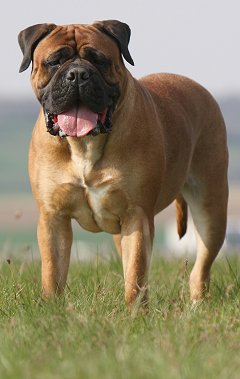
Though usually mild-mannered, the powerful Bullmastiff is also serious and self-assured. He is afraid of nothing, and once aroused will seldom back down.
Bullmastiff puppies (up to two or three years old) can be rambunctious and have an aversion to keeping all four feet on the ground at the same time.
Fortunately, adults are calm and quiet and need only moderate exercise to maintain their impressive muscle tone.
This breed is intensely loyal to his family and doesn't like being left outside. If he doesn't get enough companionship or personal attention, he may walk through fences just to be with people.
Though sensible with strangers, the Bullmastiff does have well-established protective and territorial instincts. He must be thoroughly socialized at an early age so that he learns to distinguish friend from foe.
He can be aggressive with other dogs of the same sex, and though he may be fine with the family cat, strange animals will not be accepted onto his property.
Tremendously strong and stubborn, Bullmastiffs are inclined to do things their own way and will test members of the family. However, he will respond to early, consistent obedience training that includes leadership, cheerful praise, and food rewards.
Overall, he's a splendid, capable companion for assertive owners, but without ongoing time and effort, socialization and supervision, he is too much to handle.
If you want a dog who...
- Is massive and powerful
- Has a short easy-care coat
- Is calm and quiet indoors as an adult
- Makes an imposing watchdog
- Is serious and self-assured with strangers, yet generally mild-mannered unless aroused
- Needs only moderate exercise
A Bullmastiff may be right for you.
If you don't want to deal with...
- A very big dog who takes up a lot of space in your house and car
- A heavy dog who wants to sit on your feet and lean his weight against your leg
- Rowdiness and exuberant jumping when young
- Destructiveness when bored or left alone too much
- Potential aggression toward people in some lines, or when not socialized enoug
- Potential aggression toward other animals
- Strong-willed mind of his own, requiring a confident owner who can take charge
- Snorting, snuffling, wheezing, grunting, loud snoring
- Slobbering and drooling
- Gassiness (flatulence)
- Serious health problems and a short lifespan
- Legal liabilities (public perception, future breed bans, insurance problems, increased chance of lawsuits)
A Bullmastiff may not be right for you.
 |
Dog Breed Traits – Which Traits Are Right For You? In this brand new series, I'll help you decide which dog breed traits would best suit you and your family, your home and yard, and your lifestyle, so you can choose the best dog breed for your family. |
Keep in mind that the inheritance of temperament is less predictable than the inheritance of physical traits such as size or shedding. Temperament and behavior are also shaped by raising and training.
FREE eBooks by Michele Welton
 "Respect Training for Puppies" and "Teach Your Dog 100 English Words" are free step by step guides to teaching your pup to be calm and well-behaved.
 "11 Things You Must Do Right To Keep Your Dog Healthy and Happy" is a free guide to keeping your dog mentally, physically, and emotionally happy and healthy so you can enjoy a longer lifetime of companionship.

More traits and characteristics of the Bullmastiff
If I was considering a Bullmastiff, I would be most concerned about...
- Providing the proper balance of exercise. Young Bullmastiffs need enough exercise to keep them lean and healthy, but not so much that their soft growing bones, joints, and ligaments become over-stressed and damaged. Adult Bullmastiffs need more exercise to keep them in shape, but not in hot or humid weather for fear of overheating. The proper amount of exercise can be difficult to regulate in giant breeds.
Since you need to minimize their exercise, young Bullmastiffs can be very rambunctious. They will romp with uncoordinated gawkiness all over your house. You need to substitute extra quantities of companionship and supervision during this trying time. Otherwise your young Bullmastiff will become bored and destructive and his powerful jaws can literally destroy your living room.
- Providing enough socialization. Most Bullmastiffs have protective instincts toward strangers. They need extensive exposure to friendly people so they learn to recognize the normal behaviors of "good guys." Then they can recognize the difference when someone acts abnormally. Without careful socialization, they may be suspicious of everyone – obviously not a good situation!
- Potential animal aggression. Many Bullmastiffs will not tolerate another dog of the same sex, and some won't tolerate the opposite sex either. Some Bullmastiffs have strong instincts to chase and seize cats and other fleeing creatures. If anything goes wrong in the breeding, socializing, training, or management of this breed, it is capable of seriously injuring or killing other animals.
- The strong temperament. Bullmastiffs have an independent mind of their own and are not pushovers to raise and train. Many Bullmastiffs are willful and dominant (they want to be the boss) and will make you prove that you can make them do things. You must show them, through absolute consistency, that you mean what you say.
To teach your Bullmastiff to listen to you, I recommend "Respect Training." Read my free online training programs.
- Bullmastiff sounds. Because of their short face, Bullmastiffs snort, grunt, and snore loudly. The sounds are endearing to some people; nerve-wracking to others.
- Slobbering. Most people are not prepared for how much Bullmastiffs slobber and drool, especially after eating or drinking.
- Gassiness (flatulence). All short-faced breeds gulp air when they eat, and that air has to go somewhere, after all. However, commercial diets make flatulence worse by including fibrous or hard-to-digest ingredients. Bullmastiffs who are fed a heavily meat-based diet have much less trouble with gassiness.
- Potential health problems. The lifespan of a Bullmastiff is short. An alarming number are crippled by bone and joint diseases and/or succumb to cancer in middle age. Read more about Bullmastiff Health.
- Potential legal liabilities. Bullmastiffs may be targeted for "banning" in certain areas, or refusal of homeowner insurance policies. Your friends and neighbors may be uncomfortable around this breed. In this day and age, the legal liabilities of owning any breed that looks intimidating and has a history as a guard dog should be seriously considered. People are quicker to sue if such a dog does anything even remotely questionable.
Frankly, most Bullmastiffs are "too much dog" for the average household. This is a serious working dog with tremendous strength. Very few people really have the ability to manage this breed.
 About the author: Michele Welton has over 40 years of experience as a Dog Trainer, Dog Breed Consultant, and founder of three Dog Training Centers. An expert researcher and author of 15 books about dogs, she loves helping people choose, train, and care for their dogs.
My best-selling books – now available FREE on my website
 Respect Training For Puppies: 30 seconds to a calm, polite, well-behaved puppy is for puppies 2 to 18 months old. Your puppy will learn the 21 skills that all family dogs need to know. Click here to read for free.
 Teach Your Dog 100 English Words is a unique Vocabulary and Respect Training Program that will teach your adult dog to listen to you and do what you say. Click here to read for free.
 11 Things You Must Do Right To Keep Your Dog Healthy and Happy helps your dog live a longer, healthier life. Get my honest advice about all 11 Things before you bring home your new puppy, because some mistakes with early health care cannot be undone. Click here to read for free.
Related posts you might enjoy