

Brussels Griffons: What's Good About 'Em, What's Bad About 'Em
Brussels Griffon temperament, personality, training, behavior, pros and cons, advice, and information, by Michele Welton, Dog Trainer, Behavioral Consultant, Author of 15 Dog Books

Often described as "full of self-importance," the terrier-like Brussels Griffon is happy, spunky, spirited, and comical.
His adept climbing skills, coupled with his curiosity and imagination, can get him into trouble. Be watchful that he does not end up too high, where he could fall and break his neck.
An alert watchdog, the Brussels Griffon may become friendly with guests or he may be cautious or even shy with new people and new situations. Socialization is a must to promote a confident, stable temperament.
Most Brussels Griffons are fine with other family pets, but if they perceive an invasion of their space by a strange dog, they can display great ferocity, though it is mostly bluff and bluster.
This is not an eager-to-please breed! The Brussels Griffon has a clever mind of his own and without a firm hand can be demanding and manipulative.
Training him to walk calmly on a leash may take time and patience, for he can be obstinate and may pitch a fit of acrobatic leaping and flinging himself about.
If you can chuckle at some of his eccentricities yet remain firm about the general rules of the household, the Brussels Griffon is very pleasant and entertaining to live with.
Like most breeds of terrier heritage, he is proud and sensitive and may become defensive if handled harshly or teased. This is not a breed for very small children.
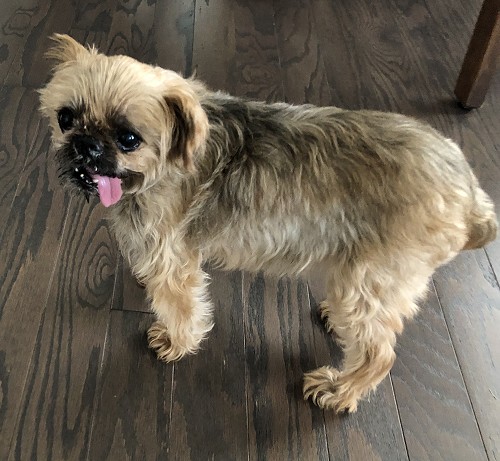
Gabby at 12 years old, beloved companion of Ellie Holzhauer
If you want a dog who...
- Is easy to carry
- Looks like a little terrier
- Comes in a rough wiry coat that doesn't shed much
- Also comes in a short coat if you prefer that (but that one sheds)
- Is one of the spunkiest toy breeds
- Takes himself very seriously (which can be amusing to watch)
- Makes a keen watchdog
- Doesn't need a lot of outdoor exercise
A Brussels Griffon may be right for you.
If you don't want to deal with...
- The fragility of toy breeds (see below)
- The fine line you need to walk with toy breeds, where you need to protect their safety, yet require them to stand on their own four feet and be well-behaved
- Stubbornness (a mind of his own)
- Excitable barking when strangers or strange dogs approach
- Regular trimming of the rough wiry coat
- Notorious housebreaking difficulties
- Waiting lists (hard to find) and a high price tag
A Brussels Griffon may not be right for you.
 |
Dog Breed Traits – Which Traits Are Right For You? In this brand new series, I'll help you decide which dog breed traits would best suit you and your family, your home and yard, and your lifestyle, so you can choose the best dog breed for your family. |
Keep in mind that the inheritance of temperament is less predictable than the inheritance of physical traits such as size or shedding. Temperament and behavior are also shaped by raising and training.
FREE eBooks by Michele Welton
 "Respect Training for Puppies" and "Teach Your Dog 100 English Words" are free step by step guides to teaching your pup to be calm and well-behaved.
 "11 Things You Must Do Right To Keep Your Dog Healthy and Happy" is a free guide to keeping your dog mentally, physically, and emotionally happy and healthy so you can enjoy a longer lifetime of companionship.

- You can avoid some negative traits by choosing an ADULT dog from an animal shelter or rescue group. With an adult dog, you can easily see what you're getting, and plenty of adult Brussels Griffons have already proven themselves not to have negative characteristics.
- If you want a puppy, you can avoid some negative traits by choosing the right breeder and the right puppy.
More traits and characteristics of the Brussels Griffon
If I was considering a Brussels Griffon, I would be most concerned about...
- Fragility. Too many people acquire a toy breed puppy without understanding how incredibly fragile a toy breed is. You can seriously injure or kill a Brussels Griffon puppy by stepping on him or sitting on him. And Brussels Griffons can seriously injure or kill themselves by leaping from your arms or off the back of your sofa. A larger dog can grab a Brussels Griffon and break his neck with one quick shake. Owning a toy breed means constant supervision and surveillance of what's going on around your tiny dog. Brussels Griffons must always be kept indoors, in a safely fenced yard, or on-leash. They are just too easy to injure when not under your complete control.
Brussels Griffons are not suited to young children, no matter how well-meaning the child. Children cannot help being clumsy, and that a child meant well is little solace to a Brussels Griffon who has been accidentally stepped on, sat on, rolled on, squeezed, or dropped onto the patio. Many Brussels Griffons feel overwhelmed by the loud voices and quick movements that children can't help making – and stress and fearfulness (even defensive biting) may be the result.
- Potential suspiciousness. Many Brussels Griffons will put on a display of excited ferociousness (in other words, they pitch a fit) when other people or animals approach them or anything they consider "theirs". It sounds funny, but isn't. Without careful socialization, a Brussels Griffon may be suspicious of everyone.
- Housebreaking. Toy breeds are almost always difficult to housebreak. It is so easy for them to sneak behind a chair or under a small table, and it takes only a few seconds for the deed to be done. The results can be hard to see. When you don't see it, you don't correct it – and so the bad habit becomes established. If you hope to housebreak a toy breed, consistent crate training is mandatory. Toy breeds should not be loosed in the house for many months, until their small internal organs become strong enough for reliable control.
- Stubbornness and barking. Brussels Griffons have a mind of their own and will make you prove that you can make them do things. For example, they are often too quick to sound the alarm, so you must teach them not to bark excessively and to stop barkingwhen you tell them to. This only works if you establish the right relationship between you and your Griffon, where you are the leader and he is the follower. Read my free online training programs.
- Grooming. Brussels Griffons with a smooth coat are easy to care for! But those with a Rough coat require clipping and trimming every few months. Breed purists may say that the coat should never be clipped because it makes the coat softer and more prone to matting. Instead they advocate hand-stripping (each dead hair pulled out so a new one can grow in its place). But in my opinion, stripping is too time-consuming and uncomfortable for the dog. Many groomers won't do it anymore. For pet dogs, I think clipping is just fine.
- Health problems. Brussels Griffons are susceptible to joint disorders. They may also have problems related to their physical deformities (their squashed nose and large eyes). See Brussels Griffon Health.
 About the author: Michele Welton has over 40 years of experience as a Dog Trainer, Dog Breed Consultant, and founder of three Dog Training Centers. An expert researcher and author of 15 books about dogs, she loves helping people choose, train, and care for their dogs.
My best-selling books – now available FREE on my website
 Respect Training For Puppies: 30 seconds to a calm, polite, well-behaved puppy is for puppies 2 to 18 months old. Your puppy will learn the 21 skills that all family dogs need to know. Click here to read for free.
 Teach Your Dog 100 English Words is a unique Vocabulary and Respect Training Program that will teach your adult dog to listen to you and do what you say. Click here to read for free.
 11 Things You Must Do Right To Keep Your Dog Healthy and Happy helps your dog live a longer, healthier life. Get my honest advice about all 11 Things before you bring home your new puppy, because some mistakes with early health care cannot be undone. Click here to read for free.
Related posts you might enjoy
Copyright © 2000-2024 by Michele Welton. All rights reserved. No part of this website may be copied, displayed on another website, or distributed in any way without permission from the author.