
Belgian Shepherds: What's Good About 'Em, What's Bad About 'Em
Belgian Shepherd temperament, personality, training, behavior, pros and cons, advice, and information, by Michele Welton, Dog Trainer, Behavioral Consultant, Author of 15 Dog Books
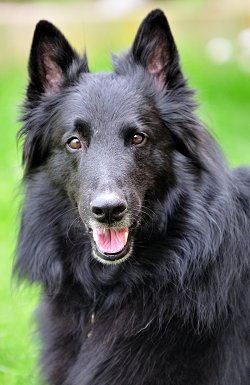
Belgian Groenendael (aka Belgian Sheepdog), the longhaired black variety of Belgian Shepherd
Belgian Shepherd Dogs come in four varieties:
- the Belgian Groenendael, aka Belgian Sheepdog (longhaired black)
- the Belgian Tervuren (longhaired fawn/mahogany)
- the Belgian Malinois (shorthaired fawn/mahogany)
- the Belgian Laekenois (roughhaired fawn)
Most of the world, including the breed's own native country, consider the four varieties to be one breed called Belgian Shepherd Dog.
Unfortunately the American Kennel Club has decided that the four varieties should be considered separate breeds. The AKC doesn't use the correct breed name Belgian Shepherd at all.
Why is this unfortunate? Because when varieties are considered different breeds, they're never bred together. That creates four small gene pools instead of one large one. Larger gene pools are much preferred for genetic diversity, and genetic diversity is very important for long-term health and vigor.
To make matters even more confusing, the AKC re-named the Groenendael as Belgian Sheepdog! Which is just silly, since all four varieties are sheepdogs or shepherd dogs – none more so than another.
Okay, that's enough about the AKC's silliness. On to temperament!
The Belgian Shepherd is an extremely intelligent but challenging breed to live with. Athletic. Agile. Graceful. Elegant. The breed is frequently in motion, often moving in quick, light-footed circles.
Sounds lovely, doesn't it? Ah but.... high energy means a lot of exercise is needed to stay in good condition.
Even more important than physical exercise is mental exercise (advanced obedience, agility, herding, schutzhund, or tracking sports). Belgian Shepherds become bored, frustrated, and prone to obsessive behaviors without something to do. This is a demanding breed that needs ongoing supervision and structured activities.
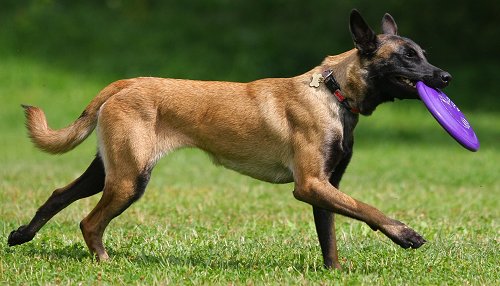
Belgian Malinois, shorthaired variety of Belgian Shepherd
Sometimes playing the mischievous clown, yet more often serious, the Belgian Shepherd is highly observant with strangers, typically reserved and aloof, and has strong protective instincts. As such, Belgian Shepherds need more extensive socialization than most breeds so that their watchfulness doesn't become suspiciousness or sharpness. Shyness and spookiness are also present in a good number of Belgian Shepherd lines.
Most Belgian Shepherds are okay with other pets if raised together. But dog-to-dog aggression is not uncommon and many individuals have a high prey drive and will pursue anything that moves. Small animals should be introduced with great care and supervision.
Though extremely attentive and responsive to the direction of a confident owner, Belgian Shepherds can nonetheless prove difficult for an inexperienced owner to train. The breed is often sensitive to correction, so he requires a light hand on the leash.... BUT he also knows his own mind and can have dominant tendencies, so you must project firmness and leadership.
The four varieties of Belgian Shepherd do have some differences in temperament (though these generalities don't apply to every individual).
- The Malinois, for example, is a top-notch competitor in protection dog sports like schutzhund and ring sport, and is frequently used by law enforcement as a police dog. Malinois have the highest energy level (to the point of hyperactivity). Typically they have an intense and "driven" personality, and a pronounced prey/chase drive. Malinois from working lines were never intended to be family pets and should not be kept as such.
- The Laekenois has also proven himself in protection dog sports and needs a confident owner who can control a dominant dog.
- Some Tervuren are successful in protection dog sports. But this variety more often competes in advanced obedience and agility (obstacle course). Tervurens vary from high energy to more mellow, from happy-go-lucky to nervous and skittish.
- Groenendaels (the black variety) often have a slightly "softer" temperament and a less pronounced working drive. Yet plenty of individuals are still top-notch competition dogs.
If you want a dog who...
- Is large and strong – but also elegant and graceful
- Is exceedingly smart and versatile – when well-trained, can learn and do almost anything
- Excels in performance activities
- Is observant and watchful, with strong protective instincts
- Comes in several coats and colors
A Belgian Shepherd may be right for you.
If you don't want to deal with...
- High activity level
- Vigorous exercise requirements
- Participating regularly with your dog in challenging canine sports
- Destructiveness when bored or not exercised enough
- Aggression or fearfulness toward strangers in some lines, or when not socialized enough
- Aggression toward other animals
- Strong-willed mind of his own, requiring a confident owner who can take charge
- Chasing and nipping at things that move: children, joggers, other animals, bikes
- Heavy shedding (Malinois, Groenendael, Tervuren)
A Belgian Shepherd may not be right for you.
 |
Dog Breed Traits – Which Traits Are Right For You? In this brand new series, I'll help you decide which dog breed traits would best suit you and your family, your home and yard, and your lifestyle, so you can choose the best dog breed for your family. |
Keep in mind that the inheritance of temperament is less predictable than the inheritance of physical traits such as size or shedding. Temperament and behavior are also shaped by raising and training.
FREE eBooks by Michele Welton
 "Respect Training for Puppies" and "Teach Your Dog 100 English Words" are free step by step guides to teaching your pup to be calm and well-behaved.
 "11 Things You Must Do Right To Keep Your Dog Healthy and Happy" is a free guide to keeping your dog mentally, physically, and emotionally happy and healthy so you can enjoy a longer lifetime of companionship.

- You can avoid some negative traits by choosing an ADULT dog from an animal shelter or rescue group. With an adult dog, you can easily see what you're getting, and plenty of adult Belgians have already proven themselves not to have negative characteristics.
- If you want a puppy, you can avoid some negative traits by choosing the right breeder and the right puppy.
More traits and characteristics of the Belgian Shepherd
If I was considering a Belgian Shepherd, I would be most concerned about...
- Providing enough exercise and mental stimulation. Belgian Shepherds MUST have regular opportunities to vent their energy and to use their busy minds to do interesting things. Bored Belgians can destroy your house and yard.
Belgian Shepherds were never intended to be simply household pets. Their working behaviors (chasing, nipping, poking) are inappropriate in a normal household setting. Trying to suppress these "hardwired" behaviors, without providing alternate outlets for their high energy level, can be difficult.
- Providing enough socialization. Most Belgian Shepherds have protective instincts toward strangers. They need extensive exposure to friendly people so they learn to recognize the normal behaviors of "good guys." Then they can recognize the difference when someone acts abnormally. Without careful socialization, they may be suspicious of everyone, which is a short step to aggression. Some Belgians go in the opposite direction – without enough socialization, they become fearful and skittish of strangers, which can lead to defensive aggression.
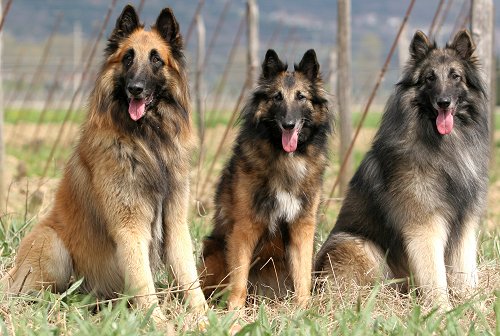
Belgian Tervuren, the longhaired brownish variety of Belgian Shepherd
- Potential animal aggression. Many Belgian Shepherds are dominant or aggressive toward other dogs of the same sex. Some have strong instincts to chase and seize cats and other fleeing creatures.
- Grooming and shedding. Belgian Malinois, Groenendaels, and Tervurens are heavy shedders. You'll find hair all over your clothing and furnishings. In addition, you need to brush and comb Groenendaels and Tervurens to prevent mats. The Laekenois is different. Laekenois have rough wiry-type coats that shed less than the other three – I would call him an average shedder. His coat needs regular trimming and clipping.
- Mind of their own. Belgian Shepherds are versatile working dogs, capable of learning a great deal. Many individuals excel at the highest levels of competition. However, while some are quick to learn and eager to please, others can be manipulative, willful, and dominant (they want to be the boss) and will make you prove that you can make them do things. Read my free online training programs.
Frankly, most Belgian Shepherds (unless you adopt an obviously laid-back adult) are "too much dog" for the average household.
 About the author: Michele Welton has over 40 years of experience as a Dog Trainer, Dog Breed Consultant, and founder of three Dog Training Centers. An expert researcher and author of 15 books about dogs, she loves helping people choose, train, and care for their dogs.
My best-selling books – now available FREE on my website
 Respect Training For Puppies: 30 seconds to a calm, polite, well-behaved puppy is for puppies 2 to 18 months old. Your puppy will learn the 21 skills that all family dogs need to know. Click here to read for free.
 Teach Your Dog 100 English Words is a unique Vocabulary and Respect Training Program that will teach your adult dog to listen to you and do what you say. Click here to read for free.
 11 Things You Must Do Right To Keep Your Dog Healthy and Happy helps your dog live a longer, healthier life. Get my honest advice about all 11 Things before you bring home your new puppy, because some mistakes with early health care cannot be undone. Click here to read for free.
Related posts you might enjoy