
Australian Cattle Dogs: What's Good About 'Em, What's Bad About 'Em
Australian Cattle Dog temperament, personality, training, behavior, pros and cons, advice, and information, by Michele Welton, Dog Trainer, Behavioral Consultant, Author of 15 Dog Books
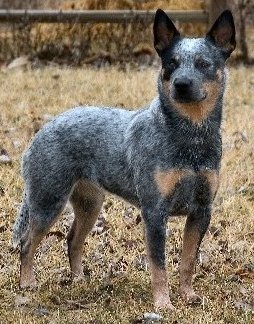
Silver Dust Real Butter, Silver Dust AuCaDos
The Australian Cattle Dog is also known as the Queensland Heeler – Queensland being a state in his native Australia, and Heeler referring his herding style of nipping at the heels of cattle in order to move them along. His color pattern can be blue-gray or red-gray, so you might also hear him called Blue Heeler or Red Heeler.
Bold and athletic, the robust Australian Cattle Dog enjoys romping and roughhousing.
He is absolutely NOT an apartment dog. To stay in hard muscular condition and a satisfied frame of mind, Queensland Heelers require lots of exercise. Working livestock, agility, jogging, biking, chasing balls, and playing Frisbee are productive outlets for this breed's high energy. Cooping him up with nothing to do will lead to destructive behaviors and obsessive barking.
With strangers, the Cattle Dog is watchful and often suspicious. Early socialization is important so that he does not become too sharp.
He can be dominant and pushy with other dogs, and with his strong chasing drives and tendency to nip at whatever he is pursuing, he is not recommended around cats unless raised with them.
A challenging combination of cleverness and hard-headedness, Australian Cattle Dogs will test members of the family during adolescence and must be handled with firm, consistent leadership. These versatile dogs can learn and do a great deal in the right hands, but they will run right over hapless owners.
If you want a dog who...
- Is medium-sized
- Has a very sturdy, natural build
- Thrives on vigorous exercise and rugged athletic activities
- Makes a vigilant watchdog
- Has a short, easy-care coat that comes in striking colors
An Australian Cattle Dog may be right for you.
If you don't want to deal with...
- Vigorous exercise requirements
- Destructiveness when bored or not exercised enough
- Suspiciousness toward strangers
- Aggression toward other animals
- Strong-willed mind of his own, requiring a confident owner who can take charge
- Chasing and nipping at things that move: children, joggers, other animals, bikes, cars
- Potential for excessive barking, often in a high-pitched voice
- Heavy shedding
An Australian Cattle Dog may not be right for you.
 |
Dog Breed Traits – Which Traits Are Right For You? In this brand new series, I'll help you decide which dog breed traits would best suit you and your family, your home and yard, and your lifestyle, so you can choose the best dog breed for your family. |
Keep in mind that the inheritance of temperament is less predictable than the inheritance of physical traits such as size or shedding. Temperament and behavior are also shaped by raising and training.
FREE eBooks by Michele Welton
 "Respect Training for Puppies" and "Teach Your Dog 100 English Words" are free step by step guides to teaching your pup to be calm and well-behaved.
 "11 Things You Must Do Right To Keep Your Dog Healthy and Happy" is a free guide to keeping your dog mentally, physically, and emotionally happy and healthy so you can enjoy a longer lifetime of companionship.

- You can avoid some negative traits by choosing an ADULT dog from an animal shelter or rescue group. With an adult dog, you can easily see what you're getting, and plenty of adult Cattle Dogs have already proven themselves not to have negative characteristics.
- If you want a puppy, you can avoid some negative traits by choosing the right breeder and the right puppy.
More traits and characteristics of the Australian Cattle Dog
If I was considering a Queensland Heeler, I would be most concerned about...
- Providing enough exercise and mental stimulation. Australian Cattle Dogs were never intended to be simply household pets. Their working behaviors (chasing, nipping, barking, territorial instincts toward other animals) are inappropriate in a normal household setting. Trying to suppress these "hardwired" behaviors, without providing alternate outlets for their high energy level, is unfair to the dog.
I do not recommend this breed if you don't have the time or inclination to take your dog hiking or swimming, or to get involved in herding, or agility (obstacle course), or advanced obedience, or tracking, or a similar canine activity. Bored Cattle Dogs are famous for chewing through drywall, ripping the stuffing out of sofas, and turning your yard into a moonscape of giant craters.
- Barking. Australian Cattle Dogs are often too quick to sound the alarm at every new sight and sound. This breed should should not be left outside in your yard, unsupervised. To make matters worse, some Cattle Dogs have intense, high-pitched barks that can set your teeth on edge.
- Suspiciousness toward strangers. Australian Cattle Dogs are typically reserved with strangers, but their reserve can veer into suspiciousness if you don't socialize them properly. Young Cattle Dogs need to be cheerfully introduced to friendly people so that they learn to recognize the normal behaviors of "good guys." Then they can recognize the difference when someone really does act abnormally. Without careful socialization, they may be suspicious of everyone, which is very difficult to live with.
- Potential animal aggression. Many Australian Cattle Dogs are dominant or aggressive toward other dogs of the same sex. Many have strong instincts to chase and seize cats and other fleeing creatures.
- The strong temperament. The best Australian Cattle Dogs are versatile working dogs, capable of learning a great deal. But they have an independent mind of their own and are not pushovers to raise and train. They can be manipulative, and many are obstinate and dominant (they want to be the boss) and will make you prove that you can make them do things.
To teach your Cattle Dog to listen to you, "Respect Training" is mandatory. Read my free online training programs.
- Shedding. For such a shorthaired dog, Australian Cattle Dogs shed much more than you might think. Their short coarse hairs stick tenaciously to clothing and furnishings.
 About the author: Michele Welton has over 40 years of experience as a Dog Trainer, Dog Breed Consultant, and founder of three Dog Training Centers. An expert researcher and author of 15 books about dogs, she loves helping people choose, train, and care for their dogs.
My best-selling books – now available FREE on my website
 Respect Training For Puppies: 30 seconds to a calm, polite, well-behaved puppy is for puppies 2 to 18 months old. Your puppy will learn the 21 skills that all family dogs need to know. Click here to read for free.
 Teach Your Dog 100 English Words is a unique Vocabulary and Respect Training Program that will teach your adult dog to listen to you and do what you say. Click here to read for free.
 11 Things You Must Do Right To Keep Your Dog Healthy and Happy helps your dog live a longer, healthier life. Get my honest advice about all 11 Things before you bring home your new puppy, because some mistakes with early health care cannot be undone. Click here to read for free.
Related posts you might enjoy